How Forex Rebates Work (and Why They Don't Change Your Spread)
A plain-language guide to how forex cashback rebates work: the IB commission flow, what counts, and why your spread never changes.
By CB-Dogs Editorial7 min read
Disclosure: CB-Dogs earns a commission (IB rebate) from brokers for accounts opened or linked through us and pays part of it back to you as cashback. This does not change your trading costs.
On this page
- The short answer
- What's an Introducing Broker (IB)?
- The money flow, step by step
- Why this doesn't — and can't — widen your spread
- What counts toward your rebate (and what doesn't)
- A worked example
- Rebates vs. deposit bonuses — what's the difference?
- Why rebate rates aren't the same everywhere
- Does using a rebate service change anything else about my account?
- How and when rebates get paid out
- Frequently asked questions
- See exactly how much you'd earn
Every trader who hears about forex cashback for the first time asks the same question: how does anyone afford to pay me back part of my trading cost, and what's the catch?
The short answer is that there isn't a catch — it's a well-established part of how retail brokers pay for new customers. This guide walks through exactly how the money moves, what does and doesn't count toward a rebate, and why joining a cashback program cannot make your spread or execution worse.
The short answer
A forex rebate (also called cashback) is a small portion of the trading cost you already pay your broker, returned to you after the fact. It comes out of the broker's own marketing budget — specifically, the commission the broker pays to an Introducing Broker (IB) for referring you. It is not a discount applied at the moment you place a trade, and it has no connection to the price engine that sets your spread. Your trades execute exactly the same way whether you're enrolled in a rebate program or not.
What's an Introducing Broker (IB)?
Retail forex and CFD brokers rarely acquire every client directly. Instead, they run affiliate-style partner programs and pay a commission to "Introducing Brokers" — websites, educators, and services that refer traders to open live accounts. This is the same basic model used by countless industries: the broker would otherwise spend that money on advertising, so instead it pays a partner for a referral that actually converts into an active trader.
CB-Dogs operates as an Introducing Broker for the brokers listed on this site. When you open an account through our link, the broker pays us a commission based on your trading volume. We disclose this openly because it's the honest explanation for how a "free" cashback service can exist at all — see our how it works page for the full breakdown of how we're compensated.
The money flow, step by step
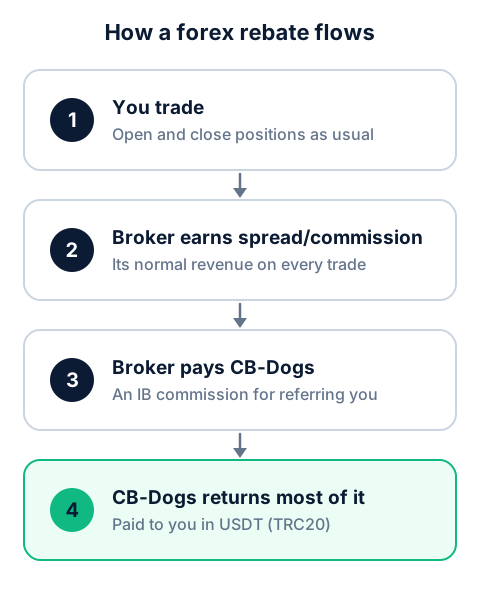
1. You trade, and the broker earns the spread (or a commission)
Every time you open and close a position, the broker earns revenue — either through the spread between the bid and ask price, a fixed commission per lot, or a mix of both, depending on the account type. This is the broker's normal, standard revenue on every client, rebate or not.
2. The broker pays part of that to its IB partner
Because you opened your account through CB-Dogs' referral link, the broker pays us a per-lot or percentage-based commission for your trading activity. This is a cost the broker already budgets for every referred client — it's simply a matter of who receives the referral.
3. The IB (that's us) pays most of it back to you
Instead of keeping the entire commission, CB-Dogs passes the majority of it back to you as cashback, paid out in USDT. We keep a smaller share to cover running the service. Exactly how much you earn per lot depends on the broker and account type you've chosen. The table below always shows the current rates, so you don't have to rely on a number frozen in an old article:
| Account type | Rebate / lot (USDT) |
|---|---|
| StandardSpread-based account, no commission. | 9.0 |
| MicroRebate is calculated per 100,000 units of micro-lot volume (i.e. the same per-lot rate as Standard, scaled to micro-lot size). | 9.0 |
| Ultra LowLower spreads, spread-based account, no commission. | 3.0 |
| KiwamiXM's tightened-spread account tier available in select regions. | 6.0 |
| ZeroCommission-based account. Rebate is paid in addition to the raw spread — commission you pay is unaffected. | 4.5 |
Provisional rate
Why this doesn't — and can't — widen your spread
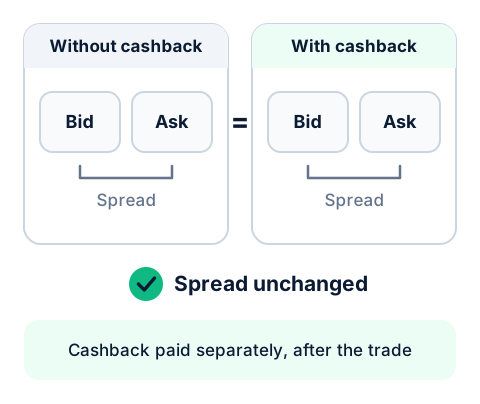
This is the part that makes people suspicious, so it's worth spelling out clearly: the rebate is not calculated by the broker's pricing engine, and it isn't funded by making your spread wider. It is paid out of the IB commission the broker already sets aside for client acquisition — a completely separate accounting line from the price feed you trade on.
Brokers have strong commercial reasons to keep this separation intact. If a broker quietly widened spreads for clients referred through cashback programs, it would need to do so selectively and invisibly, which creates regulatory and reputational risk far larger than the rebate itself. In practice, cashback and rebate programs run through the broker's standard IB infrastructure — the same system used for ordinary affiliate marketing — and the pricing you receive is the same pricing any other client on that account type receives.
What counts toward your rebate (and what doesn't)
Rebates are almost always calculated on closed trading volume — the number of lots you've completed — rather than on profit or loss. That means:
- Whether you win or lose the trade doesn't matter. A losing trade earns the same rebate as a winning trade of the same size, because the rebate is a function of volume, not outcome.
- Only closed, completed trades typically count. Open positions don't generate a rebate until they're closed.
- Brokers commonly apply exclusions, most often a minimum holding time (to discourage abusive patterns like near-instant open-and-close trades) and sometimes rules around hedged or reversed positions. These exclusions vary by broker, so always check the specific broker's current terms rather than assuming one broker's rules apply to another.
- Bonus-funded trades may be treated differently by some brokers. If you're using a deposit bonus alongside a rebate program, check your broker's current terms, since combining the two isn't always permitted.
A worked example
Let's say your account earns $6 per standard lot in cashback, and you trade 20 standard lots in a month. That would work out to $120 for the month, paid in USDT. This is a purely illustrative, round-number example — it is not a quoted rate. For your actual rebate per lot and an estimate based on your own trading volume, try the calculator:
1 standard lot = 100,000 units of the base currency.
Used only to show how the fee-free threshold applies below.
Rate used
9.0 USDT per lot
Estimated monthly cashback
90.0 USDT
Estimated yearly cashback
1080.0 USDT
If you withdrew 100 USDT today
No fee — you're at or above the 50 USDT fee-free threshold.
You would receive 100.0 USDT
Figures are estimates based on provisional rates and the trading volume you enter. They are not a guarantee of future cashback and do not account for excluded trades.
Rebates vs. deposit bonuses — what's the difference?
They're often confused, but they work in opposite ways:
- A deposit bonus is extra credit added to your account balance up front, usually with trading-volume requirements before you can withdraw it, and it's typically non-withdrawable as cash until those conditions are met.
- A rebate is real cash (paid in USDT through CB-Dogs) that accrues from your actual trading activity and becomes withdrawable once the broker has paid the underlying commission and a short confirmation period has passed — it isn't tied up as trading credit.
Some brokers don't allow you to combine a deposit bonus and an IB rebate on the same trades. If you're already using a bonus offer, check your broker's current terms before assuming both will apply.
Why rebate rates aren't the same everywhere
If you've compared a few cashback sites, you may have noticed the advertised rate for the "same" broker and account type isn't always identical. A few honest reasons explain this, beyond simple exaggeration:
- Different IBs negotiate different commission terms with the broker, often based on referred trading volume, and can choose to keep a different share for themselves versus passing on to traders.
- Account type genuinely changes the rate. A standard account, a raw-spread account, and a commission-based account each have a different cost structure, so the IB commission — and therefore the rebate — differs by design, not by accident.
- Advertised "up to" figures on some sites reflect a best case (often the highest-volume tier or a specific account type) rather than a typical rate. Be cautious of any number presented without the account type and conditions attached, and treat outsized-looking figures with skepticism rather than assuming they apply to you.
This is exactly why CB-Dogs shows rates through a structured table by account type rather than a single headline number in marketing copy — you can see which account type a rate actually applies to, and the table gets updated whenever rates change, rather than leaving an outdated number sitting in old blog content.
Does using a rebate service change anything else about my account?
No. Beyond the rebate itself, your trading account works exactly as it would without one. You still deal directly with the broker for deposits, withdrawals of your trading balance, platform access, and support. CB-Dogs doesn't have access to your funds, doesn't place trades on your behalf, and doesn't provide trading signals, managed accounts, or copy-trading — it tracks your eligible trading volume through the broker's IB reporting and pays out the resulting cashback separately, in USDT. If you're already comfortable with your broker and platform, adding a rebate program doesn't introduce a new relationship you need to manage day to day.
How and when rebates get paid out
Once your rebate balance accrues, CB-Dogs pays it out in USDT over the TRC20 network only. A few practical points:
- The minimum withdrawal is a small fixed amount (currently 10 USDT), and there's a flat network fee on withdrawals below 50 USDT — withdrawals of 50 USDT or more are fee-free.
- Your cashback becomes withdrawable only after the broker has actually paid CB-Dogs the underlying commission and a short confirmation period has passed — we can't release funds we haven't received yet.
- For XM specifically, this typically takes somewhere around three to four weeks from the original trade to a withdrawable balance, though this is a general guide rather than a guaranteed timeline.
For the full walkthrough of why USDT/TRC20 is used and how a payout actually works, see our dedicated guide on forex rebates paid in USDT.
Frequently asked questions
No. The rebate is paid out of the broker's separate IB commission budget after your trade closes. Your spread, commission structure, execution quality and leverage are identical to what any other client on the same account type receives.
See exactly how much you'd earn
The clearest way to understand your own numbers is to plug in your trading volume. Try the cashback calculator, compare account types on the XM broker page, or go ahead and register to start earning cashback on your next trade.
Risk warning: forex and CFD trading carries a high risk of losing money. Cashback does not offset trading losses. Nothing here is investment advice.