Forex Rebate vs. Deposit Bonus: Which Is Actually Better?
A neutral, side-by-side comparison of forex rebates and deposit bonuses — guarantees, withdrawal rules, hidden risks, and which fits your trading style.
By CB-Dogs Editorial6 min read
Disclosure: CB-Dogs earns a commission (IB rebate) from brokers for accounts opened or linked through us and pays part of it back to you as cashback. This does not change your trading costs.
On this page
- The short answer
- What is a forex rebate (cashback)?
- What is a forex deposit bonus?
- Side-by-side comparison
- The hidden risk of bonuses: overtrading to "unlock" credit
- Can you combine a rebate and a bonus?
- Which is better for your trading style?
- A closer look at "guaranteed" vs. "conditional"
- A worked example (rebate math)
- A quick self-check before you decide
- Frequently asked questions
- See what a rebate would actually pay you
CB-Dogs is a rebate provider, so it would be easy for this article to simply argue that rebates are better. They aren't always. Depending on how you trade, a deposit bonus can genuinely be worth more to you in the short term — and pretending otherwise wouldn't help you make a good decision. This is a straight, side-by-side comparison, including the cases where a bonus wins.
The short answer
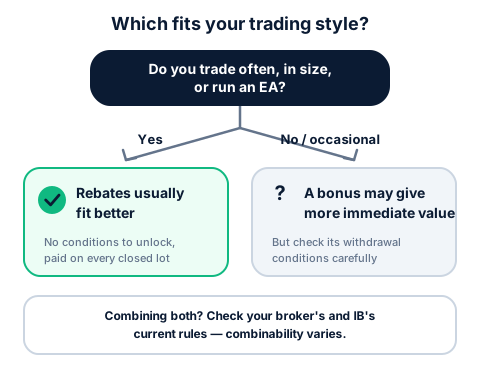
It depends on how you trade. Rebates are guaranteed cash paid on every closed lot, win or lose, with no strings attached — which tends to favor frequent, high-volume traders. Bonuses are a lump of credit added up front, usually locked behind volume or time conditions — which can give more immediate value to an occasional trader who doesn't plan to trade enough to make a per-lot rebate add up quickly.
What is a forex rebate (cashback)?
A rebate is a portion of the trading cost you already pay your broker, returned to you after the fact, funded by the commission the broker pays its Introducing Broker (IB) for referring you.
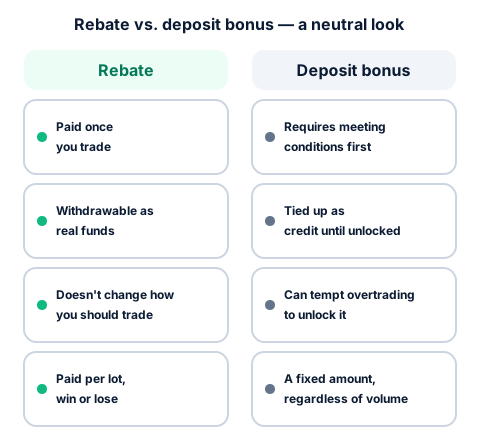
- Paid per lot traded, regardless of win or loss. The rebate is a function of volume, not of your account's profit or loss.
- Usually withdrawable as real funds — with CB-Dogs, as USDT — once it clears, rather than sitting as trading credit you can't move.
For the full mechanics of how the money actually flows from broker to IB to you, see how forex rebates work.
What is a forex deposit bonus?
A deposit bonus is credit a broker adds to your trading account, usually as an incentive to deposit or to reward existing activity.
- Credit added to your account, not your bank balance. It typically shows up as extra buying power inside the platform, not as cash you can withdraw immediately.
- Typically tied to withdrawal conditions. Most bonus terms require you to trade a certain volume (a "lot" or turnover requirement) before the bonus itself, or profits made using it, become withdrawable.
Common bonus types
Not all bonuses work identically, which is part of why comparing them to a rebate isn't a single, clean comparison:
- Welcome / deposit-match bonuses add credit proportional to your first deposit, usually with a turnover requirement scaled to the bonus size.
- No-deposit bonuses give a small amount of tradeable credit without requiring a deposit at all, typically with tighter withdrawal caps and stricter conditions.
- Loyalty or reload bonuses are offered to existing clients periodically, often with similar turnover conditions to a welcome bonus but smaller amounts.
The comparison below applies to bonuses generally; always check which specific type you're being offered, since the conditions can differ meaningfully between them.
Side-by-side comparison
| Rebate | Deposit bonus | |
|---|---|---|
| When you get it | After you trade, per closed lot | Up front, on deposit or as a promotion |
| Guarantee | Paid regardless of win or loss | Often has conditions before it counts |
| Withdrawable | Yes, as real funds once cleared | Usually only after volume/turnover conditions are met |
| Effect on trading behavior | None — doesn't require any specific trade pattern | Can create pressure to trade more than you otherwise would |
| Typical fit | Frequent traders, higher volume, EA/algo strategies | Occasional traders wanting immediate account size |
The hidden risk of bonuses: overtrading to "unlock" credit
The part of this comparison that gets the least attention is behavioral, not financial. When a bonus requires a specific trading-volume target before it (or its profits) can be withdrawn, it creates an incentive to place trades in order to hit that target — rather than because those trades reflect your actual strategy. That pressure is real and worth naming plainly: a bonus's value on paper and its value after you've traded to unlock it aren't always the same thing.
This isn't a reason to avoid bonuses outright — plenty of traders meet volume requirements naturally through their normal trading and get the full benefit. It's a reason to check the actual volume requirement against your typical trading pattern before accepting a bonus, not after.
Can you combine a rebate and a bonus?
Which is better for your trading style?
High-frequency traders and scalpers
Rebates usually win here. A rebate paid per closed lot compounds naturally with high trade frequency, with no conditions to satisfy first.
EA and algo traders
The same logic applies, often more strongly, since automated strategies can generate consistent volume month after month. See forex rebates for EA and algo traders for what typically qualifies.
Low-volume or occasional traders
A bonus may give more immediate value here, since a rebate on a small number of trades takes longer to add up to a meaningful amount than a lump of bonus credit does. Just weigh that against the bonus's own withdrawal conditions before treating it as "free."
New traders still building capital
Read the withdrawal restrictions carefully before counting a bonus as usable capital — until its conditions are met, it functions more like a target than a balance.
A closer look at "guaranteed" vs. "conditional"
The single word that separates these two products is guarantee. A rebate's per-lot rate doesn't change based on whether you meet some later condition — if you traded the volume, the rebate is calculated on it, independent of outcome or of anything else you do afterward. A bonus's advertised value, by contrast, is really a ceiling: the maximum you could eventually access if you meet its stated conditions within whatever time window applies, and potentially less, or nothing, if you don't.
Neither structure is dishonest — both are disclosed in each provider's or broker's terms. But they answer a different question. A rebate answers "how much will I get back for what I've already done." A bonus answers "how much could I get, if I do what's required." Knowing which question you actually care about is often the fastest way to decide between them.
A worked example (rebate math)
Say a hypothetical account earns $6 per standard lot in rebates (a round, illustrative number, not a quoted rate), and you trade 20 standard lots in a month. That's $120 for the month, paid in USDT, regardless of whether those trades were individually profitable. To see this with your own trading volume instead of an illustrative example:
1 standard lot = 100,000 units of the base currency.
Used only to show how the fee-free threshold applies below.
Rate used
9.0 USDT per lot
Estimated monthly cashback
90.0 USDT
Estimated yearly cashback
1080.0 USDT
If you withdrew 100 USDT today
No fee — you're at or above the 50 USDT fee-free threshold.
You would receive 100.0 USDT
Figures are estimates based on provisional rates and the trading volume you enter. They are not a guarantee of future cashback and do not account for excluded trades.
A quick self-check before you decide
If you're still unsure which fits your situation, three questions tend to settle it quickly:
- Do I already trade regularly, or would I be trading mainly to unlock something? If it's the latter, lean toward a rebate — it doesn't create that pressure in the first place.
- Do I need funds sooner rather than later? A bonus can feel more immediate; a rebate builds up over your actual trading activity.
- Am I comfortable reading and tracking a turnover requirement? If not, a rebate's lack of conditions is simpler to reason about day to day.
None of these questions has a universally "correct" answer — they're meant to surface which factor matters most to you, since that's usually enough to break the tie.
Frequently asked questions
In this industry, "rebate" and "cashback" are generally used interchangeably to mean a partial refund of trading costs based on volume. A "deposit bonus," by contrast, is credit added up front rather than paid based on your trading activity afterward — the two work in opposite directions.
See what a rebate would actually pay you
Plug in your own trading volume with the cashback calculator, or register with CB-Dogs to start earning rebates on your next trade. If you'd like a checklist for vetting any cashback provider before you sign up with one, see how to verify a forex cashback provider is legitimate.
Risk warning: forex and CFD trading carries a high risk of losing money. Cashback does not offset trading losses. Nothing here is investment advice.