How to Keep Records of Forex Rebates for Tax Purposes
A country-neutral guide to recording your forex rebate payouts — what to track, a copyable template, and when to consult a tax professional.
By CB-Dogs Editorial5 min read
Disclosure: CB-Dogs earns a commission (IB rebate) from brokers for accounts opened or linked through us and pays part of it back to you as cashback. This does not change your trading costs.
On this page
- The short answer
- Why rebate record-keeping matters, regardless of your country
- What to record for every rebate payout
- A simple record-keeping template you can copy
- How long should you keep these records?
- How this differs from your trading P/L records
- When and how to talk to a tax professional in your country
- What if you also earn referral income?
- A note for readers living outside their home country
- Frequently asked questions
- Track your rebates automatically
The short answer
Whatever your country's tax rules turn out to require, they'll be far easier to comply with if you've already kept clean, dated records of every rebate payout as it happened — rather than trying to reconstruct months of history from memory when a filing deadline arrives. This guide is about that record-keeping habit, not about what's taxable.
Why rebate record-keeping matters, regardless of your country
Tax authorities generally expect a taxpayer to be able to show, on request, when income was received and what it was worth at the time — not to guess retroactively. Forex rebates paid in USDT add one extra wrinkle most trading-income records don't have: the payout arrives in a stablecoin, which most tax systems will eventually want valued in your local currency at the time you received it. Capturing that value once, at the moment of receipt, is far easier than trying to reconstruct a historical exchange rate later.
What to record for every rebate payout
Date received
The calendar date the payout arrived in your wallet — not the date you requested the withdrawal, and not the date the underlying trades happened.
Broker and trading account reference
Which broker and which account number the rebate relates to, especially useful if you trade multiple accounts or brokers over time.
Lots traded / rebate calculation basis
The volume the rebate was calculated on, so you (or a tax professional) can later reconcile the rebate amount against your own trading records if needed.
Amount in USDT and the USDT-to-local-currency rate at the time
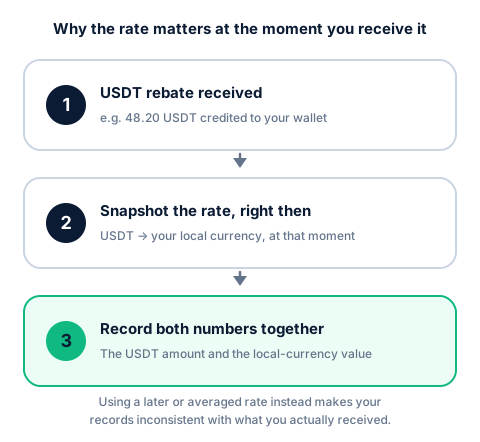
Record both the raw USDT amount and what that converted to in your local currency at the time of receipt, using a rate from a source you can point back to later (a reputable exchange or rate-tracking site, noted alongside the entry). Waiting and using a later or averaged rate instead makes the record inconsistent with what you actually received on that date.
Transaction ID (TRC20) for your own audit trail
The blockchain transaction ID lets you (or anyone reviewing your records later) independently verify the payout on a public block explorer — a level of verifiability bank transfers don't usually offer as conveniently.
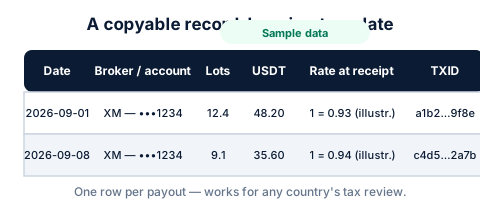
A simple record-keeping template you can copy
| Date | Broker / account | Lots | USDT amount | Rate at receipt | TXID |
|---|---|---|---|---|---|
| 2026-09-01 | XM — •••1234 | 12.4 | 48.20 | 1 USDT ≈ 0.93 (illustrative) | a1b2…9f8e |
| 2026-09-08 | XM — •••1234 | 9.1 | 35.60 | 1 USDT ≈ 0.94 (illustrative) | c4d5…2a7b |
A plain spreadsheet with these six columns, updated each time a payout lands, is enough for most purposes. Add a row per payout rather than a monthly total, since the per-payout rate and transaction ID can't be reconstructed later from a single aggregated number.
A practical way to actually keep this up to date: rather than trying to remember to update a spreadsheet, add the entry the same day a payout arrives, while the transaction ID and a rate source are still one click away in your wallet or exchange app. A record started weeks later, from memory, is far more likely to have an approximate rate instead of the actual one — which defeats the purpose of tracking it at all.
How long should you keep these records?
Most tax authorities that require record-keeping at all specify a minimum retention period, and those periods vary by country — some require several years, others longer. Because CB-Dogs cannot state a figure that's accurate everywhere, a practical, conservative habit is to keep every rebate record indefinitely in a simple spreadsheet or export, since digital storage costs are negligible and the alternative — needing a record you no longer have — is the more expensive outcome. A qualified tax professional in your country can confirm the specific minimum that applies to you.
How this differs from your trading P/L records
Your trading platform's profit-and-loss statement tracks the outcome of your trades. Your rebate record tracks a separate stream of cashback income, calculated on trading volume rather than trading result, and paid by a different party (CB-Dogs, as the IB) rather than your broker directly. Keeping them as two distinct records — rather than merging rebate income into trading P/L — makes each one easier to explain on its own if a tax professional asks about it.
When and how to talk to a tax professional in your country
What if you also earn referral income?
If you refer other traders and earn a share of their rebates, that's a separate income stream from your own cashback, paid from CB-Dogs' share rather than reducing the referred trader's payout. The same record-keeping logic applies: log the date, amount in USDT, the rate at receipt, and the transaction ID for referral payouts exactly as you would for your own rebate payouts, ideally in a clearly labeled separate column or sheet so the two income types are never merged into one figure by accident.
A note for readers living outside their home country
Many readers of this guide live outside the country they consider home, and tax residency rules (which country's tax rules actually apply to you) can be genuinely complicated in that situation — often depending on days spent in a country, formal residency status, and any applicable tax treaties. This is exactly the kind of question that varies enough by individual circumstance that a general guide like this one can't answer it responsibly; it's precisely what the record template above is meant to hand to whichever tax professional can.
Frequently asked questions
Tax treatment varies by country, and CB-Dogs cannot make a general claim about how any specific tax authority classifies rebate income. What's consistent is that most tax systems expect some form of record when money is received, which is why keeping the details in this guide is useful regardless of the eventual classification.
Track your rebates automatically
A member dashboard that logs each payout's date, amount, and transaction reference automatically is planned for a future phase of CB-Dogs. Until then, the template above, updated as each payout arrives, covers the same ground manually. In the meantime, see forex rebates paid in USDT for how payouts work, or forex rebate vs. deposit bonus if you're still deciding between the two.
Risk warning: forex and CFD trading carries a high risk of losing money. Cashback does not offset trading losses. Nothing here is investment advice.