How to Calculate Your Real Monthly Forex Trading Cost
Stop guessing what forex trading costs you. A step-by-step formula for your monthly spread, commission and swap total — and where rebates fit in.
By CB-Dogs Editorial6 min read
Disclosure: CB-Dogs earns a commission (IB rebate) from brokers for accounts opened or linked through us and pays part of it back to you as cashback. This does not change your trading costs.
On this page
- The short answer
- Step 1 — Know your three per-trade costs
- Step 2 — Multiply by your monthly trading volume
- A full worked calculation, start to finish
- A worked example — three trader profiles
- Where a rebate fits in — your net monthly cost
- Why this number tends to surprise people
- Common mistakes when estimating your trading cost
- Frequently asked questions
- See your own numbers
Most trading-cost explanations stop at a single trade: here's the spread, here's the pip value, here's what one round-trip costs. That's useful, but it isn't the number that actually matters to your account balance over time — your monthly trading cost is. This guide walks through turning a per-trade formula into a real monthly total, for your actual trading pattern.
The short answer
Your monthly trading cost is the sum of three per-trade cost types, multiplied by how much you actually traded that month:
Monthly cost ≈ (Average spread cost + Average commission cost + Average swap cost per trade) × Number of trades
Each of those three cost types has its own formula, covered step by step below, followed by a worked comparison across three different trading styles.
Step 1 — Know your three per-trade costs
Spread cost
Spread cost = Spread (in pips) × Pip value × Lots.
This is the built-in cost of crossing the bid/ask gap once per round-trip trade. For the full derivation of pip value and worked examples across currency pairs, see forex lot size, pips, and spread cost explained.
Commission cost
Commission cost = Commission per lot × Lots.
Some account types charge a separate, fixed commission instead of (or alongside) a wider spread — often quoted "per side" (charged once on opening and once on closing) or "round-turn" (one combined charge for the full trade). Check which convention your account type uses before comparing numbers, since a "$3.50 per lot" round-turn commission and a "$3.50 per side" commission are not the same total cost.
Swap cost
Swap cost = Daily swap rate × Lots × Nights held.
Swap (also called rollover) is charged — or in some cases credited — for holding a position open overnight, and depends on the interest-rate differential between the two currencies in the pair, plus your broker's own swap markup. It's the one cost of the three that's zero if you close every position the same day.
The direction matters more than people expect: being long a higher-yielding currency against a lower-yielding one can sometimes produce a small swap credit rather than a charge, and the same pair can flip sign depending on which side of the trade you're on. This is also why a trading style built entirely around same-day positions (many day-trading and scalping approaches) can often treat swap as a non-factor in its monthly cost, while a swing or position-trading style should not.
Step 2 — Multiply by your monthly trading volume
Once you know your average cost per trade, the second half of the formula is simple multiplication:
Trades per day × Trading days per month × Average lot size per trade gives you the total volume to plug back into the formulas above.
This is the step most single-trade explanations skip — and it's the one that actually determines whether your monthly cost is $12 or $1,800.
A full worked calculation, start to finish
Take the "active trader" profile below: about 100 trades a month, averaging 0.3 lot each. Assume these illustrative per-trade figures:
- Spread: 1.0 pip → Spread cost = 1.0 × $10.00 (pip value per standard lot) × 0.3 lots = $3.00 per trade
- Commission: $0.50 per lot, round-turn (illustrative) → Commission cost = $0.50 × 0.3 lots = $0.15 per trade
- Swap: averaging $0.35 per trade across a mix of same-day and overnight positions (illustrative)
Per-trade total: $3.00 + $0.15 + $0.35 = $3.50
Multiply by 100 trades a month: $3.50 × 100 = $350/month — the same figure in the comparison table below.
That's the entire calculation. Swap in your own average spread, commission rate, swap figure, trade count, and lot size, and the same three lines produce your real number instead of this illustrative one.
A worked example — three trader profiles
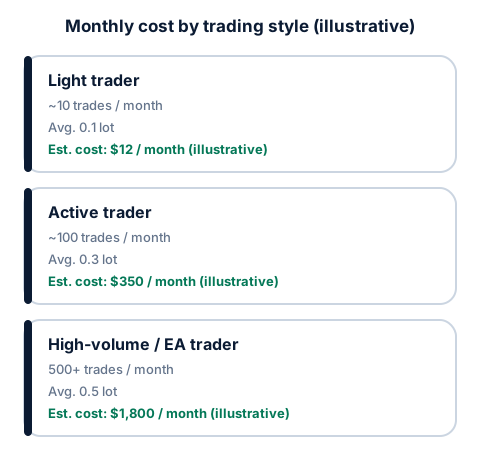
| Profile | Trades/month | Avg. lot size | Est. monthly cost (illustrative) |
|---|---|---|---|
| Light trader | ~10 | 0.1 | $12 |
| Active trader | ~100 | 0.3 | $350 |
| High-volume / EA trader | 500+ | 0.5 | $1,800 |
The pattern is intuitive once you see it laid out: cost scales with both how often you trade and how large each trade is. A high-volume or EA-driven strategy that places many smaller trades can land anywhere on this table depending on average lot size — there's no single "EA trading is expensive" or "EA trading is cheap" rule, only the multiplication above applied to your actual numbers.
Where a rebate fits in — your net monthly cost
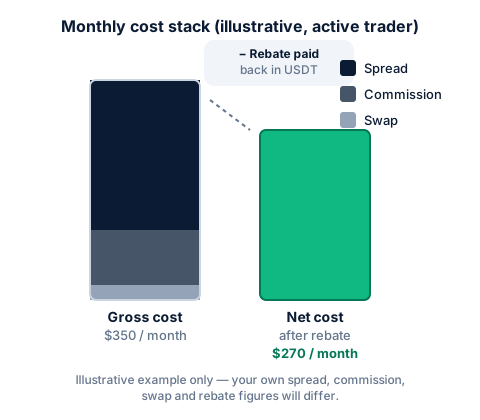
A forex rebate (cashback) is calculated on your closed trading volume and paid back separately, in USDT, after the broker pays the underlying IB commission. It's a partial offset applied after the fact — it reduces your net monthly cost, but it doesn't eliminate the gross cost calculated above, and it isn't a discount applied at the moment you place a trade.
To see what your own volume would translate into, use the calculator with your real trade count and lot size instead of the illustrative numbers above:
1 standard lot = 100,000 units of the base currency.
Used only to show how the fee-free threshold applies below.
Rate used
9.0 USDT per lot
Estimated monthly cashback
90.0 USDT
Estimated yearly cashback
1080.0 USDT
If you withdrew 100 USDT today
No fee — you're at or above the 50 USDT fee-free threshold.
You would receive 100.0 USDT
Figures are estimates based on provisional rates and the trading volume you enter. They are not a guarantee of future cashback and do not account for excluded trades.
Why this number tends to surprise people
Most traders track their profit-and-loss closely and their trading cost not at all, simply because the P/L updates automatically on the platform while the cost calculation above requires deliberately doing the math. The result is that two traders with identical win rates can have very different net outcomes purely because one of them is trading at a lot size or frequency that generates a much higher monthly cost — invisible on the platform, but very visible once you run the numbers in this guide.
This is also why the number is worth recalculating periodically rather than once: a change in your average lot size, how often you trade, or how long you typically hold positions changes the monthly total more than most traders expect, since every input in Step 2 multiplies rather than adds.
Common mistakes when estimating your trading cost
- Mixing up per-side and round-turn commission. Doubling (or halving) this one number changes your whole monthly total.
- Forgetting the sign of swap. Depending on the pair and direction, swap can be a small credit rather than a charge — don't assume it's always a cost.
- Judging cost from a single trade. One trade's outcome is dominated by market movement; monthly cost is dominated by the multiplication in Step 2, which is far more predictable and worth calculating once.
- Using an old spread or commission figure. These change with market conditions and account-type updates, so recalculate periodically rather than relying on a number from months ago.
- Comparing your monthly cost to someone else's. Two traders on the same account type can have very different monthly costs simply because their trade count or average lot size differs — your own number is only meaningful next to your own past numbers, not a stranger's.
Frequently asked questions
Cost per trade tells you the built-in spread, commission, and swap on a single position. Cost per month multiplies that by how often and how large you actually trade — which is usually the more useful number, since it reflects your real trading pattern rather than one isolated example.
See your own numbers
Run your real trade count and lot size through the cashback calculator, compare account types on the XM broker page, or register before your next trade so this month's volume counts.
Risk warning: forex and CFD trading carries a high risk of losing money. Cashback does not offset trading losses. Nothing here is investment advice.