Forex Lot Size, Pips, and Spread Cost Explained (With Formulas)
Learn the exact formulas for lot size, pip value, and spread cost in forex, with worked examples for EUR/USD, USD/JPY, and mini lots.
By CB-Dogs Editorial7 min read
Disclosure: CB-Dogs earns a commission (IB rebate) from brokers for accounts opened or linked through us and pays part of it back to you as cashback. This does not change your trading costs.
On this page
- The short answer
- What is a lot in forex?
- What is a pip (and how is it different for JPY pairs)?
- What is the spread, and why does it cost you money?
- The formula: calculating your exact spread cost
- Turning a single trade's cost into your real trading volume
- Spread vs. commission-based (ECN/RAW) accounts — what changes in the formula
- This cost doesn't disappear — but part of it can come back to you
- Frequently asked questions
- Calculate your own numbers
Most traders can tell you their win rate. Far fewer can tell you what a single trade actually costs them in dollars and cents — because that requires combining three ideas (lot size, pip, and spread) into one formula, and most explanations stop at defining the terms instead of finishing the math.
This guide finishes the math. By the end, you'll be able to take any lot size, any spread, and any currency pair, and work out exactly what that trade costs you before it even needs to move in your favor.
The short answer
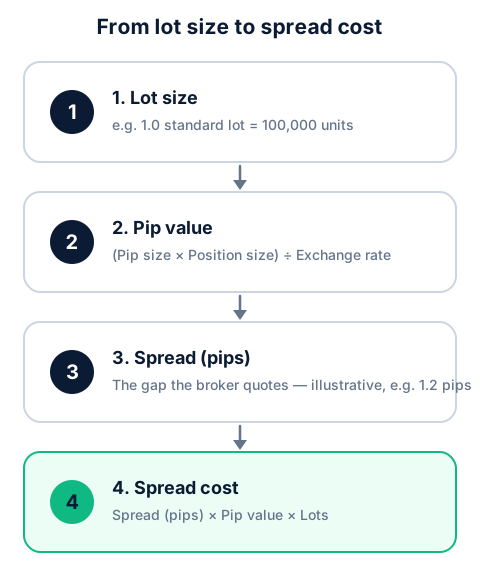
Three building blocks combine into your trading cost:
- Lot size — the number of currency units your position controls (a standard lot is 100,000 units).
- Pip value — how much one pip of price movement is worth for your position size, in your account currency.
- Spread — the gap between the buy and sell price, measured in pips, which is the cost you pay to enter most trades.
Put together: Spread cost = Spread (in pips) × Pip value per lot × Number of lots.
What is a lot in forex?
A "lot" is simply a standardized unit of position size, so traders and brokers can talk about size without listing a raw unit count every time.
Standard, mini, and micro lots
- Standard lot = 100,000 units of the base currency
- Mini lot = 10,000 units (0.1 standard lot)
- Micro lot = 1,000 units (0.01 standard lot)
If you trade "0.5 lots" of EUR/USD, you're controlling 50,000 euros' worth of the pair. Lot size is what everything else in this article scales against — double your lot size and you double both your pip value and your potential spread cost.
What is a pip (and how is it different for JPY pairs)?
A pip ("percentage in point") is the standard unit of price movement most brokers quote. For most pairs, one pip is a 0.0001 change in price — the fourth decimal place. For pairs where the Japanese yen is the quote currency (like USD/JPY or EUR/JPY), one pip is a 0.01 change — the second decimal place, because the yen doesn't use the same number of decimal places as most other currencies.
Some brokers also quote fractional pips ("pipettes") — one more decimal place of precision — but the pip itself remains the standard unit for talking about spread and cost.
Pip value formula
For a pair quoted in US dollars (like EUR/USD, where USD is the second, "quote" currency), the exchange rate in that formula is effectively 1, since the result is already in dollars. That's why a standard lot of any XXX/USD pair has a pip value of $10 — it's baked into the formula, not a coincidence.
For a pair like USD/JPY, the quote currency is yen, so the raw result comes out in yen and has to be converted back to dollars by dividing by the current USD/JPY exchange rate — which is why the pip value for JPY pairs looks different, and shifts slightly whenever that exchange rate moves.
What is the spread, and why does it cost you money?
The spread is the difference between the price you can sell at (bid) and the price you can buy at (ask). When you open a trade, you enter at the worse of the two prices, which means your position starts slightly below break-even — by exactly the spread. On a standard, non-commission account, the spread is typically how the broker earns its revenue on your trade.
A narrower spread means a smaller built-in cost on entry; a wider spread means a bigger one. That's the entire mechanism — no hidden fees, just a gap between two prices that you cross once per round-trip trade.
Spreads also aren't always fixed. Many account types use a variable spread that widens and narrows with market liquidity — often tighter during active trading hours for a given currency pair, and wider around major news releases or during thin, low-liquidity periods. Two trades placed hours apart on the same pair and account can genuinely have different spread costs for this reason alone, which is one reason the worked examples below use a labelled, assumed spread rather than presenting a single "typical" number as if it never changes.
The formula: calculating your exact spread cost
Spread cost = Spread (in pips) × Pip value per lot × Number of lots.
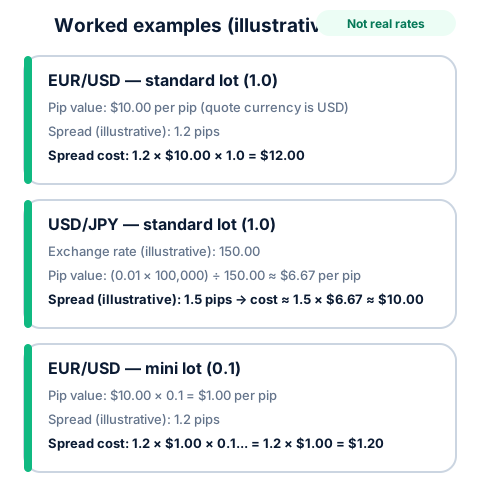
Worked example 1: EUR/USD, standard lot
Assume a spread of 1.2 pips (illustrative) on a 1.0 standard lot of EUR/USD.
- Pip value: $10.00 per pip (standard lot, USD quote currency)
- Spread cost: 1.2 × $10.00 × 1.0 = $12.00
Worked example 2: USD/JPY (a pip definition that differs)
Assume a spread of 1.5 pips (illustrative) on a 1.0 standard lot of USD/JPY, with an illustrative exchange rate of 150.00.
- Pip value: (0.01 × 100,000) ÷ 150.00 ≈ $6.67 per pip
- Spread cost: 1.5 × $6.67 × 1.0 ≈ $10.00
Notice that the pip size is different (0.01 instead of 0.0001) and the pip value depends on a live exchange rate — two reasons JPY-pair costs don't map directly onto USD-quoted pairs.
Worked example 3: mini lot (smaller position, same formula)
Assume the same 1.2-pip spread (illustrative) on EUR/USD, but at 0.1 lot (a mini lot) instead of a full standard lot.
- Pip value: $10.00 × 0.1 = $1.00 per pip
- Spread cost: 1.2 × $1.00 = $1.20
The formula doesn't change — only the lot size scales the result linearly. Trade one-tenth the size, pay one-tenth the spread cost.
Turning a single trade's cost into your real trading volume
A single trade's spread cost looks small in isolation. It stops looking small once you multiply it by how often you actually trade.
Take the EUR/USD example above: a $12.00 spread cost on one round-trip trade. If you open and close a similar-sized position twice a day, five days a week:
- 2 trades/day × 5 days/week × 52 weeks/year = 520 trades/year
- 520 × $12.00 = $6,240/year in spread cost alone (illustrative — excludes commissions and swap)
That's the number most traders never actually calculate, because it requires doing exactly the multiplication above rather than looking at one trade at a time. If you want to take this further and turn it into a realistic monthly figure across different trading styles, see our companion guide on calculating your real monthly forex trading cost.
Spread vs. commission-based (ECN/RAW) accounts — what changes in the formula
Some account types charge a narrower spread (sometimes close to the raw interbank spread) plus a separate, fixed commission per lot. The pip-value and spread-cost formulas above still apply to the spread portion unchanged — you just add a second, simpler term:
Total cost ≈ (Spread × Pip value × Lots) + (Commission per lot × Lots)
Which structure is cheaper overall depends on your typical spread, the commission rate, and how many lots you trade — there's no universal answer, and account types genuinely differ by broker, so compare your own numbers rather than assuming one structure always wins.
A rough way to compare the two on paper: take your typical trade size and estimate the spread-only cost using the formula above, then estimate the commission-account cost using its (usually narrower) spread plus its fixed commission. Whichever total is lower for your typical lot size and trading frequency is the cheaper structure for you specifically — it can differ from what's cheaper for a trader with a very different pattern on the exact same account types.
This cost doesn't disappear — but part of it can come back to you
Nothing in this article makes your spread narrower — that's not how a rebate works, and this isn't a script for cutting trading costs to zero. What a cashback program does is return part of the IB commission your broker already sets aside for referred clients, separately from your spread, after your trade closes. It's a partial offset to the cost above, not a discount applied at the moment you trade.
For the mechanics of how that rebate is calculated and paid, see how forex rebates work and forex rebates paid in USDT.
Frequently asked questions
A pip is the standard unit of price movement (the fourth decimal place for most pairs, the second for JPY pairs). A pipette is one-tenth of a pip — an extra decimal place some brokers display for more precise quoting. The spread-cost formula in this article uses full pips; if your broker quotes in pipettes, divide by 10 before applying the formula.
Calculate your own numbers
The formulas above work for any spread and any lot size — plug in your own numbers rather than someone else's example. To see what a rebate would add back on top of your actual trading volume, try the cashback calculator, or register with CB-Dogs before opening your next trade.
Risk warning: forex and CFD trading carries a high risk of losing money. Cashback does not offset trading losses. Nothing here is investment advice.