USDT TRC20 Transaction Fees and Energy Explained (When You Send USDT)
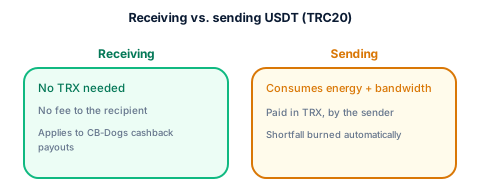
Receiving USDT on TRON (TRC20) costs nothing and needs no TRX, but sending it consumes 'energy' and 'bandwidth,' ultimately paid in TRX — either from resources your wallet already has, or burned from its TRX balance, which is why a wallet with zero TRX can fail to send USDT it holds.
By CB-Dogs Editorial4 min read
Disclosure: CB-Dogs receives an advertising (referral) fee — sometimes called an IB commission — from brokers for accounts opened or linked through us, and returns part of it to you as cashback, the same model used by cashback and points sites. This does not change your trading costs.
On this page
CB-Dogs pays cashback as USDT on the TRON network (TRC20), and receiving it costs you nothing — no TRX needed, no fee deducted. The question that trips people up comes later: when you try to send that USDT somewhere else (an exchange, a friend, a conversion service), the transaction can suddenly ask for TRX, or fail outright. This guide explains why, from the sender's side.
Key takeaways
- Receiving USDT (TRC20) costs the recipient nothing and requires no TRX balance — this applies to CB-Dogs cashback payouts and any other TRC20 transfer you receive
- Sending a TRC20 transfer, including USDT, consumes two TRON network resources — 'energy' (smart-contract execution) and 'bandwidth' (transaction size) — which the sender's account must cover
- If your wallet doesn't have enough free or staked energy and bandwidth, the shortfall is covered by burning TRX from your balance automatically
- A wallet with USDT but zero TRX can fail to send that USDT, because there's no TRX available to cover the energy shortfall — this is a common first-time confusion, not a bug
- Keeping a small TRX balance in the wallet you plan to send USDT from avoids this failure mode; how much is 'enough' varies with network conditions
Receiving is free; sending is not
Our TRC20 vs. ERC20/BEP20 guide and USDT forex rebates guide already cover this from the recipient's side: when CB-Dogs sends you a cashback payout, you pay nothing and need no TRX to receive it. That's still true — this article is about what happens on the other side of a transfer, when you become the sender instead of the recipient (for example, moving your payout to an exchange, or converting it to your local currency — see our guide to converting USDT safely).
What "energy" and "bandwidth" actually are
Every action on the TRON network consumes one or both of two resources:
- Bandwidth covers the raw size of a transaction (in bytes). A simple native TRX transfer uses only bandwidth.
- Energy covers smart-contract execution. USDT on TRON is a smart-contract token (not native TRX), so every USDT transfer runs a smart-contract function and therefore consumes energy, in addition to bandwidth.
Every TRON account gets a small amount of free bandwidth that regenerates daily, and accounts that have "staked" (frozen) TRX for resources get an allotment of free energy and bandwidth proportional to the amount staked. If your available free and staked resources aren't enough to cover a transaction, the shortfall is automatically paid for by burning TRX from your account balance — converted at the network's current resource pricing, not a value you set yourself.
Why a wallet with USDT but no TRX can't send it
This is the scenario that catches people off guard: your wallet shows a USDT balance from a CB-Dogs cashback payout, you try to send it onward, and the transaction fails or is rejected before it even broadcasts. The reason is almost always the same — your wallet has no TRX, and therefore nothing to burn to cover the energy shortfall for that smart-contract transfer. The USDT balance itself is real and correctly received; it just can't move on its own, because moving it is a separate action that needs its own (small) resource cost, paid in TRX, not USDT.
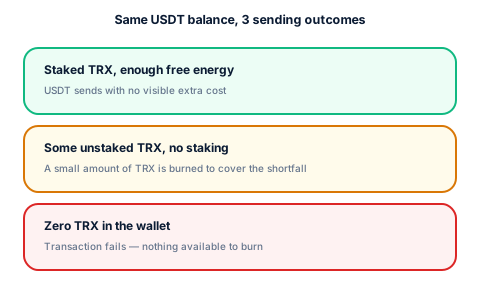
Three scenarios illustrate the difference:
- Wallet with staked TRX and enough free energy/bandwidth: the USDT transfer sends with no visible fee, because the network resources it needed were already available.
- Wallet with some unstaked TRX, no staking: the transfer still sends, but a small amount of TRX is automatically burned to cover the energy shortfall.
- Wallet with zero TRX: the transfer cannot complete — there's no TRX available to burn, and no staked resources to draw on.
How to avoid getting stuck
The practical fix is straightforward: keep a small amount of TRX in the same wallet you plan to send USDT from, separate from your USDT balance. Some ways people typically get that initial TRX:
- Buying a small amount of TRX on an exchange and withdrawing it to your wallet alongside your USDT.
- Using a wallet or exchange feature that sponsors energy for withdrawals, avoiding the need to hold TRX yourself for that specific transfer (availability varies by provider).
- Some services offer to convert a small portion of an incoming USDT amount into TRX automatically for exactly this purpose — check whether your wallet supports this before assuming it does.
Frequently asked questions
No — receiving USDT on TRC20 costs you nothing and requires no TRX balance. This article is specifically about what happens when you later send that USDT somewhere else.
Next steps
Our USDT wallet setup guide covers preparing a wallet to receive CB-Dogs cashback, and the USDT conversion guide covers the next step once you're ready to move your payout onward. Register with CB-Dogs to start earning cashback, paid in USDT with no fee to you as the recipient.
Risk warning: forex and CFD trading carries a high risk of losing money. Cashback does not offset trading losses. Nothing here is investment advice.
Related articles
Cashback on your XM trades — free, paid in USDT
Sign up free