How to Convert USDT to Local Currency Safely
A safety-first guide to turning USDT into your local currency: regulated exchanges, P2P with escrow, common scam patterns to avoid, and why the rules depend on your own country.
By CB-Dogs Editorial6 min read
Disclosure: CB-Dogs receives an advertising (referral) fee — sometimes called an IB commission — from brokers for accounts opened or linked through us, and returns part of it to you as cashback, the same model used by cashback and points sites. This does not change your trading costs.
On this page
Getting paid in USDT solves one problem — you receive your funds quickly, on a low-fee network, without depending on a specific bank's willingness to accept international transfers. It creates a second, smaller problem: at some point, most people want at least part of that USDT in the currency they actually spend day to day. This guide covers the safe ways to do that, the patterns scammers rely on, and why this article deliberately doesn't tell you which exchange to use or what your tax treatment is.
The short answer
There are three broad ways to turn USDT into local currency:
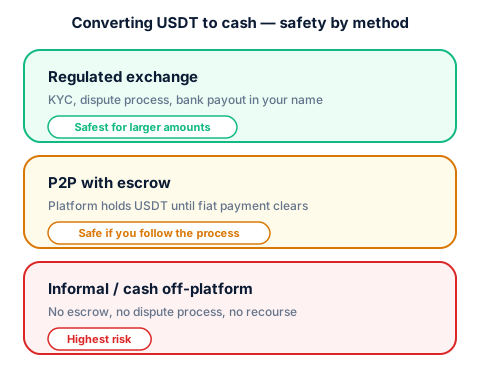
- A regulated centralized exchange that supports your local currency for withdrawal — generally the safest option for larger amounts, with KYC verification, dispute processes, and a paper trail.
- Peer-to-peer (P2P) trading through a platform's built-in escrow, where the platform holds the USDT until the fiat payment is confirmed — convenient in regions with limited direct exchange support, but only as safe as the platform's escrow and dispute system.
- Cash or informal trades outside any platform — meeting someone directly with no escrow, no dispute process, and no recourse if either side doesn't hold up their end. This is the highest-risk method and the one scammers specifically target.
Method 1: Regulated exchanges
A regulated, KYC-compliant exchange is generally the most predictable route for converting a meaningful amount of USDT into your local currency, especially if a bank transfer is the end goal.
How it typically works:
- Deposit your USDT to the exchange (matching the correct network — see our guide to TRC20 vs. ERC20 vs. BEP20 if you're moving between wallets first).
- Sell USDT for your local currency, or for USD/EUR if your currency isn't directly supported.
- Complete identity verification if you haven't already — this is standard, not a red flag.
- Withdraw to a bank account or card in your own legal name — most regulated exchanges will not pay out to a third party's account, and a request asking you to do so is itself a warning sign.
Settlement to a bank account typically takes anywhere from same-day to a few business days, depending on the exchange and your local banking system — build in a buffer rather than assuming instant availability.
Method 2: P2P trading with escrow
Peer-to-peer trading connects you directly with another individual who wants to buy your USDT for cash or a bank transfer, at an agreed rate. Reputable P2P marketplaces build this on top of an escrow system: your USDT is locked by the platform the moment a trade starts, and it's only released to the buyer once you confirm the fiat payment has actually landed in your account — not merely been claimed as sent.
The escrow is what makes P2P safe rather than a security downgrade from an exchange. The moment you're asked to release funds outside that mechanism — for example, "trust me and release it first, I've already paid" — the safety the platform provides no longer applies, no matter how convincing the request sounds.
Safe P2P practice, in order:
- Trade only through the platform's official chat and payment-confirmation flow — never move the conversation to a private messaging app at the counterparty's request.
- Wait for the payment to actually appear and clear in your bank account or e-wallet, not just a screenshot or a claim that it was sent.
- Release the escrowed USDT only after that confirmation.
- If anything feels rushed, urgent, or emotionally pressured ("release it now or I'll report you"), pause and use the platform's dispute or support process instead of resolving it privately.
Method 3: What to avoid
Cash-in-person trades, direct wallet-to-wallet swaps with a stranger outside any platform, and "off-platform, better rate" offers from someone you met inside a legitimate marketplace are the highest-risk category, because none of them have a dispute process if something goes wrong. If you do choose an in-person cash trade for practical reasons, meet in a public, well-lit place, bring someone with you if possible, and never let payment and the crypto transfer happen as two separate, unverified steps with a time gap between them.
Common scam patterns to recognize
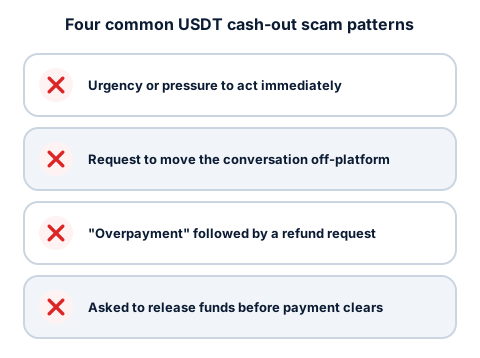
- Overpayment and refund requests. A buyer "accidentally" sends more than agreed and asks you to refund the difference — often before the original payment has actually cleared or is later reversed/charged back, leaving you having sent both the refund and the original USDT.
- Fake payment screenshots or fabricated bank notifications. A convincing-looking image is not proof of a cleared payment — only your own bank or wallet balance is.
- Pressure to move off-platform. Anyone urging you to leave escrow protection "just this once" for a better rate is asking you to give up the one thing that makes the trade recoverable if it goes wrong.
- Too-good-to-be-true rates. A rate meaningfully better than the platform average is a common lure, not a sign of generosity — verify against the platform's current market rate before assuming it's legitimate.
- Fake support contacts. Scammers impersonate platform support in chat or on social media. Only use support channels reachable from the platform's own official app or a bookmarked, verified URL — never a link sent to you directly. This mirrors the same pattern covered in our guide to avoiding USDT address poisoning and wallet scams.
A simple pre-conversion checklist
- Confirm the platform or counterparty is using an actual escrow or verified-payment system, not just a promise.
- Never release USDT until the fiat payment has cleared in your own account.
- Keep all communication and payment proof inside the platform, not in a private chat app.
- Double-check the receiving network and address before sending anything (see our Trust Wallet TRC20 guide).
- Record the date, amount, and exchange rate at the time of conversion for your own records — see our general guide on keeping records of rebates for tax purposes for the same underlying logic applied to conversions.
Legal and tax treatment depends entirely on your country
Whether converting USDT to cash requires reporting, whether it's treated as a taxable disposal event, and which conversion methods are even legally available to you all depend on your country of residence and its current rules — this varies too much to generalize, and the rules change over time. This article is not legal or tax advice. If you're unsure how a conversion affects your own situation, a qualified professional in your country of residence is the right source, not a general guide like this one.
Frequently asked questions
For larger amounts, a regulated, KYC-verified exchange that supports withdrawals to your local currency is generally the most predictable and recoverable option. For smaller amounts or where direct exchange support is limited, P2P trading through a platform's built-in escrow is the next safest option, provided you never release funds before the fiat payment has actually cleared.
Related guides
For the receiving side of this process, see our guides on forex rebates paid in USDT, TRC20 vs. ERC20 vs. BEP20, and avoiding USDT scams and address poisoning. Once you're ready, register with CB-Dogs to start earning cashback in USDT on your trading.
Risk warning: forex and CFD trading carries a high risk of losing money. Cashback does not offset trading losses. Nothing here is investment advice.