Exness Withdrawal: Methods, Processing Times and Fees Explained
Exness withdrawals are typically fastest by e-wallet and crypto (including USDT) and slowest by bank wire, Exness itself states it applies no separate withdrawal fee of its own, and the first withdrawal after a deposit is normally returned to the same payment method up to the deposited amount before profits can go elsewhere.
By CB-Dogs Editorial6 min read
Disclosure: CB-Dogs receives an advertising (referral) fee — sometimes called an IB commission — from brokers for accounts opened or linked through us, and returns part of it to you as cashback, the same model used by cashback and points sites. This does not change your trading costs.
On this page
- Two different things called an "Exness withdrawal"
- Withdrawal methods Exness offers
- How processing actually works, and what "instant" means
- Fees: what Exness charges vs. what your method charges
- The same-method rule, and why it exists
- Common Exness withdrawal problems (and how to avoid them)
- Withdrawing your CB-Dogs cashback (a separate process entirely)
- Frequently asked questions
- Related reading
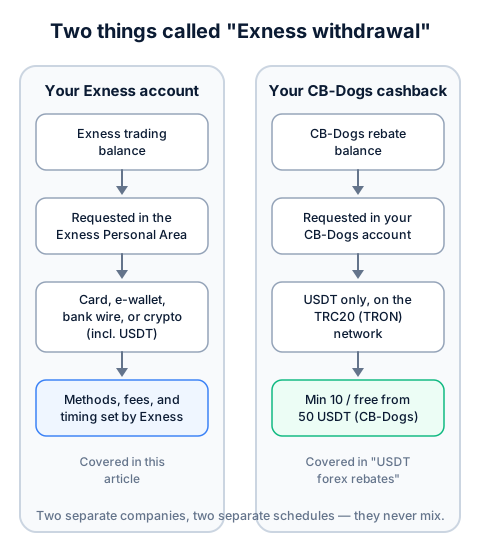
This article is about withdrawing money from your own Exness trading account — moving your trading balance to a card, e-wallet, bank, or crypto wallet. That's different from receiving your CB-Dogs cashback, paid separately, only in USDT on TRC20. If cashback is what you're after, skip to the section below or go to our forex rebates paid in USDT guide.
Key takeaways
- Exness groups withdrawals into a few method categories — bank cards, e-wallets, bank wire, and crypto (including USDT) — with each method's fee, minimum, and processing time shown in your Personal Area, not as one fixed platform-wide number.
- Exness states it charges no separate withdrawal fee of its own; a request that isn't instant is generally handled within 24 hours on Exness's side, though the payment method or network can add its own delay and its own charge.
- The first withdrawal after a deposit is normally returned to that same payment method, up to the deposited amount, before remaining profit can go elsewhere — a standard anti-money-laundering control, not an Exness-specific inconvenience.
- Stuck or rejected withdrawals most often trace back to incomplete identity verification, a payment-method mismatch, or account details that don't match your verified profile — all avoidable by checking them before you submit.
- Withdrawing your Exness trading balance and receiving CB-Dogs cashback are two unrelated processes, run by two different companies on two different schedules — this article covers the first one.
Two different things called an "Exness withdrawal"
Before the methods and fees, it's worth being clear which "withdrawal" you mean, because the two get mixed up constantly:
- Withdrawing your Exness trading balance — money you deposited and traded with. You request it from Exness's own Personal Area, and Exness controls the methods, fees, and timing. That's the subject of this article.
- Withdrawing your CB-Dogs cashback — the rebate we pay for trading through our partner link, separate from your Exness balance. We pay only in USDT on TRC20, with our own rules: a 10 USDT minimum, free from 50 USDT, and a flat 3 USDT fee below that. See the last section, or our USDT forex rebates guide, for the full mechanics.
Withdrawal methods Exness offers
Exness groups withdrawal options into a handful of categories rather than a single flat process: bank cards (Visa/Mastercard-type debit and credit), e-wallets (a category that has commonly included providers such as Skrill and Neteller), bank wire transfer, and cryptocurrency, including USDT alongside other coins such as Bitcoin.
Exness shows each method's specific processing time, fee, and minimum/maximum below that method inside your Personal Area, rather than one fixed table for every client, since they depend on your registered region and account currency — which is why this article avoids quoting a specific dollar figure for any single method; the accurate number is the one shown to you at the moment you withdraw. As a general pattern reported across independent reviews (not company-confirmed here), e-wallets and crypto tend to settle fastest, cards sit in the middle, and bank wire tends to be slowest and most likely to carry a fee from the receiving bank rather than Exness itself.
How processing actually works, and what "instant" means
According to Exness's published help information, if a deposit or withdrawal isn't instant, Exness aims to process it within 24 hours on its own side. That window covers Exness approving and releasing the request — not a promise about when money lands in your bank, card, or wallet, since that last leg depends on the payment method or network itself. E-wallets and crypto (including USDT) tend to settle fastest, since there's no bank-clearing step in between — a crypto withdrawal mainly waits on network confirmation. Bank cards and bank wire add their own clearing time on top, outside Exness's control. None of this starts until your account is verified — see below.
Fees: what Exness charges vs. what your method charges
According to Exness's published information, Exness states it does not charge deposit or withdrawal processing fees of its own. Your card issuer, e-wallet provider, receiving bank, or — for crypto — the blockchain network can still take a cut outside Exness's control; for USDT, that's typically a small network fee rather than a bank-style flat charge. The fee that applies to your method is the one shown in your Personal Area before you confirm, not a number on a marketing page. This "no company fee, but the method might still cost you something" pattern is common industry-wide — see our broker-agnostic forex broker withdrawal methods and fees guide.
The same-method rule, and why it exists
A rule reported consistently across independent sources — standard practice among regulated brokers, for anti-money-laundering reasons — is that your first withdrawal after a deposit returns to that same payment method, up to the deposited amount, before remaining profit can go elsewhere. Deposit by card, and your card withdrawal is generally capped at what you put in by card; profit beyond that can go to an e-wallet or crypto address once the deposit is returned. The logic: it confirms whoever withdraws also controls where the funds came from. If your original method can't be used again, Exness support can generally advise an alternative, with extra verification of the new method.
Common Exness withdrawal problems (and how to avoid them)
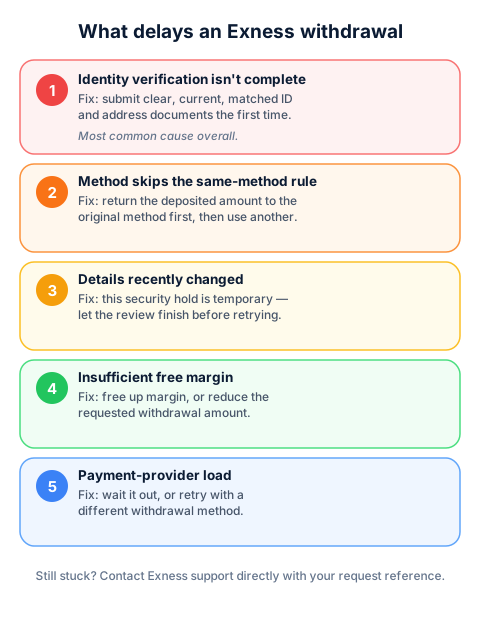
Independent reports of "my Exness withdrawal is pending" or "rejected" consistently point to a handful of recurring causes:
- Identity verification isn't complete. Exness generally requires KYC — a government-issued ID and proof of address — before releasing a withdrawal, though you can typically trade before that finishes. Submit clear, current, matched documents the first time.
- The requested method skips the same-method rule above — a new e-wallet before the original deposit method is repaid up to its deposited amount.
- Account details were recently changed, or documents are outdated — a temporary security hold against account takeover, not a random inconvenience.
- Open positions leave insufficient free margin for the requested amount.
- Payment-provider load or a mismatched detail — usually worth waiting out or retrying with a different method.
If a withdrawal is stuck well past what you'd expect, contact Exness support directly with your request reference — this article rules out the common self-inflicted causes, but can't see your specific account.
Withdrawing USDT from your Exness account balance (not your CB-Dogs cashback) follows the same request process as any other method: choose USDT/crypto in your Personal Area, confirm the destination address and network, and submit. As with any crypto transfer, the network you select has to match what your wallet supports — see our TRC20 vs ERC20 vs BEP20 guide if unsure, and USDT safety and address poisoning before sending to any address for the first time.
Withdrawing your CB-Dogs cashback (a separate process entirely)
None of the above applies to your CB-Dogs rebate. We pay cashback only in USDT on TRC20 — never cards, e-wallets, or any other network — under our own fixed rules: a 10 USDT minimum, free from 50 USDT, and a flat 3 USDT fee below that. Changing your registered payout wallet triggers a 24-hour hold, and receiving USDT on TRC20 doesn't require holding any TRX.
| Account type | Rebate / lot (USDT) |
|---|---|
| StandardNo separate commission — Exness pays partners a share of the spread. The estimate below is for EURUSD at our current partner rank; GBPUSD and gold (XAUUSD) typically pay more per lot, tighter-spread pairs less. Rates rise automatically as our trading volume with Exness grows. | 0.96 |
| ProNo separate commission — Exness pays partners a share of the spread, at a lower percentage than Standard. We don't yet have a reliable per-instrument estimate for this account type, so no figure is shown; your cashback is still 60% of the actual commission Exness pays us. | 0.0 |
| ZeroCommission-based account with near-zero raw spreads. The estimate below is for EURUSD at our current partner rank; other instruments vary. Cashback is paid in addition to the raw spread and does not affect the commission you pay Exness. | 0.25 |
| Raw SpreadCommission-based account with raw interbank spreads. Exness pays partners a fixed amount per lot that varies by instrument; we don't yet have a reliable figure to show, so no estimate is listed — your cashback is still 60% of the actual commission Exness pays us. | 0.0 |
Provisional rate
If you haven't linked your Exness account to CB-Dogs yet, see our guide to opening an Exness account and linking your cashback.
Frequently asked questions
Exness states it charges no separate withdrawal fee of its own. Your card issuer, e-wallet provider, receiving bank, or (for crypto) the network itself can still apply its own charge, shown before you confirm the request.
Related reading
- Forex rebates paid in USDT — CB-Dogs' own cashback payout, separate from this page.
- How to open an Exness account and link it to your cashback — start here first.
- Forex broker withdrawal methods and fees explained — the general, broker-agnostic version.
- TRC20 vs ERC20 vs BEP20 — matching the network to your wallet.
- USDT safety, scams, and address poisoning — verifying an address before you send.
- Exness broker page — account-opening link and current cashback rates.
Risk warning: forex and CFD trading carries a high risk of losing money. Cashback does not offset trading losses. Nothing here is investment advice.
Related articles
Cashback on your XM trades — free, paid in USDT
Sign up free