Forex Broker Withdrawal Methods and Fees: A Generic Overview
Forex brokers typically support a handful of withdrawal method categories — bank wire, card reversal, e-wallets, and increasingly crypto — each with its own common fee and processing-time pattern, and most brokers require withdrawing back through the same method used to deposit, up to the deposited amount, before releasing profits by another method.
By CB-Dogs Editorial6 min read
Disclosure: CB-Dogs receives an advertising (referral) fee — sometimes called an IB commission — from brokers for accounts opened or linked through us, and returns part of it to you as cashback, the same model used by cashback and points sites. This does not change your trading costs.
On this page
- The short answer
- The common method categories
- The "same method" rule
- Typical fee and processing-time patterns
- A worked, illustrative example
- Minimum withdrawal amounts
- Why fee patterns differ by method in the first place
- Verification (KYC) and its effect on processing time
- A short checklist before you deposit
- How this differs from your CB-Dogs cashback payout
- Related reading
- Frequently asked questions
- Work out your own numbers
This article is about withdrawing funds from your broker trading account — not about how CB-Dogs pays out cashback, which is covered separately in our USDT rebate payouts guide. Every broker sets its own withdrawal methods, fees, and minimums, but the common categories and patterns are consistent enough across the industry to be worth understanding in general terms before you fund an account.
Key takeaways
- Most forex brokers support some mix of bank wire, card reversal, e-wallets, and increasingly crypto for withdrawals — exact availability depends on the specific broker and your region.
- A near-universal rule (for anti-money-laundering reasons) is that withdrawals are returned via the same method and account used to deposit, up to the amount originally deposited, before any remaining profit is released another way.
- Bank wire withdrawals tend to have the highest flat fee and slowest processing time; card reversals and e-wallets are often faster or fee-free up to the deposited amount; crypto withdrawal cost depends mainly on network fees.
- A broker's stated 'processing time' covers only how fast the broker approves and sends the withdrawal — the receiving bank, card network, or blockchain can add its own separate delay on top.
- None of this affects your cashback rebate, which CB-Dogs pays separately and directly to your own USDT (TRC20) wallet, regardless of which method you use to withdraw funds from your broker.
The short answer
Withdrawal methods fall into a handful of broad categories — bank wire, card reversal, e-wallet, and crypto — and most brokers support several of them, though exact availability, fees, and minimums are set individually by each broker and can vary by your account's region.
The common method categories
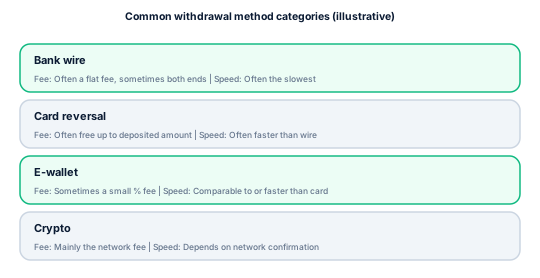
- Bank wire. Often the slowest method and the one most likely to carry a flat fee, sometimes on both the sending and receiving side (the receiving bank's own fee is outside the broker's control).
- Card reversal (debit/credit card). Commonly used to return funds up to the amount originally deposited by card, often with no broker-side fee, though it can only return that original deposited amount — any profit beyond it typically needs a different method.
- E-wallets. Third-party payment services some brokers support, generally faster than bank wire, sometimes with a small percentage fee.
- Crypto (including USDT). Availability and specific supported networks vary by broker; cost is mostly the underlying network fee rather than a broker markup at brokers that pass it through directly — our guide to USDT TRC20 transaction fees and energy covers how that specific network's fee mechanism works, and TRC20 vs. ERC20 vs. BEP20 covers why the specific network chosen matters for cost.
The "same method" rule
Practically, this means if you deposited $500 by card and your account has grown to $800, you can generally expect the first $500 back to that same card, with the remaining $300 in profit released by a method the broker separately supports for profit withdrawals (often bank wire, e-wallet, or crypto). Planning your deposit method with this rule in mind avoids an unexpected step later.
Typical fee and processing-time patterns
Illustrative and generic, not any specific broker's published schedule:
| Method | Typical fee pattern | Typical processing time (broker side only) |
|---|---|---|
| Bank wire | Often a flat fee, sometimes on both ends | Often the slowest of the common methods |
| Card reversal | Often no fee up to the deposited amount | Often faster than bank wire |
| E-wallet | Sometimes a small percentage fee | Often comparable to or faster than card |
| Crypto | Mainly the network fee, not a broker markup at some brokers | Depends on network confirmation time and the broker's own processing |
A worked, illustrative example
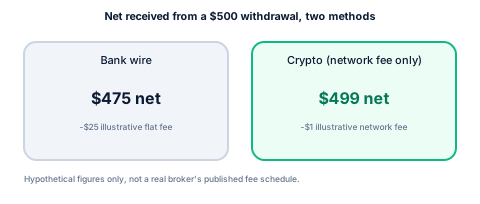
Illustrative inputs: a $500 withdrawal request.
- By bank wire: −$25 flat fee (illustrative) = $475 net received, plus the receiving bank's own possible fee, outside the broker's control.
- By crypto (network fee only): −$1 illustrative network fee = $499 net received, assuming the broker passes through the network cost without its own separate markup.
The gap between methods is driven almost entirely by the fee structure, not by how much the broker "wants" to pay you — which is exactly why checking your specific broker's current schedule before choosing a withdrawal method is worth the two minutes it takes.
Minimum withdrawal amounts
Many brokers set a minimum withdrawal amount per request, separate from any minimum deposit — commonly a modest fixed figure, though the exact number is broker-specific and can also vary by method. If you're planning to withdraw a small amount, checking this minimum first avoids a request being rejected outright.
Why fee patterns differ by method in the first place
A bank wire typically involves a correspondent banking network with its own per-transfer cost to the broker, which is a large part of why it tends to carry the highest fee of the common methods — the broker is often passing through a real cost rather than adding a pure markup. A card reversal, by contrast, generally costs the broker relatively little for amounts up to the original deposit, which is part of why it's often offered free up to that threshold. An e-wallet sits in between, with the provider itself sometimes charging a small percentage that gets passed on. A crypto withdrawal's cost is largely the blockchain network's own transaction fee, which for a network like TRC20 is typically small and fairly stable, as covered in our USDT TRC20 transaction fees and energy guide — understanding this helps explain why a broker's fee schedule looks the way it does, rather than seeming arbitrary.
Verification (KYC) and its effect on processing time
Most regulated brokers require identity verification before releasing a withdrawal, even if that verification was already completed at account opening — a mismatch between the name on your withdrawal method and your verified account details is one of the most common reasons a request is delayed rather than rejected outright. Completing verification fully before you need to withdraw, rather than at the moment of the request, is one of the simplest ways to avoid an avoidable delay stacking on top of the broker's normal processing time.
A short checklist before you deposit
Since the "same method" rule means your deposit method effectively pre-commits part of your later withdrawal path, it's worth checking a few things before funding an account rather than after:
- Does this method support withdrawals as well as deposits, or is it deposit-only at this broker?
- What's the minimum withdrawal amount for this specific method?
- Is there a broker-side fee, and does it change once you exceed the amount you deposited by this method?
- How long does verification typically take if you haven't completed it yet?
How this differs from your CB-Dogs cashback payout
Related reading
- Forex rebates paid in USDT (TRC20) — how CB-Dogs' own cashback payout works, separate from your broker withdrawal.
- USDT TRC20 transaction fees and energy explained — the network-fee mechanics behind a crypto withdrawal specifically.
- How to convert USDT to local currency safely — the step after receiving crypto funds, whether from a broker or a rebate payout.
Frequently asked questions
A mix of bank wire, card reversal, e-wallets, and increasingly crypto, though exact availability depends on the specific broker and your account's region.
Work out your own numbers
Check your own broker's withdrawal page for its current methods, fees, and minimums before choosing how to fund your account. To see how qualifying volume adds up separately as USDT cashback, try the cashback calculator, or register with CB-Dogs before your next trade.
Risk warning: forex and CFD trading carries a high risk of losing money. Cashback does not offset trading losses. Nothing here is investment advice.
Related articles
Cashback on your XM trades — free, paid in USDT
Sign up free