Break-Even Pips: How Far Price Must Move to Cover Your Trading Costs
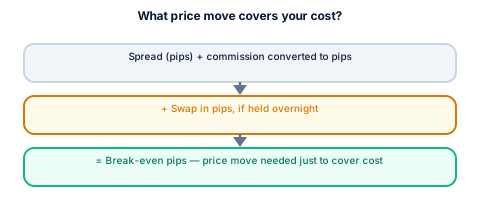
Break-even pips is the price move, in pips, a trade needs before it stops being a loss purely from cost: spread in pips plus commission converted to pips, plus swap in pips if the position is held overnight.
By CB-Dogs Editorial7 min read
Disclosure: CB-Dogs receives an advertising (referral) fee — sometimes called an IB commission — from brokers for accounts opened or linked through us, and returns part of it to you as cashback, the same model used by cashback and points sites. This does not change your trading costs.
On this page
- The short answer
- Building the formula
- Worked example 1 — a same-session trade
- Worked example 2 — held three nights
- Comparing break-even pips across account types
- Break-even pips on different instruments
- Why this differs from break-even win rate
- Why this matters more for short-term trading styles
- Does a rebate change break-even pips?
- Related reading
- Frequently asked questions
- Work out your own numbers
Our guide to how cashback lowers your break-even win rate covers the minimum win percentage a strategy needs to avoid losing money. This article answers a related but different question: for a single trade, how many pips does the price need to move in your favor before that one trade has covered its own cost — spread, commission, and swap — and stopped being a loss purely from fees?
Key takeaways
- Break-even pips = spread (pips) + commission converted to pips + swap in pips (if held overnight).
- This is a per-trade figure measured in price movement, distinct from break-even win rate, which is a percentage measured across many trades.
- Commission is usually quoted in dollars per lot, not pips, so converting it to pips requires dividing by pip value per lot.
- A trade that closes exactly at its break-even pips level has neither gained nor lost money from the price move — it has simply paid back its own cost.
- A rebate lowers the effective break-even pips figure slightly, since it offsets part of the cost the price move needs to cover, though it's paid separately from the trade's price outcome.
The short answer
Break-even pips = Spread (pips) + Commission converted to pips + Swap in pips (if the position is held past rollover).
Once you know this number for a specific trade setup, you know the minimum favorable price move needed before that trade has broken even purely on cost — before it has produced any actual profit at all.
Building the formula
- Spread in pips is already in the right unit — it's the difference between the bid and ask price, expressed in pips, as covered in our lot, pip, and spread cost guide.
- Commission converted to pips requires one extra step, since commission is usually quoted per lot in dollars (or your account currency), not pips. Commission in pips = (Commission per lot in dollars) ÷ (Pip value per lot). This uses the same pip-value building block covered in our commission per lot guide.
- Swap in pips, if the position is held past the daily rollover, works the same way: divide the dollar swap charge per lot by pip value per lot, using the formula from our swap and overnight fees guide.
Adding all three (in pips) gives the total price move needed just to cover cost — nothing more.
Worked example 1 — a same-session trade
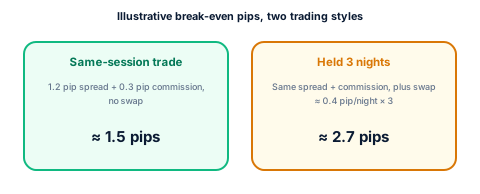
Illustrative inputs, raw-spread account, EUR/USD: spread 1.2 pips, commission $7 per lot round turn, pip value $10 per standard lot, position closed the same session (no swap).
Commission in pips = $7 ÷ $10 = 0.7 pips.
Break-even pips = 1.2 + 0.7 = 1.9 pips. The price needs to move about 1.9 pips in your favor before this trade has covered spread and commission, purely from the price move itself.
Worked example 2 — held three nights
Same account and pair, but the position is held open for three nights instead of closing the same session. Illustrative swap: −$4 per lot per night.
Swap in pips per night = $4 ÷ $10 = 0.4 pips. Over three nights: 0.4 × 3 = 1.2 pips.
Break-even pips = 1.2 (spread) + 0.7 (commission) + 1.2 (swap over 3 nights) = 3.1 pips.
Holding the same trade for three extra nights roughly doubles its break-even pips in this illustrative example — not because the spread or commission changed, but because swap accumulated a separate cost that also needs to be covered by the eventual price move.
Comparing break-even pips across account types
Break-even pips isn't fixed for a given pair — it depends heavily on which account type and cost structure you're trading under, since spread and commission trade off against each other differently by design. On a standard account, where cost is folded entirely into a wider spread, break-even pips is simply that quoted spread, with no separate commission term. On a raw-spread account, the spread component shrinks but the commission component appears, and the two need to be added together rather than compared in isolation — a point covered in more depth in our raw spread vs. standard account guide. Neither structure is inherently better for break-even pips specifically; the real comparison depends on the actual spread-and-commission pair your account offers, exactly as it does for overall cost comparison.
Break-even pips on different instruments
The same formula applies to any instrument, not just forex pairs — gold, indices, and other CFDs all have their own spread, commission, and swap conventions that convert into a break-even pips (or points) figure the same way. Because contract size and pip value differ by instrument, as covered in our contract size and margin guide, a break-even figure calculated for one instrument doesn't transfer to another even if the raw pip or point counts look similar — always redo the conversion using that specific instrument's own pip value.
Why this differs from break-even win rate
Break-even win rate, covered in our related guide, is a percentage calculated across many trades — it answers "what fraction of trades does my strategy need to win, given its typical win and loss sizes and cost per trade, to avoid losing money overall?" Break-even pips answers a narrower, per-trade question: "for this one trade, how far does price need to move before cost is covered?" The two use overlapping inputs (spread, commission, swap) but measure different things — one in percentage of trades won, the other in price movement on a single trade. A trader might use break-even pips when judging whether a specific setup's expected move is large enough to be worth the cost, and break-even win rate when evaluating a strategy's overall viability across many trades.
Why this matters more for short-term trading styles
A trade targeting a large move — tens or hundreds of pips — treats a break-even figure of a few pips as a rounding error relative to its target. A trade targeting a small move, common in short-term or scalping styles, can find that break-even pips represents a much larger share of its intended profit target, which is part of why minimum-holding-time and cost-sensitivity questions come up more often for that trading style — see our guide to forex rebates for scalpers for the related rebate-eligibility angle.
Does a rebate change break-even pips?
A cashback rebate, where it applies, is typically paid per qualifying lot rather than being added directly into the price-based break-even calculation — but it can be expressed as an equivalent pip reduction if you convert it the same way as commission or swap: rebate in pips = rebate per lot ÷ pip value per lot. Subtracting that from the break-even pips total gives an effective, cost-adjusted figure. This is a way of visualizing the rebate's effect, not a claim that the rebate arrives as part of the trade's price outcome — it's paid separately, based on qualifying closed volume, as explained in our guide to how forex rebates work.
Related reading
- How cashback lowers your break-even win rate — the related percentage-based formula across many trades, rather than pips on a single trade.
- Lot size, pip, and spread cost explained — the pip-value building block this formula depends on.
- Forex swap and overnight fees explained — the full swap formula behind the multi-night example above.
- Contract size, lot size and margin explained — why pip value, and therefore break-even pips, changes by instrument.
Frequently asked questions
The number of pips a trade's price needs to move in your favor before it has covered its own cost — spread, commission converted to pips, and swap in pips if held overnight. It measures cost recovery on a single trade, not profit.
Work out your own numbers
Pull your own broker's current spread, commission, and swap figures and plug them into the formula above using your instrument's actual pip value. To see how a rebate offsets part of that cost over time, try the cashback calculator, or register with CB-Dogs before your next trade.
Risk warning: forex and CFD trading carries a high risk of losing money. Cashback does not offset trading losses. Nothing here is investment advice.
Related articles
Cashback on your XM trades — free, paid in USDT
Sign up free