Commission Per Lot: Round Turn vs. Per Side Explained
What 'round turn' and 'per side' mean when a broker quotes commission per lot, why the same true cost can look like two different numbers, and how to compare them correctly.
By CB-Dogs Editorial6 min read
Disclosure: CB-Dogs receives an advertising (referral) fee — sometimes called an IB commission — from brokers for accounts opened or linked through us, and returns part of it to you as cashback, the same model used by cashback and points sites. This does not change your trading costs.
On this page
- The short answer
- Round turn vs. per side, side by side
- A comparison trap worth knowing
- Worked examples (illustrative numbers)
- Why brokers use one convention over the other
- Standard (spread-only) accounts don't have this problem
- Why this matters for reconciling a cashback statement
- Frequently asked questions
- Work out your own numbers
Two brokers each advertise "$3.50 commission per lot." One of them actually charges you $3.50 total per lot traded. The other charges you $7.00. Nothing about either advertisement is dishonest — they're just quoting two different things using the same phrase, and the difference is entirely in whether "per lot" means round turn or per side.
This guide explains exactly what each term means, why the distinction changes your real cost by a factor of two, and how it matters when you're comparing brokers or reconciling your own trade history against a cashback statement.
The short answer
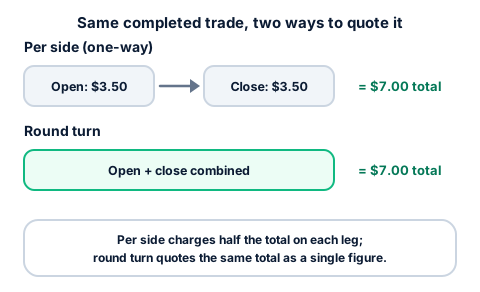
Per side (also called "one-way") commission is charged twice on a completed trade — once when you open the position, once again when you close it. Round turn commission is a single quoted figure that already covers both legs — opening and closing together. A broker charging $3.50 per side and a broker charging $7.00 round turn are charging you exactly the same total amount for the same trade; only the label differs.
Round turn vs. per side, side by side
| Per side (one-way) | Round turn | |
|---|---|---|
| Charged | Once at open, once at close | As a single combined figure for the full trade |
| Quoted example | $3.50 per side | $7.00 round turn |
| Total cost for 1.0 lot, opened and closed | $3.50 + $3.50 = $7.00 | $7.00 |
| Common phrasing | "commission per side," "one-way" | "round trip," "round turn," "all-in" |
Total commission cost = Commission rate × Lots, using whichever convention applies — round-turn rate applied once, or per-side rate applied twice (once per leg). The formula itself doesn't change; what changes is which number you plug in.
A comparison trap worth knowing
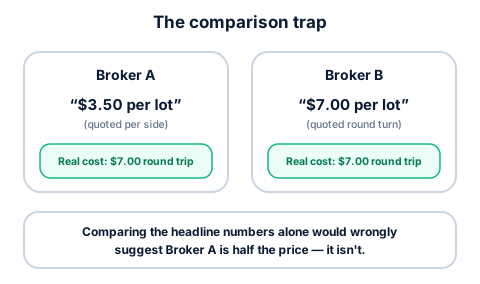
Imagine Broker A advertises "$3.50 commission per lot" and Broker B advertises "$7.00 commission per lot." At a glance, Broker A looks half the price. But if Broker A is quoting per side and Broker B is quoting round turn, they're identical: Broker A's $3.50 charged twice equals Broker B's $7.00 charged once. Comparing the headline numbers without checking which convention each broker uses is one of the most common ways traders misjudge real trading costs when shopping between brokers or account types.
Worked examples (illustrative numbers)
Example 1 — per-side quote. A broker quotes $3.50 per side. You open and close a 2.0-lot position. Total commission: ($3.50 × 2 legs) × 2.0 lots = $14.00.
Example 2 — round-turn quote. A broker quotes $7.00 round turn. Same 2.0-lot position, opened and closed once. Total commission: $7.00 × 2.0 lots = $14.00.
Both examples land on the same total because they describe the same real-world cost — this is intentional, to show that the "cheaper-looking" number isn't automatically the cheaper broker.
Example 3 — partial close. A broker quotes $3.50 per side. You open a 1.0-lot position, then close 0.4 lots and later close the remaining 0.6 lots separately. Commission is typically charged per leg on the actual lots involved in that leg: opening (1.0 lot) $3.50, first partial close (0.4 lot) a proportional $1.40, second partial close (0.6 lot) a proportional $2.10 — for a total of $7.00, matching what a single 1.0-lot round trip would have cost either way. Exact partial-close commission handling can vary by broker, so this is a common-pattern illustration rather than a universal rule.
All figures above are rounded, hypothetical inputs used to demonstrate the formula — not a real broker's published commission schedule.
Why brokers use one convention over the other
There's no universal rule for which convention a given broker or account type uses, but a few patterns show up often enough to be worth knowing:
- Raw-spread / ECN-style accounts, which charge a separate, disclosed commission on top of a tight spread, more often quote per side, since the commission is designed to be transparent about exactly what's charged at each step of the trade lifecycle.
- Some introducing-broker (IB) and rebate-reporting contexts quote round turn, since it's a single figure that matches how a completed trade is usually reported as one row rather than two.
- Marketing pages sometimes lead with whichever number looks smaller, which is exactly why the comparison trap above is worth watching for — a per-side quote will always look more attractive on a landing page than the equivalent round-turn number, even when the real cost is identical.
None of this is a rule you can rely on without checking — it's simply useful context for why you might see either convention depending on where you're reading the number.
Standard (spread-only) accounts don't have this problem
It's worth noting that this entire round-turn-versus-per-side question only applies to accounts that charge a separate, disclosed commission — typically raw-spread or ECN-style accounts. A standard account that folds its entire cost into a wider spread, with no separate commission line at all, doesn't have a round-turn-or-per-side ambiguity to resolve, because there's no commission figure to interpret in the first place. Our guide to raw spread vs. standard accounts covers how to compare a commission-based account against a spread-only one on a like-for-like cost basis.
Why this matters for reconciling a cashback statement
Rebate programs, including CB-Dogs, calculate cashback from your qualifying closed lot volume, as explained in our guide to how forex rebates work — not from your commission cost directly. But when you're cross-checking your own trade history against a rebate statement, understanding round-turn versus per-side matters for a different reason: some broker trade-history exports list commission as two separate rows (one per leg), while others list a single combined row per completed trade. If you're summing rows to estimate your own trading costs alongside your rebate, mistaking a per-side listing for a round-turn one (or vice versa) will make your cost estimate off by exactly double. Our guide to verifying your rebate volume from trade history walks through reading a statement's columns correctly, including this exact distinction.
Frequently asked questions
Round turn (also 'round trip') means the quoted commission figure already covers both opening and closing a position — it's charged once per completed trade, not once per leg.
Work out your own numbers
Check your account's contract specification for its exact commission convention, then apply the formula above with your own lot volume. To see how qualifying volume adds up over time, try the cashback calculator, or register with CB-Dogs before your next trade.
Risk warning: forex and CFD trading carries a high risk of losing money. Cashback does not offset trading losses. Nothing here is investment advice.