Raw Spread vs. Standard Account: Which Is Cheaper? (Break-Even Formula)
The formula for working out whether a raw-spread-plus-commission account or a wider-spread standard account costs less for your own trading volume.
By CB-Dogs Editorial5 min read
Disclosure: CB-Dogs receives an advertising (referral) fee — sometimes called an IB commission — from brokers for accounts opened or linked through us, and returns part of it to you as cashback, the same model used by cashback and points sites. This does not change your trading costs.
On this page
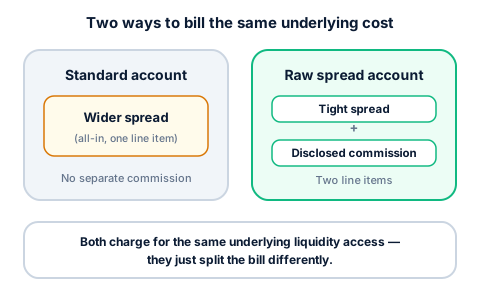
"Raw spread" (sometimes called ECN or zero-spread) accounts and "standard" accounts package the exact same underlying cost — spread plus commission — in two different ways. Neither is universally cheaper. Which one actually costs you less depends entirely on your own spread, commission, and typical position size, and there's a simple formula that tells you which side of that line you're on.
The short answer
A standard account folds your entire cost into a single, wider spread and charges no separate commission. A raw spread account charges a much tighter (sometimes near-zero) spread, plus a separate, disclosed commission per lot. Raw spread is cheaper whenever the spread difference between the two account types (in pips) is larger than the commission cost expressed in the same pip terms — and standard is cheaper when it isn't. Since both spread and commission scale with lot size, the comparison is proportional at every volume; it isn't really a "trade a lot and raw wins" question so much as a "do the numbers for your typical spread and commission" question.
Comparing the two cost structures
Standard account cost = Spread (pips) × Pip value × Lots
Raw spread account cost = (Spread (pips) × Pip value × Lots) + (Commission per lot × Lots)
Both formulas use the pip-value building block covered in our lot, pip, and spread cost guide. The only structural difference is the extra commission term on the raw side — offset by that account's meaningfully narrower spread.
The break-even formula
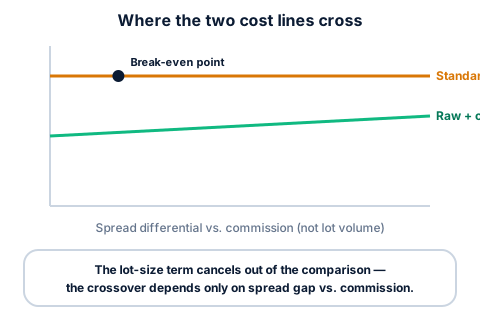
To compare fairly, convert the commission into the same unit as spread (pips):
Commission in pips = Commission per lot ÷ Pip value per lot
Then: Raw spread is cheaper when (Standard spread − Raw spread) > Commission in pips.
Because both sides of the standard-account formula and the raw-account formula scale with the same "× Lots" term, that term cancels out of the comparison entirely — the break-even point is a spread-and-commission question, not a volume question. Trading more lots doesn't shift which account type is cheaper for you; it just multiplies whichever gap already exists.
Worked example (illustrative numbers)
Assume a standard account quotes a 1.2-pip spread on EUR/USD with no commission. A raw spread account on the same broker quotes a 0.2-pip spread plus $7.00 round-turn commission per standard lot. Pip value for a standard lot of EUR/USD is a fixed $10.00, per our pip value reference guide.
- Commission in pips: $7.00 ÷ $10.00 = 0.70 pips
- Spread differential: 1.2 − 0.2 = 1.00 pip
- Since 1.00 pip > 0.70 pips, the raw spread account is cheaper by 0.30 pips per round trip — roughly $3.00 per standard lot at this pip value, in either direction of trade size, since the "× Lots" term cancels.
If the commission had instead been $13.00 round turn (1.30 pips), the comparison would flip: 1.00 pip of spread savings would no longer cover 1.30 pips of commission, and the standard account would be the cheaper choice for the same trader.
All figures above are rounded, hypothetical inputs used to demonstrate the formula — not a live quote or a specific broker's current spread or commission schedule.
A second worked example, flipped
Assume a different broker pairing: a standard account quotes a tighter 0.8-pip spread on EUR/USD with no commission, while its own raw account quotes a 0.1-pip spread plus $12.00 round-turn commission per standard lot.
- Commission in pips: $12.00 ÷ $10.00 = 1.20 pips
- Spread differential: 0.8 − 0.1 = 0.70 pips
- Since 0.70 pips is less than 1.20 pips, the standard account is now the cheaper choice by 0.50 pips per round trip — roughly $5.00 per standard lot — the opposite conclusion from the first example, purely because this broker's standard spread already starts tighter and its raw-account commission is higher.
This is the entire point of running the formula rather than assuming: "raw spread accounts are cheaper" and "standard accounts are cheaper" are both true statements depending on which broker's actual spread and commission figures you plug in. Neither is a rule of thumb that holds across every broker or every account pairing.
Why "which is cheaper" isn't the only question
The pure-cost comparison above ignores a few practical factors worth weighing separately:
- Execution style. Some traders prefer a raw account's typically faster, more direct order routing regardless of the exact cost difference; that's a separate consideration from pip-and-commission math.
- Simplicity. A standard account's single all-in spread is easier to track mentally than watching two separate line items, even if the raw account works out marginally cheaper on paper.
- Cashback eligibility and rate can differ by account type. Where a broker's IB program pays cashback per qualifying lot, the per-lot rate itself can be set differently for a commission-based account than for a spread-only account, since it's usually funded from a share of the advertising (IB referral) fee tied to that account's own commercial terms. That means the account type that wins on raw spread-plus-commission math alone might not always be the account type with the highest net cost after cashback — it depends on the specific rates for each account type.
| Account type | Rebate / lot (USDT) |
|---|---|
| StandardSpread-based account, no commission. | 9.0 |
| MicroRebate is calculated per 100,000 units of micro-lot volume (i.e. the same per-lot rate as Standard, scaled to micro-lot size). | 9.0 |
| Ultra LowLower spreads, spread-based account, no commission. | 3.0 |
| KiwamiXM's tightened-spread account tier available in select regions. | 6.0 |
| ZeroCommission-based account. Rebate is paid in addition to the raw spread — commission you pay is unaffected. | 4.5 |
Provisional rate
Related reading
- Commission per lot: round turn vs. per side explained — make sure you're comparing the commission side of this formula correctly.
Frequently asked questions
No. It's cheaper only when the spread savings (in pips) exceed the commission cost expressed in the same pip terms. If the commission is large relative to the spread gap, a standard account can work out cheaper for the identical trade.
Work out your own numbers
Plug your broker's current spread and commission figures for each account type into the formula above to find your own break-even point. To see how cashback compares across account types, check the broker page, try the cashback calculator, or register with CB-Dogs before your next trade.
Risk warning: forex and CFD trading carries a high risk of losing money. Cashback does not offset trading losses. Nothing here is investment advice.