Forex Cost Glossary: Spread, Swap, Commission, Lot, Pip, Margin, Slippage
A one-page reference for the core forex trading-cost terms, each with a short definition, its formula, and a link to the full guide.
By CB-Dogs Editorial5 min read
Disclosure: CB-Dogs receives an advertising (referral) fee — sometimes called an IB commission — from brokers for accounts opened or linked through us, and returns part of it to you as cashback, the same model used by cashback and points sites. This does not change your trading costs.
On this page
Forex cost terminology gets thrown around a lot, often without a clear definition attached — "spread," "pip," "swap," "margin," "slippage" all sound related but measure completely different things. This page collects the core terms in one place, each with a plain definition and its formula, and links out to the full guide where one exists on this site. Bookmark it as a quick reference rather than reading it as a single narrative.
The short answer
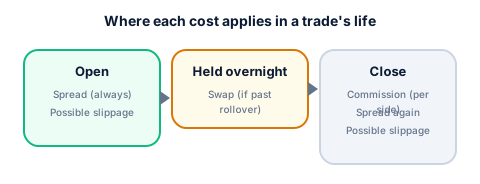
Every forex trade has up to four separate cost components — spread, commission, and swap — plus slippage as a possible execution cost, all measured against building blocks like lot size, pip value, and margin. None of these terms are interchangeable, and mixing them up is the most common reason a trader misjudges what a trade actually costs.
The anatomy of a trade's cost
Lot
A lot is a standardized unit of trade size. A standard lot is 100,000 units of the base currency; a mini lot is 10,000 units; a micro lot is 1,000 units. Lot size is the multiplier behind every other cost calculation on this page — see our full lot, pip, spread and cost guide.
Pip and pip value
A pip is the smallest standardized price movement for an instrument — typically the fourth decimal place for most currency pairs (or the second for JPY pairs). Pip value converts that movement into money:
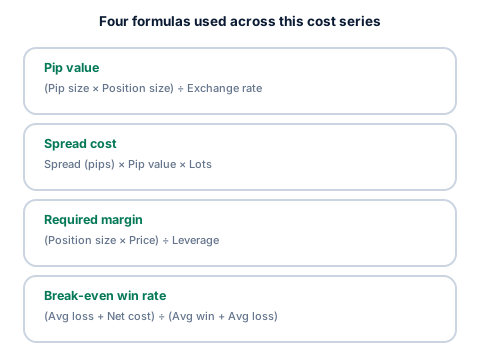
Pip value = (Pip size × Position size) ÷ Exchange rate
For a standard lot on a pair quoted directly against USD, this commonly works out to around $10 per pip; it's different for gold and for JPY pairs. See our pip value reference table for major pairs and gold side by side.
Spread
The spread is the difference between the bid (sell) price and the ask (buy) price — the built-in cost of entering a position, paid the moment you open a trade regardless of which direction it moves afterward.
Spread cost = Spread (in pips) × Pip value × Lots
Spreads aren't fixed all day — they widen predictably around specific low-liquidity and high-news windows, covered in our trading sessions and spread-widening guide. Whether a broker bundles its entire cost into a wider spread or charges a tighter spread plus a separate commission also changes the total — see raw spread vs. standard accounts.
Commission
A commission is a separate, disclosed per-trade fee, common on raw-spread or ECN-style accounts, charged either "round turn" (once, covering both the open and close) or "per side" (charged separately on open and on close). The two conventions can describe an identical real cost while looking different on a rate sheet — see our commission per lot guide for the comparison trap this creates.
Commission cost = Commission per lot × Lots
Swap (overnight / rollover fee)
Swap, also called an overnight or rollover fee, is a charge or credit applied to a position still open at the broker's daily cutoff, based on the interest-rate differential between the two currencies in the pair (or the broker's own financing rate for instruments like gold).
Swap cost = Daily swap rate × Lots × Nights held
Many brokers apply a "triple swap" convention on one specific weekday to account for the weekend. See our full swap and overnight fees guide for the direction rules and worked examples.
Margin and leverage
Margin is the portion of your own funds a broker sets aside as collateral for a leveraged position; leverage is the multiplier that determines how much exposure that margin controls.
Required margin = (Position size × Price) ÷ Leverage
If your account's margin level (equity ÷ used margin) falls too low, you can face a margin call and, eventually, a stop-out. See our full leverage and margin guide for the worked scenario from required margin through stop-out.
Slippage and requotes
Slippage is the difference between the price you expected and the price your order actually filled at — it can work against you (negative slippage) or in your favor (positive slippage), and tends to widen in fast-moving conditions. A requote is a broker declining to fill at the requested price and offering a new one instead of filling automatically. Neither is a fixed fee — see our slippage and requotes guide for what actually drives it.
Position size (from risk)
Position size, sized correctly, ties your intended dollar risk to your stop-loss distance rather than to a round lot number picked out of habit:
Position size (lots) = Risk amount ÷ (Stop-loss distance in pips × Pip value per lot)
See our full position sizing from risk guide for worked examples.
Break-even win rate
Break-even win rate is the minimum win percentage a strategy needs just to avoid losing money over time, given its average win, average loss, and cost per trade:
Break-even win rate = (Average loss + Net cost per trade) ÷ (Average win + Average loss)
A cashback rebate lowers the "net cost per trade" term, which lowers the win rate needed — see our full how cashback lowers your break-even win rate guide for the derivation.
Rebate (cashback)
A rebate, or cashback, is a partial return of the costs above, funded by the advertising (IB referral) fee a broker pays for referring your account, and calculated on your qualifying closed lot volume — not on profit or loss. See our full how forex rebates work guide for the complete mechanics, and how it compares with a deposit bonus in our rebate vs. deposit bonus comparison.
Quick formula reference
Frequently asked questions
Spread is the built-in gap between the bid and ask price, paid on every trade regardless of account type. Commission is a separate, disclosed per-trade fee, common on raw-spread or ECN-style accounts, charged in addition to a (usually tighter) spread.
Go deeper on any term
Each section above links to a full guide with worked examples for that specific cost. To see how these costs and a rebate combine for your own trading volume, try the cashback calculator, or register with CB-Dogs before your next trade.
Risk warning: forex and CFD trading carries a high risk of losing money. Cashback does not offset trading losses. Nothing here is investment advice.