How to Calculate Forex Position Size From Risk Percentage
The formula for sizing a forex position from your account balance, a risk percentage, and your stop-loss distance, with worked examples.
By CB-Dogs Editorial5 min read
Disclosure: CB-Dogs receives an advertising (referral) fee — sometimes called an IB commission — from brokers for accounts opened or linked through us, and returns part of it to you as cashback, the same model used by cashback and points sites. This does not change your trading costs.
On this page
Deciding how many lots to trade by "feel" is one of the most common ways traders take on far more risk than they realize. Position sizing fixes that by working backward from a number you choose deliberately — how much of your account you're willing to risk on this one trade — rather than forward from how many lots feels comfortable to click.
The short answer
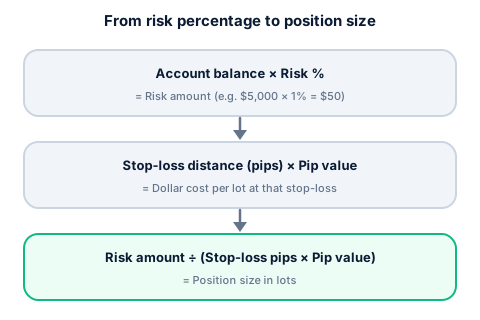
Position size (lots) = (Account balance × Risk %) ÷ (Stop-loss distance in pips × Pip value per lot). You decide the risk percentage in advance; the stop-loss distance comes from your trade analysis; the pip value comes from the pair and lot size, as covered in our pip value reference guide. The formula then tells you the position size that limits your loss, if the stop-loss is hit, to exactly the dollar amount you chose to risk.
Breaking the formula into steps
- Risk amount = Account balance × Risk %. For example, a $5,000 account with a 1% risk setting produces a $50 risk amount for this trade.
- Stop-loss distance in pips comes from your own trade analysis — the distance between your planned entry and your stop-loss level.
- Pip value per lot depends on the pair and lot size, using the standard formula: (Pip size × Position size) ÷ Exchange rate.
- Position size (lots) = Risk amount ÷ (Stop-loss pips × Pip value per lot).
Worked examples (illustrative numbers)
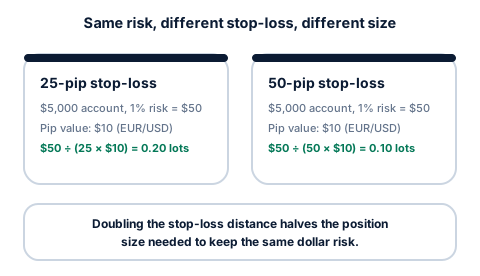
Example 1 — EUR/USD, standard-lot pip value $10. Account balance $5,000, risk 1% ($50), stop-loss distance 25 pips.
Position size = $50 ÷ (25 pips × $10) = $50 ÷ $250 = 0.20 lots.
Example 2 — same account, wider stop-loss. Same $5,000 account, same 1% risk ($50), but a 50-pip stop-loss instead of 25.
Position size = $50 ÷ (50 pips × $10) = $50 ÷ $500 = 0.10 lots — exactly half the size, because the stop-loss distance doubled while the risk amount stayed fixed.
Example 3 — USD/JPY, illustrative pip value $6.67. Same $5,000 account, 1% risk ($50), 30-pip stop-loss.
Position size = $50 ÷ (30 pips × $6.67) ≈ $50 ÷ $200 ≈ 0.25 lots.
All figures above are rounded, hypothetical inputs used to demonstrate the formula — not a recommendation for any specific account size, risk percentage, or pair.
Why this order of operations matters
The formula deliberately starts from risk, not from lot size. Choosing a lot size first and then checking what you'd lose if the stop-loss hits works backward from convenience rather than forward from a deliberate decision — and it means your actual dollar risk can vary wildly from trade to trade depending on how far away your stop-loss happens to sit, even while your position size looks "normal." Sizing from risk keeps the dollar amount at stake consistent, and lets the position size (which is otherwise just an implementation detail) adjust to fit.
Common mistakes when applying this formula
- Sizing from a "comfortable" lot size first, then checking the risk. This reverses the formula's intended order and can leave your real dollar risk swinging widely from trade to trade depending on how far your stop-loss happens to sit that day.
- Using account equity instead of balance inconsistently. Some traders size against their starting balance, others against current equity including open floating profit or loss — either can be a reasonable choice, but switching between them inconsistently makes your risk percentage less meaningful over time. Pick one and apply it consistently.
- Forgetting correlated positions add up. Risking 1% on five different EUR-based pairs at the same time isn't the same as risking 1% total — if those positions move together, your combined exposure to a single underlying move can be much larger than any one trade's risk figure suggests. The formula sizes one trade at a time; it doesn't automatically account for how multiple open positions interact.
- Rounding to a "clean" lot size without checking the resulting risk. Rounding 0.23 lots down to 0.20 or up to 0.25 changes your actual dollar risk slightly — usually not a large difference, but worth being aware of rather than assuming the formula's output and your final entered lot size are identical.
How this connects to your overall trading cost
Position size also determines your spread, commission, and swap costs, since all three scale with lot size — covered in our guides to lot, pip, and spread cost, commission conventions, and swap and overnight fees. A rebate, where available, is calculated on the same qualifying lot volume your position sizing produces — larger, properly-sized positions naturally generate more qualifying volume over time, without changing how the risk-based sizing decision itself should be made.
Frequently asked questions
Position size (lots) = (Account balance × Risk %) ÷ (Stop-loss distance in pips × Pip value per lot). Risk amount and stop-loss distance are inputs you determine; the formula solves for the lot size that fits them.
Work out your own numbers
Plug your own account balance, chosen risk percentage, and stop-loss distance into the formula above using the cashback calculator page's pip-value reference, or register with CB-Dogs to start earning qualifying cashback on your own properly-sized trades.
Risk warning: forex and CFD trading carries a high risk of losing money. Cashback does not offset trading losses. Nothing here is investment advice.