Forex Cent Accounts Explained: Lot Sizes and Rebate Impact
How cent account balances and lot sizes work, why traders use them, and how a cashback rebate scales when your trades are sized in cents.
By CB-Dogs Editorial5 min read
Disclosure: CB-Dogs receives an advertising (referral) fee — sometimes called an IB commission — from brokers for accounts opened or linked through us, and returns part of it to you as cashback, the same model used by cashback and points sites. This does not change your trading costs.
On this page
A cent account is one of the less-explained account types a broker offers, usually sitting quietly on a signup page next to "standard" and "micro" with little context. It's a genuinely useful bridge for a specific situation: real-money, real-execution trading at a fraction of the stakes of a standard account. This guide explains how the lot sizing actually works, why traders use cent accounts, and — since it's the question this site exists to answer — what happens to a cashback rebate when your trades are this small.
The short answer
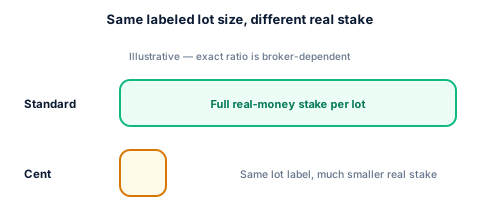
A cent account denominates your account balance, and often your position sizing, in cents rather than your account currency's main unit — letting you trade with real market execution at a much smaller real-money stake than a standard account. Because a rebate is calculated on your genuine standard-lot-equivalent trading volume, a cent-account trade's cashback scales down proportionally along with the account's own smaller stakes.
Why cent accounts exist
A demo account removes real financial stakes entirely, which is useful for learning a platform but doesn't expose you to real execution, real slippage, or the psychological weight of risking your own money — covered in more depth in our demo vs. live accounts guide. A standard account puts full real-money stakes behind every position from day one. A cent account sits between the two: real money, real execution, real (if small) consequences, at a fraction of a standard account's dollar risk per position.
This makes cent accounts a common choice for:
- Traders transitioning off demo who want live-market conditions before committing standard-account-sized capital.
- Testing a new strategy or a new EA with real execution behavior rather than a demo server's simulated fills.
- Very small starting deposits, where a standard account's minimum practical position size would represent an uncomfortably large share of the account.
How the lot-size scaling works
Exactly how a broker implements "cents instead of dollars" differs by platform, but the underlying idea is consistent: your balance, and typically your position sizing, is expressed in a smaller unit than a standard account's, which lets the smallest tradeable position represent a much smaller real-money amount. In practice, this usually means a cent account can go meaningfully smaller than a standard platform's typical 0.01-lot minimum step, which matters for anyone sizing a position from a small risk amount — see our position sizing from risk guide for the underlying formula, and our lot and pip guide for how standard lot sizing works as the baseline.
Are cent-account costs different?
The cost formulas are exactly the same as any other account — spread, commission where applicable, and swap all still apply, following the same mechanics covered in our forex cost glossary. What differs is scale: because position sizes are so much smaller, the real-dollar spread, commission, and swap on any single trade are correspondingly small too. Cent accounts are also commonly associated with somewhat wider spreads in relative terms than a broker's standard account, which is worth checking against your specific broker's published rates before assuming cent-account trading is automatically cheaper per unit of exposure.
How a rebate scales on a cent account
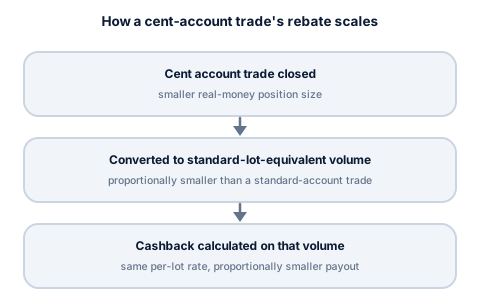
A cashback rebate, as covered in our how forex rebates work guide, is calculated on qualifying closed trading volume measured in standard-lot-equivalent terms — not on the number label a platform happens to show you. Since a cent account's position sizing represents a much smaller real-money stake per labeled lot, its genuine standard-lot-equivalent volume is proportionally smaller too, and the resulting cashback scales down accordingly. This isn't a penalty specific to cent accounts — it's the same volume-based calculation applied consistently, just against a smaller real trade size.
If your broker offers a different published cashback rate specifically for its cent account type (rather than simply scaling the standard rate down), check the live rate rather than assuming it matches the standard-account figure exactly:
| Account type | Rebate / lot (USDT) |
|---|---|
| StandardSpread-based account, no commission. | 9.0 |
| MicroRebate is calculated per 100,000 units of micro-lot volume (i.e. the same per-lot rate as Standard, scaled to micro-lot size). | 9.0 |
| Ultra LowLower spreads, spread-based account, no commission. | 3.0 |
| KiwamiXM's tightened-spread account tier available in select regions. | 6.0 |
| ZeroCommission-based account. Rebate is paid in addition to the raw spread — commission you pay is unaffected. | 4.5 |
Provisional rate
A worked example (illustrative numbers)
Suppose a trader closes the equivalent of 0.5 standard lots' worth of real trading volume in a month on a cent account, compared with another trader closing 0.5 standard lots on a standard account. If both accounts qualify at the same per-lot cashback rate, both would earn the same rebate for that same genuine volume — the account type itself doesn't change the rate, only how many labeled "lots" it took to reach that real volume. The practical difference is usually that a cent account's smaller position sizes make it take proportionally more individual trades, or more calendar time, to accumulate the same standard-lot-equivalent volume that a standard-account trader reaches faster. These figures are a round, illustrative example, not a quoted rate.
Cent accounts vs. micro and mini accounts
A micro lot (1,000 units) and a mini lot (10,000 units) are simply smaller standard-currency position sizes on an ordinary standard account — see our lot and pip guide for the full sizing table. A cent account is a different mechanism: it's not just a smaller lot size, it's the account's own balance and often its minimum sizing that's denominated in a smaller unit, which is why it can go below what a standard platform's minimum lot step normally allows.
Frequently asked questions
An account type where your balance and typically your position sizing are denominated in cents rather than your account currency's main unit, allowing much smaller real-money position sizes than a standard account with the same real market execution.
Check your own account type
Confirm your specific broker's cent-account lot-size convention and cashback rate before assuming a figure from this article applies to you. See how a cent account compares with going straight to a standard account on the XM broker page, or estimate your own cashback with the cashback calculator.
Risk warning: forex and CFD trading carries a high risk of losing money. Cashback does not offset trading losses. Nothing here is investment advice.