How Forex Brokers Make Money (Spread, Commission, Swap, A-Book/B-Book)
A balanced look at how forex and CFD brokers actually earn revenue: spreads, commissions, swap markups, and the A-book vs. B-book execution models.
By CB-Dogs Editorial6 min read
Disclosure: CB-Dogs receives an advertising (referral) fee — sometimes called an IB commission — from brokers for accounts opened or linked through us, and returns part of it to you as cashback, the same model used by cashback and points sites. This does not change your trading costs.
On this page
- The short answer
- Revenue source 1: the spread
- Revenue source 2: commission
- Revenue source 3: swap markup
- Revenue source 4: other account fees
- The execution question: A-book vs. B-book
- Where IB commissions and cashback fit into this picture
- Why this matters for choosing a broker or account type
- Frequently asked questions
- Compare costs, not just labels
Retail forex and CFD brokers rarely charge a visible, itemized bill the way a bank or a subscription service does. That makes it easy to lose track of where their revenue actually comes from — and, for some traders, to wonder whether the broker's incentives are aligned with theirs at all. This guide lays out the actual revenue sources, explains the two main execution models brokers use, and stays neutral on which model is "better," because the honest answer depends on the broker's specific execution quality, not the model label alone.
The short answer
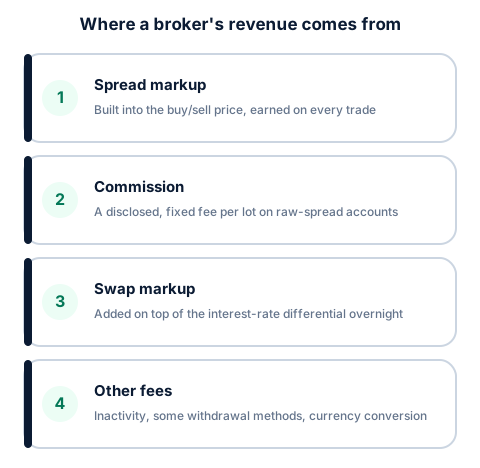
Brokers earn money from four main sources, in some combination depending on the broker and account type:
- Spread — the gap between the buy and sell price, marked up above the broker's own cost.
- Commission — a fixed, disclosed fee per lot, common on raw-spread/ECN-style accounts.
- Swap — an overnight financing charge with the broker's own markup added on top of the underlying interest-rate differential.
- Other fees — inactivity fees, withdrawal fees on certain methods, or conversion fees, depending on the broker.
Separately from how much a broker charges, how it manages the risk from client trades — routing to the market (A-book) versus holding the risk in-house (B-book) — is a distinct question with its own trade-offs, covered below.
Revenue source 1: the spread
On a standard (spread-only) account, the broker's price feed already has its own cost baked in — the price it receives from its liquidity sources, plus a markup it adds before showing you the price. That markup is the spread you see, and it's the broker's revenue on that trade, win or lose. This is the same cost mechanism explained in detail in our guide to lot size, pips, and spread cost.
Revenue source 2: commission
On raw-spread or ECN-style accounts, the broker typically passes through a spread much closer to its own underlying cost, and instead charges a separate, fixed commission per lot, disclosed as a specific dollar (or points) amount. This structure is generally more transparent about the exact cost per trade, since the commission is a stated number rather than embedded in a variable spread — though whichever structure is actually cheaper for you depends on your typical trade size and frequency, as covered in our cost formula guide.
Revenue source 3: swap markup
As explained in our dedicated guide to swap and overnight fees, holding a position overnight involves an interest-rate differential between the two currencies in a pair. Brokers commonly add their own markup or administrative fee on top of the raw rate differential, and that markup is a genuine, ongoing revenue source — one that's easy to overlook because it accrues quietly, once a day, rather than being paid up front like spread or commission.
Revenue source 4: other account fees
Depending on the broker, additional fees can include inactivity charges after a period without trading, fees on certain withdrawal methods, or currency-conversion fees when your account currency differs from the instrument you're trading. These vary widely and aren't universal — check a specific broker's fee schedule directly rather than assuming any of these apply.
The execution question: A-book vs. B-book
Separately from where the revenue above comes from, brokers also have to decide how to handle the market risk created by client trades. This is a different question from pricing, and it's often confused with it.
A-book: routing to the market
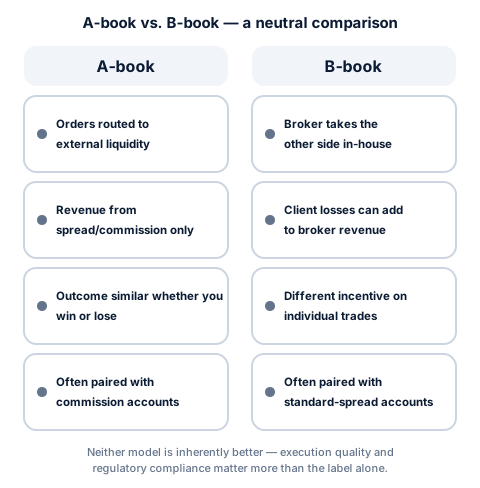
In an "A-book" (or straight-through-processing / ECN-style) model, the broker passes client orders through to external liquidity providers or a matching venue, rather than taking the other side itself. The broker's revenue here comes from the spread markup and/or commission on the volume, not from client losses — so its financial outcome is broadly the same whether a given client wins or loses. This structure removes a direct conflict of interest on individual trades, since the broker earns roughly the same either way.
B-book: holding the risk in-house
In a "B-book" (or market-maker) model, the broker takes the other side of client trades internally rather than routing every order externally, and manages the resulting exposure itself — often by netting opposing client positions against each other and hedging the remaining net exposure in the market. Under this model, a client's trading loss can become part of the broker's revenue, which is the source of the perceived conflict of interest people associate with this model. That doesn't automatically mean execution is worse or prices are manipulated — reputable brokers using this model are still bound by regulatory requirements around fair pricing and execution — but the incentive structure is genuinely different from A-book, and it's reasonable for traders to want to understand which model applies to their account.
Hybrid models are common
In practice, many brokers run a hybrid approach: routing higher-volume or consistently profitable client flow to the A-book (often after observing trading patterns over time), while keeping smaller or less-active flow B-book internally, hedging the aggregate exposure rather than every individual position. Account type can be one signal of which model applies — commission-based, raw-spread accounts are more commonly associated with A-book routing — but this isn't a universal rule, and a broker's actual practice for a specific account type is something only the broker's own disclosures can confirm.
Where IB commissions and cashback fit into this picture
Separately from any of the above, brokers also budget for client acquisition — the cost of attracting new traders in the first place. Introducing Broker (IB) commissions, paid to referral partners like CB-Dogs, come out of this marketing budget, not out of the spread, commission, or swap revenue described above, and not out of client losses under a B-book model either. This is why a rebate program has no relationship to which execution model your account uses — it's a completely separate accounting line, explained in more detail in our guide to how forex rebates work.
| Account type | Rebate / lot (USDT) |
|---|---|
| StandardSpread-based account, no commission. | 9.0 |
| MicroRebate is calculated per 100,000 units of micro-lot volume (i.e. the same per-lot rate as Standard, scaled to micro-lot size). | 9.0 |
| Ultra LowLower spreads, spread-based account, no commission. | 3.0 |
| KiwamiXM's tightened-spread account tier available in select regions. | 6.0 |
| ZeroCommission-based account. Rebate is paid in addition to the raw spread — commission you pay is unaffected. | 4.5 |
Provisional rate
Why this matters for choosing a broker or account type
None of this is meant to suggest one revenue model or execution approach is universally better — a well-run B-book broker with fair, consistent execution can serve a trader just as well as an A-book broker, and a poorly-run version of either model can serve one badly. What matters in practice is verifiable execution quality over time, transparent fee disclosure, and a broker's regulatory standing — not which single label its marketing uses. Our guide to verifying a forex cashback provider is legitimate covers a related but separate question: how to evaluate the IB/rebate side of this relationship specifically.
Frequently asked questions
It depends on the execution model. Under an A-book model, the broker routes your order to the market and earns from spread/commission regardless of your trade's outcome. Under a B-book model, the broker takes the other side of your trade internally, so a portion of client losses can become broker revenue, which is the source of the conflict-of-interest concern associated with that model.
Compare costs, not just labels
Whatever revenue model a broker uses, your own trading cost is what ultimately matters. See our guides on calculating spread cost and your real monthly trading cost, try the cashback calculator to see what a rebate would add back, or register with CB-Dogs to start earning cashback on your next trade.
Risk warning: forex and CFD trading carries a high risk of losing money. Cashback does not offset trading losses. Nothing here is investment advice.