Forex Leverage and Margin Explained (Margin Call and Stop-Out)
How leverage and margin work in forex trading, with formulas and worked examples for required margin, margin level, margin calls, and stop-outs.
By CB-Dogs Editorial6 min read
Disclosure: CB-Dogs receives an advertising (referral) fee — sometimes called an IB commission — from brokers for accounts opened or linked through us, and returns part of it to you as cashback, the same model used by cashback and points sites. This does not change your trading costs.
On this page
Leverage is usually the first thing new forex traders hear about, and often the least well understood. It's frequently described as "borrowed money," which isn't quite right, and the two numbers that actually determine whether you get a margin call or a forced liquidation — margin level and stop-out — get far less attention than leverage itself. This guide works through all four concepts with formulas and worked examples, so the mechanics are clear before you ever need them under pressure.
The short answer
- Leverage lets you control a larger position than your account balance alone would allow, expressed as a ratio like 1:100.
- Margin is the portion of your own funds the broker sets aside as collateral for that position — not a fee, and not spent, but temporarily locked while the position is open.
- Margin level is a live percentage comparing your account equity to your used margin, and it's the number that actually determines whether you're in a safe zone, a margin call, or a stop-out.
- Margin call is a warning threshold; stop-out is the threshold where the broker automatically starts closing positions to protect against a negative balance.
What leverage actually does
Leverage is a ratio between the size of the position you can control and the funds required to open it. At 1:100 leverage, $1,000 of your own funds lets you control a position worth $100,000 (notional value). Leverage doesn't add money to your account, and it isn't a loan in the conventional sense with a separate repayment schedule — it simply changes how much of your own capital is required as margin for a given position size. It also scales both directions equally: the same leverage that lets a small move produce a large percentage gain lets the same-sized move against you produce a proportionally large loss relative to your margin.
Required margin formula
Required margin = (Lot size × Contract size × Price) ÷ Leverage
For a standard lot (100,000 units), the "notional value" of the position is simply 100,000 × the current price. Dividing that by your leverage ratio gives the margin the broker sets aside.
Worked example: required margin
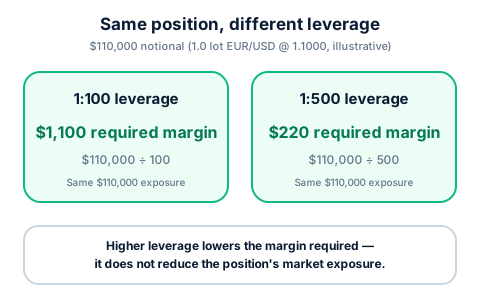
Assume a hypothetical 1.0 standard lot of EUR/USD at a price of 1.1000, with 1:100 leverage:
- Notional value: 100,000 × 1.1000 = $110,000
- Required margin: $110,000 ÷ 100 = $1,100
At 1:500 leverage instead, the same position would require only $110,000 ÷ 500 = $220 — a smaller portion of your account tied up as margin for the identical position size, which is exactly why higher leverage is often marketed as letting you "trade bigger" with less capital. It doesn't reduce your actual market risk on that position at all — the notional exposure and the dollar impact of a given price move are unchanged either way.
Margin level formula
Margin level (%) = (Equity ÷ Used margin) × 100
Equity is your account balance adjusted for any open position's floating profit or loss. Used margin is the total margin currently locked across your open positions. This percentage is the single number most trading platforms display prominently, because it's what determines your standing relative to a margin call or stop-out.
Worked example: margin level
Using the $1,100 required-margin example above, on a $2,000 account with no other open positions:
- Margin level: ($2,000 ÷ $1,100) × 100 ≈ 182%
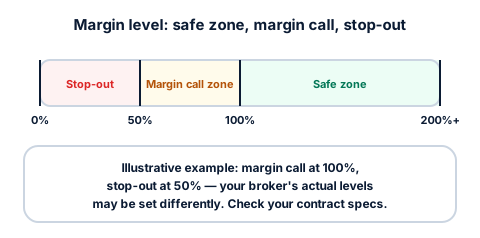
As the trade moves against you and equity falls (used margin stays the same, since it's based on position size, not current P/L), margin level drops. If equity fell to $1,100, margin level would be exactly 100% — a commonly used (though not universal) illustrative margin-call threshold.
Margin call vs. stop-out — two different lines
- Margin call: a notification (historically, and still sometimes literally, a call — now usually a platform alert or email) that your margin level has fallen to a broker-defined warning threshold. It's a signal to act — by adding funds, closing part of the position, or reducing exposure — not an automatic action by itself.
- Stop-out: a lower threshold where the broker's system automatically closes some or all of your open positions, starting typically with the largest losing position, to prevent equity from going negative. This happens without further input from you once the threshold is reached.
Illustrative examples of how these might be configured (real thresholds vary by broker and sometimes by regulation): a margin call at 100% and stop-out at 50%; or a margin call at 80% and stop-out at 20%. Neither of these is a universal standard — always confirm your own account's specific levels rather than assuming a figure from this article or elsewhere applies to you.
A full worked scenario
Take the earlier example: a $2,000 account, $1,100 used margin, starting margin level ≈182%. Assume a hypothetical margin call at 100% and stop-out at 50%.
- At 100% margin level (equity has fallen to $1,100): a margin-call warning appears. The unrealized loss so far is $2,000 − $1,100 = $900.
- At 50% margin level (equity has fallen to $550): the stop-out threshold is reached, and the broker's system begins automatically closing positions. The unrealized loss at this point is $1,450 — well over the account's starting margin requirement, though still bounded by the account balance itself under a standard (non-negative-balance-protection) setup.
This example uses round, hypothetical numbers purely to demonstrate the mechanism — actual thresholds, execution speed during a stop-out, and whether any slippage occurs during forced closure all depend on your specific broker and current market conditions.
Why leverage and margin matter beyond a single trade
Higher available leverage doesn't obligate you to use it fully — you can trade a small position size relative to your account balance even on an account offering very high maximum leverage, which is one of the more overlooked risk-management levers available to any trader. The margin-level formula above applies the same way regardless of what leverage ratio your account offers; what changes is how much of your account a given position size consumes, and therefore how much room you have before reaching a margin call.
Related reading
- What is negative balance protection? — what happens if a stop-out isn't fast enough to prevent a negative balance.
Frequently asked questions
Not in the conventional sense. Leverage changes how much of your own funds are required as margin to control a given position size — there's no separate loan balance or interest charged specifically for the leverage itself, though holding a position overnight can involve a separate swap cost unrelated to leverage.
Keep building on the fundamentals
For the cost side of every trade you place — separate from leverage and margin — see our guides on lot size, pips, and spread cost and swap and overnight fees. When you're ready to see what cashback would add back on your own trading volume, try the cashback calculator or register with CB-Dogs.
Risk warning: forex and CFD trading carries a high risk of losing money. Cashback does not offset trading losses. Nothing here is investment advice.