What Is Negative Balance Protection?
What negative balance protection means, how it works when an account goes negative, and what it does and doesn't protect you from.
By CB-Dogs Editorial4 min read
Disclosure: CB-Dogs receives an advertising (referral) fee — sometimes called an IB commission — from brokers for accounts opened or linked through us, and returns part of it to you as cashback, the same model used by cashback and points sites. This does not change your trading costs.
On this page
Leverage lets you control a position larger than your deposited capital, which is exactly what makes an extreme, fast market move a genuine risk to more than just your trade — in theory, it can put your account balance below zero. Negative balance protection is the feature that's supposed to stop that from happening to you. This guide explains what it actually means, how it works mechanically, and — just as important — what it doesn't cover.
The short answer
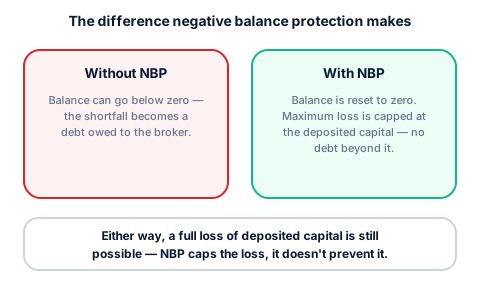
Negative balance protection (NBP) is a broker feature that caps your maximum possible loss at the money you've deposited. If a fast market move causes your account equity to fall below zero before your positions can be closed, NBP resets your balance back to zero and the broker absorbs the remainder — rather than you owing the broker the difference.
How an account could go negative in the first place
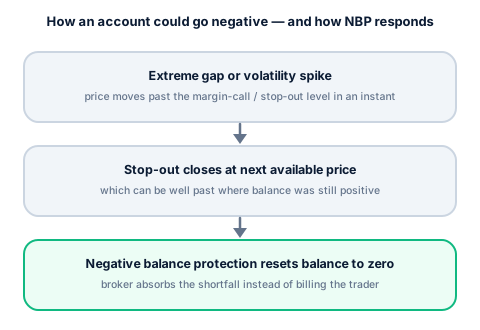
Normally, a broker's automatic stop-out process closes losing positions once your account's margin level falls to a set threshold, long before your balance could reach zero — covered in our guide to leverage and margin explained. The problem is that stop-outs, like any other order, execute at the next available price, not necessarily the exact threshold price. During an extreme, fast-moving event — a sudden gap over a weekend, a shock announcement, a moment where liquidity effectively disappears for a few seconds — the price can move so far, so fast, that even an automatic stop-out fills well past where the account still had a positive balance. Without a protection mechanism, that shortfall would become a debt: the trader owing the broker more than they ever deposited.
This isn't a hypothetical concern invented for this article — sudden, unexpected currency shocks have historically produced exactly this outcome for some highly leveraged traders, which is part of why negative balance protection became a standard feature many brokers now offer, and in some jurisdictions a regulatory requirement.
How negative balance protection actually works
When NBP applies and an account's balance would otherwise go negative after a stop-out or forced closure, the broker:
- Closes the remaining exposure at whatever price is available.
- Calculates the resulting balance, which in this scenario is below zero.
- Resets the balance to zero rather than leaving it negative, absorbing the shortfall itself instead of billing the trader for it.
The trader's maximum loss in this scenario is capped at 100% of the capital they had deposited — a large loss, potentially all of it, but not a debt beyond that.
What negative balance protection does not do
This is the part most often misunderstood:
- It doesn't prevent losing your full deposit. NBP caps the loss at your deposited capital — it doesn't reduce how much of that capital you can lose in a single bad move.
- It doesn't replace a stop-loss or sound risk management. NBP is a last-resort backstop for extreme, fast-moving scenarios, not a substitute for setting your own exit levels — see our guide to stop-loss types and what they cost for the tools you control directly.
- It doesn't guarantee your stop-loss fills at your exact level. A standard stop-loss can still experience slippage in fast conditions, as covered in our guide to slippage and requotes explained — NBP only steps in for the more extreme case where equity would otherwise turn negative, not for ordinary slippage on a stop that still closes with a positive balance remaining.
- It isn't automatically the same everywhere. Some brokers apply it per account, others per trade; some apply it broadly, others only for certain instruments or account types. Always check the specific policy that applies to your account.
How to check whether it applies to you
Negative balance protection should be stated plainly in your broker's terms and conditions or account documentation — it isn't something you need to opt into or configure yourself if the broker offers it. If it isn't mentioned explicitly, or the wording is unclear about whether it applies to your specific account type and instrument, ask your broker's support directly before assuming it's in place.
Does a rebate relate to negative balance protection?
No — they're unrelated. A forex cashback rebate is a partial return of your trading costs, calculated on qualifying closed lot volume as described in our guide to how forex rebates work. Negative balance protection is a risk-management feature that limits your maximum possible loss. Neither affects the other, and a rebate doesn't reduce or offset the kind of extreme loss that NBP is designed to cap.
Frequently asked questions
It's a broker feature that caps your maximum possible trading loss at the money you've deposited. If an extreme market move would otherwise push your account balance below zero, the broker resets it to zero and absorbs the shortfall instead of billing you for it.
Check your own account
Confirm your broker's specific negative balance protection policy in your account terms before assuming it applies to your situation. To see what cashback would add back on top of your trading volume, try the cashback calculator, or register with CB-Dogs before your next trade.
Risk warning: forex and CFD trading carries a high risk of losing money. Cashback does not offset trading losses. Nothing here is investment advice.