Slippage and Requotes Explained: What They Actually Cost You
What slippage and requotes are, why they happen most during news and thin liquidity, and how to estimate their real cost with worked examples.
By CB-Dogs Editorial6 min read
Disclosure: CB-Dogs receives an advertising (referral) fee — sometimes called an IB commission — from brokers for accounts opened or linked through us, and returns part of it to you as cashback, the same model used by cashback and points sites. This does not change your trading costs.
On this page
Spread, commission, and swap are the trading costs you can calculate in advance. Slippage isn't — it only shows up after your order fills, and it can be larger than all three combined during the wrong ten seconds of a fast market. This guide explains what slippage and requotes actually are, why they cluster around predictable moments, and how to estimate their cost using the same pip-value building block from our lot, pip, and spread cost guide.
The short answer
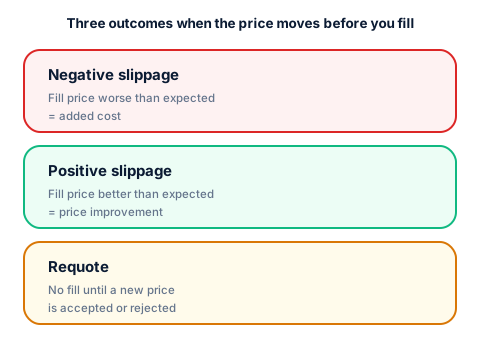
Slippage is the difference between the price you expected when you placed an order and the price your order actually filled at. A requote is what happens on some platforms and order types when the broker can't fill you at your requested price at all, and instead sends back a new price for you to accept or reject before anything executes.
Slippage cost = (Fill price − Expected price) × Pip value per lot × Lots, using the same pip-value formula from our cost guide. The result can be negative (you got a worse price — a real added cost) or positive (you got a better price, sometimes called positive slippage or price improvement).
Slippage vs. a requote: two different things
- Slippage happens on market execution: your order fills at the best available price at that instant, whatever it is. Most modern platforms use this model.
- A requote happens on instant execution (or "dealing desk") venues that only fill orders exactly at the quoted price. If that price has already moved by the time your order arrives, the platform can't fill it, so it asks you to accept a new price instead — nothing executes until you do.
Because requotes require your action, they cost you time and can mean missing a price entirely if you decline or hesitate. Slippage, by contrast, executes automatically — you find out about the cost after the fact, not before it.
Why slippage and requotes happen at all
Both come down to the same underlying cause: the price moved between the moment you clicked and the moment your order reached the market. That gap is usually a fraction of a second, but during fast-moving conditions even a fraction of a second is enough for the price to have already changed. Three conditions make this far more likely:
- Low liquidity. Fewer buyers and sellers quoting means fewer prices available at each level, so a normal-sized order can "walk through" several price levels instead of filling at one.
- High volatility. A market moving quickly changes the best available price many times per second, widening the gap between your intended price and the price that's actually reachable.
- Order type and size. Market orders accept whatever price is available and are more exposed to slippage than limit orders, which only fill at your specified price or better (at the cost of possibly not filling at all). Very large orders relative to available liquidity are also more likely to move through multiple price levels.
When slippage typically spikes
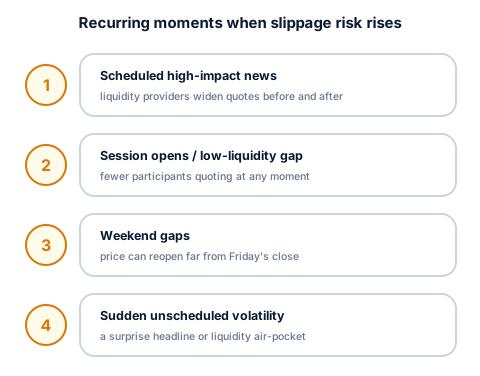
- Scheduled high-impact news (central bank rate decisions, major employment or inflation data) — liquidity providers often widen their quotes and pull back size in the seconds before and after a release, exactly when the price is most likely to gap.
- Session opens and the daily low-liquidity window — as covered in our guide to trading sessions and when spreads widen, the same thin-liquidity windows that widen spreads also increase slippage risk, since both stem from fewer participants quoting at any given moment.
- Weekend gaps. The market closes Friday and reopens Sunday evening; if news breaks over the weekend, the opening price can differ meaningfully from Friday's close, and any order resting at that boundary can experience gap slippage well beyond what intraday levels would suggest.
- Sudden, unscheduled volatility — a surprise headline, a flash move, or a liquidity air-pocket can produce the same conditions as a scheduled release, just without any warning on the calendar.
Worked examples (illustrative numbers)
Example 1 — negative slippage, EUR/USD. You place a market buy expecting a fill at 1.10500. Fast conditions mean it actually fills at 1.10520 — 2 pips worse. On a 1.0 standard lot with a $10 pip value: 2 × $10 × 1.0 = $20 in added cost, on top of the spread you'd already expect to pay.
Example 2 — positive slippage. Same setup, but the fill comes back at 1.10490 instead — 1 pip better than expected. That's 1 × $10 × 1.0 = $10 in your favor, sometimes called price improvement.
Example 3 — a requote instead of a fill. You place an order on an instant-execution account at 1.10500. The price has already moved to 1.10530 by the time it arrives, so the platform requotes you at 1.10530 instead of filling automatically. If you accept, that's a 3-pip difference from your original intended price (3 × $10 × 1.0 = $30); if you decline, you've lost the original price entirely and have to re-place the order at whatever the market offers next.
All figures above are rounded, hypothetical inputs used to demonstrate the mechanics — not a real broker's execution statistics or a guarantee of any specific slippage amount.
Can you reduce slippage and requote risk?
A few approaches lower the exposure, though none eliminate it completely:
- Use limit orders where your strategy allows it. A limit order only fills at your price or better, trading a chance of non-execution for protection against a worse fill.
- Avoid placing new market orders in the seconds around scheduled high-impact news, if your strategy doesn't specifically depend on trading that moment.
- Consider a guaranteed stop-loss for exit protection in genuinely fast-moving conditions — see our guide to stop-loss types and what they cost for how that trade-off works.
- Check your broker's execution model and average fill statistics, where published, rather than assuming market or instant execution based on marketing language alone.
Does a rebate offset slippage?
No, and it isn't designed to. A forex cashback rebate is calculated on your qualifying closed trading volume, as explained in our guide to how forex rebates work — it doesn't know or care what price your order filled at. Slippage is a fill-price outcome; a rebate is a volume-based payment from the broker's advertising commission budget. The two are unrelated line items, though in practice, cashback still reduces your combined cost of trading overall, regardless of which cost category — spread, commission, swap, or slippage — made up the total.
Frequently asked questions
Slippage is the difference between the price you expected when placing an order and the price it actually filled at. It can be negative (a worse price, an added cost) or positive (a better price, sometimes called price improvement).
Work out your own numbers
The formula above applies to any fill-price difference on any pair or account — plug in your own numbers using your platform's actual pip value. To see what cashback would add back on top of your trading volume, try the cashback calculator, or register with CB-Dogs before your next trade.
Risk warning: forex and CFD trading carries a high risk of losing money. Cashback does not offset trading losses. Nothing here is investment advice.