Stop-Loss Types Explained: Standard, Trailing, and Guaranteed
The three main stop-loss types, how each one works, and what each actually costs you — including when a guaranteed stop charges a disclosed fee.
By CB-Dogs Editorial6 min read
Disclosure: CB-Dogs receives an advertising (referral) fee — sometimes called an IB commission — from brokers for accounts opened or linked through us, and returns part of it to you as cashback, the same model used by cashback and points sites. This does not change your trading costs.
On this page
A stop-loss is the order that closes a losing position automatically once the price reaches a level you set — but "stop-loss" isn't just one order type. Three variations exist, and each has a different cost profile: one has no direct fee but can suffer slippage in fast markets, one adjusts itself automatically as price moves in your favor, and one charges explicitly for guaranteeing your exit price no matter what. This guide covers all three.
The short answer
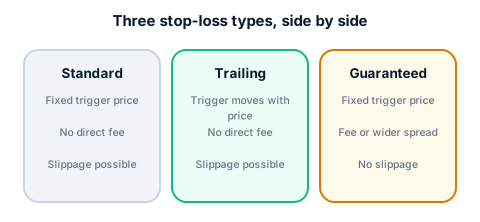
- Standard (fixed) stop-loss — closes your position at the first available price once the market reaches your stop level. No direct fee, but the fill price isn't guaranteed.
- Trailing stop-loss — a standard stop that automatically moves in your favor as the price moves, staying a fixed distance behind the best price reached, then holds in place if price reverses.
- Guaranteed stop-loss (GSLO) — fills at exactly the price you set, even through a gap or a fast-moving market, in exchange for a disclosed fee or a wider spread.
Standard (fixed) stop-loss
A standard stop-loss sits at a fixed price you choose when placing the order. Once the market trades at or through that level, the order triggers and attempts to close your position at the next available price. There's no direct fee for placing one — but "next available price" is the key phrase: in a fast-moving or thin market, that price can be worse than your stop level, a cost called slippage, covered in full in our guide to slippage and requotes explained. In calm conditions, this gap is typically small or nonexistent; in genuinely fast conditions (a gap, a news spike), it can be significant.
Trailing stop-loss
A trailing stop-loss works exactly like a standard stop, except its trigger price automatically moves in your favor as the trade moves in your favor, staying a fixed distance (in pips or points) behind the best price reached since you opened the trade. If the price reverses instead, the trailing stop stays where it last moved to — it never moves against you. This makes it a tool for locking in a growing profit without having to manually move your stop-loss every time the trade advances. Like a standard stop, a trailing stop has no direct fee, but the same fill-price and slippage caveat applies once it triggers: the trailing distance sets where it triggers, not what price it fills at.
Guaranteed stop-loss (GSLO)
A guaranteed stop-loss removes the fill-price uncertainty entirely: your broker commits to closing your position at exactly the price you set, even if the market gaps straight through it during extreme volatility or a weekend news event. This is the only one of the three types that fully removes slippage and gap risk from your exit.
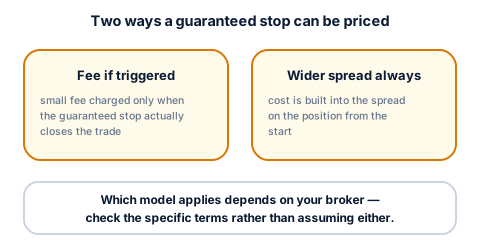
That guarantee isn't free. Brokers that offer GSLOs commonly charge for it in one of two ways:
- A fee charged only if the guaranteed stop actually triggers — if the trade closes normally (manually, at take-profit, or never reaches the stop level), no fee applies at all.
- A wider spread built into the position from the start, whether or not the guaranteed stop ever triggers.
Which model applies, and the exact cost, depends entirely on your broker and account type — always check the specific terms before assuming either structure.
Comparing the three
| Type | Fill price guaranteed? | Direct fee? | Best suited for |
|---|---|---|---|
| Standard (fixed) | No — subject to slippage in fast markets | None | General use; calm-to-normal conditions |
| Trailing | No — subject to slippage once triggered | None | Locking in profit as a trade moves favorably |
| Guaranteed (GSLO) | Yes — exact price, even through a gap | Yes — a fee or a wider spread | Positions held through known high-risk windows (major news, weekend gaps) |
Worked example (illustrative numbers)
Standard stop, fast market. You set a stop at 1.10000 on a 1.0 standard lot EUR/USD position. A news spike means it actually fills at 1.09970 — 3 pips of slippage. At a $10 pip value: 3 × $10 × 1.0 = $30 worse than expected, on top of the loss the stop was already designed to limit.
Guaranteed stop, same scenario. The same stop is set as a GSLO at 1.10000. Despite the identical spike, it fills at exactly 1.10000 — no slippage. Assume an illustrative guaranteed-stop fee of 1 pip's worth if triggered: 1 × $10 × 1.0 = $10 fee, but $20 less total cost than the standard stop's slippage in this scenario.
All figures above are rounded, hypothetical inputs to illustrate the trade-off, not a specific broker's fee, spread, or a guarantee that a guaranteed stop always costs less than slippage would have — in calm conditions, the standard stop's zero direct fee can easily come out ahead instead.
How this relates to margin and stop-out
A stop-loss is an order you place yourself to exit at a level you choose. It's a different mechanism from a broker's automatic stop-out, which force-closes positions when your account's margin level falls too low, regardless of any stop-loss you have or haven't set — covered in full in our guide to leverage and margin explained. A well-placed stop-loss is one of the main tools traders use to try to avoid ever reaching a margin call or stop-out in the first place.
Does a rebate change your stop-loss cost?
No. A forex cashback rebate is calculated on qualifying closed trading volume, as covered in our guide to how forex rebates work — it's unrelated to which stop-loss type you use, whether it triggers, or any fee a guaranteed stop charges. It still reduces your overall trading cost across whatever combination of spread, commission, swap, slippage, and stop-related fees you actually incur.
Related reading
- What is negative balance protection? — the safety net for the rare case a stop-loss doesn't fill in time.
Frequently asked questions
Standard (fixed), trailing, and guaranteed. A standard stop closes at the next available price once triggered. A trailing stop automatically moves in your favor as the trade advances. A guaranteed stop fills at exactly your set price, even through a gap, for a disclosed fee or wider spread.
Work out your own numbers
Check which stop-loss types your own platform offers and how each is priced before you rely on one for risk management. To see what cashback would add back on top of your trading volume regardless of which stop-loss type you use, try the cashback calculator, or register with CB-Dogs before your next trade.
Risk warning: forex and CFD trading carries a high risk of losing money. Cashback does not offset trading losses. Nothing here is investment advice.