Forex Swap and Overnight Fees Explained (With Formula)
What a forex swap (rollover) fee is, how it's calculated, why it can be positive or negative, and how it adds to the total cost of holding a trade overnight.
By CB-Dogs Editorial6 min read
Disclosure: CB-Dogs receives an advertising (referral) fee — sometimes called an IB commission — from brokers for accounts opened or linked through us, and returns part of it to you as cashback, the same model used by cashback and points sites. This does not change your trading costs.
On this page
Spread and commission get most of the attention when traders talk about trading costs, because they're paid up front, on every trade. Swap (also called an overnight or rollover fee) is easy to overlook for the same reason it can quietly become the largest cost of all for a longer-term position: it's charged quietly, once a day, in the background, for as long as you hold.
This guide explains exactly what swap is, why it can go in either direction, how to calculate it, and how it fits alongside the spread and commission costs covered in our lot size, pip, and spread cost guide.
The short answer
A swap fee is the cost (or, sometimes, the credit) applied to a forex position that's still open when the trading day rolls over, reflecting the interest-rate difference between the two currencies in the pair. Every currency has a benchmark interest rate set by its central bank; when you hold a forex position overnight, you're economically long one currency and short the other, so the interest-rate differential between them gets settled through the swap.
Swap cost = Swap rate (points per lot per night, as published by your broker) × Lot size × Number of nights held, converted to your account currency using the pip value if the rate is quoted in points.
Why swap can be positive or negative
Each currency pair has two interest rates behind it — one for each currency. Broadly:
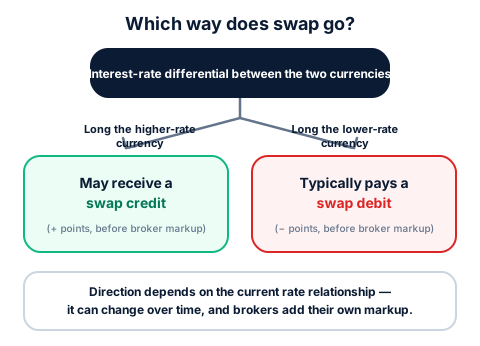
- If you're long the currency with the higher interest rate in the pair (and short the lower-rate one), you may receive a swap credit.
- If you're long the currency with the lower interest rate (and short the higher-rate one), you'll typically pay a swap debit.
This is independent of whether the trade is winning or losing on price — swap is settled based on which currency you're holding overnight, not on your unrealized profit or loss. Brokers also commonly apply their own markup or administrative fee on top of the raw interest-rate differential, so the number you see quoted is rarely the pure central-bank rate difference — it's the broker's own published swap rate for that instrument, which is the number that actually applies to you.
The "triple swap" day
Spot forex trades settle two business days after the trade date (T+2). To keep that settlement cycle aligned with the calendar despite weekends (when banks are closed), many brokers charge three days' worth of swap on a single weekday rather than charging it on Saturday and Sunday individually. Commonly this falls on Wednesday for standard spot FX pairs, since it's the day whose T+2 settlement would otherwise land on the weekend — but the exact weekday can differ by instrument (some CFDs and metals follow a different schedule) and by broker, so check your platform's contract specification rather than assuming Wednesday applies universally.
Worked examples (illustrative numbers)
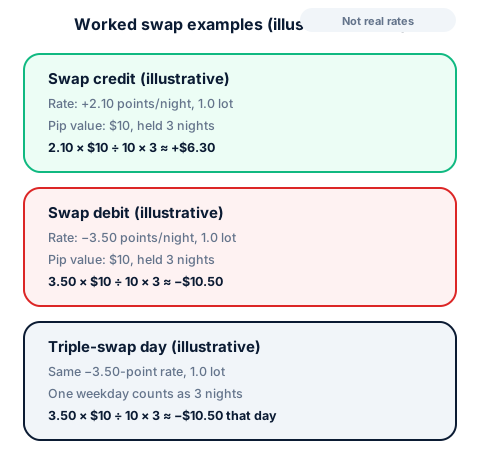
Example 1 — swap credit. Assume a hypothetical swap rate of +2.10 points per night on a 1.0 standard lot long position, and a pip value of $10 for the pair. Holding for 3 nights: 2.10 × $10 ÷ 10 × 3 ≈ +$6.30 credited (points are commonly quoted in tenths of a pip, so divide by 10 to convert to whole pips before applying the pip-value formula from our cost formula guide).
Example 2 — swap debit. Assume a hypothetical swap rate of −3.50 points per night on the same 1.0 standard lot, same pip value. Holding for 3 nights: 3.50 × $10 ÷ 10 × 3 ≈ −$10.50 debited.
Example 3 — the Wednesday effect. Using the same −3.50-point rate, a position still open when triple swap applies pays roughly 3× the daily amount that day alone: 3.50 × $10 ÷ 10 × 3 ≈ −$10.50 charged on that single day, on top of whatever nights the position was already held. A short-term trade that happens to span a triple-swap day can see a noticeably larger overnight charge than the daily rate alone would suggest.
All figures above are rounded, hypothetical inputs used purely to demonstrate the formula — not a real broker's rate for any pair or account type.
How swap fits into your total trading cost
Swap is one of three components that make up your real cost of trading, alongside spread and commission:
Total cost ≈ (Spread × Pip value × Lots) + (Commission per lot × Lots) + (Swap rate × Pip value × Lots × Nights held)
For very short-term trades — closed within the same session — swap typically doesn't apply at all, since it's only charged on positions still open at rollover. This is one reason scalpers and day traders who close everything before the session ends see spread and commission dominate their cost structure, while swing and position traders holding for days or weeks see swap accumulate as a much larger share of total cost. Our guide to calculating your real monthly trading cost walks through combining all three for your own trading pattern.
Can you avoid swap entirely?
A few approaches reduce or eliminate swap exposure, each with its own trade-off:
- Close positions before rollover. This avoids swap entirely but only suits strategies that don't need to hold overnight.
- Trade a pair with a currently favorable swap direction for your position. This can produce a credit instead of a debit, but the direction can change if central bank rates shift, so it isn't a permanent guarantee.
- Swap-free ("Islamic") accounts. Some brokers offer accounts without daily swap charges, generally intended for traders whose religious beliefs prohibit paying or receiving interest. These accounts commonly apply a different fee structure instead (such as a fixed administrative fee after a certain number of days), so "swap-free" doesn't necessarily mean "cost-free" — check the account's specific terms rather than assuming there's no overnight cost at all.
Does a rebate offset swap costs?
Not directly. A forex cashback rebate is calculated on closed trading volume — the number of lots you've completed — as explained in our guide to how forex rebates work. It's a separate payment from the broker's advertising (IB) commission budget, unrelated to swap, spread, or commission individually. In practice, though, it functions as a partial offset against your combined trading costs overall: the more qualifying volume you trade, the more cashback accrues, regardless of whether that cost came from spread, commission, or swap. It doesn't change your swap rate and it isn't calculated from it.
Frequently asked questions
It's a daily charge or credit applied to a forex position still open at the trading day's rollover, based on the interest-rate difference between the two currencies in the pair, plus the broker's own markup or administrative fee.
Work out your own numbers
The formulas above apply to any swap rate your broker publishes — check your platform's current contract specifications and plug in your own figures. To see what cashback would add back on top of your trading volume, try the cashback calculator, or register with CB-Dogs before your next trade.
Risk warning: forex and CFD trading carries a high risk of losing money. Cashback does not offset trading losses. Nothing here is investment advice.