Forex Trading Sessions and When Spreads Widen
The four forex trading sessions, when they overlap for the tightest spreads, and the recurring windows — rollover, session gaps, news — when spreads widen.
By CB-Dogs Editorial6 min read
Disclosure: CB-Dogs receives an advertising (referral) fee — sometimes called an IB commission — from brokers for accounts opened or linked through us, and returns part of it to you as cashback, the same model used by cashback and points sites. This does not change your trading costs.
On this page
The forex market runs 24 hours a day, five days a week, but it isn't equally liquid every hour of that window. Spreads — the cost you pay on every single trade, as covered in our lot, pip, and spread cost guide — track that liquidity closely. This guide walks through the four trading sessions, why some hours are tighter than others, and the recurring moments when spreads widen predictably.
The short answer
Spreads widen when there are fewer market makers actively quoting a price and fewer participants trading against each other, and they tighten when more of both are active at once. Because forex trading activity is tied to which financial centers are open, spreads follow a broadly predictable daily rhythm: tightest during session overlaps, widest during the daily low-liquidity gap, around rollover, and briefly around scheduled high-impact news.
The four sessions
- Sydney — opens the trading week, generally quieter on its own for major USD pairs.
- Tokyo (Asian session) — active for JPY and other Asia-Pacific pairs; thinner for European and dollar-centric pairs.
- London (European session) — historically the highest-volume session for most major pairs.
- New York (US session) — heavy volume, especially where it overlaps with London.
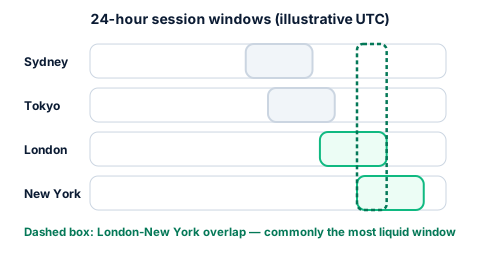
Two sessions running at once means two regions' worth of market makers and participants quoting and trading simultaneously — which is exactly why overlaps, particularly London-New York, are commonly cited as the tightest-spread, most liquid window of the day for most major pairs.
| Session | Commonly cited approximate window (UTC) | Overlaps with |
|---|---|---|
| Sydney | ~21:00–06:00 | Tokyo (brief, early Tokyo hours) |
| Tokyo | ~00:00–09:00 | Sydney (early), London (brief, late Tokyo hours) |
| London | ~07:00–16:00 | Tokyo (brief), New York (mid-afternoon UTC) |
| New York | ~12:00–21:00 | London (the overlap most often cited as the most liquid window) |
These windows are approximate and shift slightly with each region's own daylight-saving calendar, so treat them as a general shape of the trading day rather than an exact schedule.
Where spreads widen
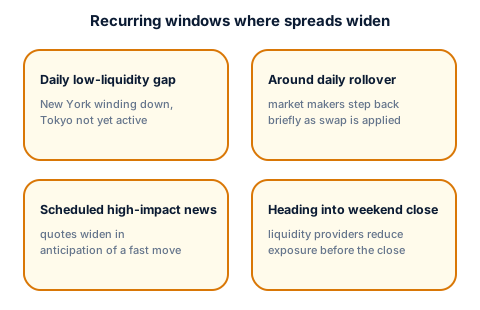
- The daily low-liquidity gap. Between the New York session winding down and the Tokyo session picking up, there's a stretch with the fewest active participants of the whole 24-hour cycle. Fewer quotes competing for your order means wider spreads, even with no news at all.
- Around the daily rollover. As covered in our guide to swap and overnight fees, many brokers mark the end of the trading day at a specific rollover time; market makers commonly step back briefly around that point while positions are marked and swap is applied, and spreads can widen for a short window as a result.
- Around scheduled high-impact news. In the moments before and immediately after a major release (a central bank decision, a key employment or inflation report), liquidity providers often widen their quotes in anticipation of a fast move, rather than risk being filled at a price that's about to become stale.
- Heading into the weekend close. As Friday's session winds down and liquidity providers reduce their exposure ahead of the market being shut for two days, spreads on many pairs tend to widen compared with a typical mid-week session.
Why this matters for your trading cost
Spread cost scales directly with how wide the spread is at the moment you trade: Spread cost = Spread (pips) × Pip value per lot × Lots, from our cost formula guide. A pair that normally trades at a 1-pip spread during the London-New York overlap might show 3-4 pips (or more, in genuinely thin conditions) during the overnight gap — multiplying your entry cost for the exact same trade, before anything else about the trade has changed.
Worked example (illustrative numbers)
Same trade, two windows. Assume a 1.0 standard lot EUR/USD trade, pip value $10.
- Placed during the London-New York overlap at an illustrative 0.8-pip spread: 0.8 × $10 × 1.0 = $8.00.
- The identical trade placed during the low-liquidity overnight gap at an illustrative 3.0-pip spread: 3.0 × $10 × 1.0 = $30.00.
Same pair, same size, same direction — a $22 difference driven entirely by when the order was placed. All figures above are rounded, hypothetical inputs to illustrate the mechanism, not a specific broker's spread at any specific time.
Practical takeaways for scheduling your trading
None of this means trading outside the London-New York overlap is a mistake — plenty of strategies specifically target other sessions (Tokyo-session ranges, Sydney-session setups) for reasons unrelated to spread cost. It does mean the same trade, in the same pair, can cost noticeably more depending purely on when you place it. A few practical habits follow directly from that:
- Check your broker's typical spread by hour, where published, rather than assuming a single "typical spread" applies around the clock.
- Be deliberate about trading through the low-liquidity gap or around rollover — if your strategy doesn't specifically need that window, the wider spread there is a cost with no corresponding benefit.
- Treat scheduled news releases as a separate, sharper spike on top of the general daily pattern, not just "another wide-spread moment" — see the news-specific triggers in our slippage guide below.
Session timing and slippage
Thin liquidity doesn't just widen the quoted spread — it's also one of the conditions that makes slippage more likely, since fewer available price levels means a normal-sized order can move through several of them before filling. See our guide to slippage and requotes explained for how that cost is calculated separately from the spread itself.
Does session timing affect your rebate?
No. A forex cashback rebate is calculated on qualifying closed lot volume, exactly as described in our guide to how forex rebates work — the session you traded in, and the spread you paid within it, don't change the rebate calculation. Trading during a wider-spread window costs you more in spread, not less in cashback, and trading during a tighter-spread window costs less overall without reducing what you earn back.
Frequently asked questions
Sydney, Tokyo (Asian session), London (European session), and New York (US session). Trading runs continuously as each session opens roughly where the previous one is winding down.
Work out your own numbers
Check your own platform's typical spreads across different hours of the day using the formula above, and factor that into when you choose to trade. To see what cashback would add back on top of your trading volume regardless of timing, try the cashback calculator, or register with CB-Dogs before your next trade.
Risk warning: forex and CFD trading carries a high risk of losing money. Cashback does not offset trading losses. Nothing here is investment advice.