Demo vs. Live Accounts: Costs and Cashback Eligibility Explained
Why demo accounts don't earn forex cashback, how demo costs differ from live trading, and what to check before moving from demo to a live account.
By CB-Dogs Editorial4 min read
Disclosure: CB-Dogs receives an advertising (referral) fee — sometimes called an IB commission — from brokers for accounts opened or linked through us, and returns part of it to you as cashback, the same model used by cashback and points sites. This does not change your trading costs.
On this page
A demo account is how most traders first learn a platform, and it's a genuinely useful tool for that. It's also, understandably, a source of a specific question once cashback enters the picture: if a demo trade "counts" the same way on the platform, does it earn a rebate too? The short answer is no, and this guide explains why, along with the cost differences worth knowing before you switch to live.
The short answer
No — demo accounts don't earn forex cashback. A rebate is a share of the advertising (IB referral) fee a broker pays on real, revenue-generating trading activity. A demo trade doesn't generate any real spread, commission, or swap revenue for the broker, so there's nothing for that broker to share back through an IB rebate program. Cashback applies only to trades executed on a real, funded live account linked to an IB.
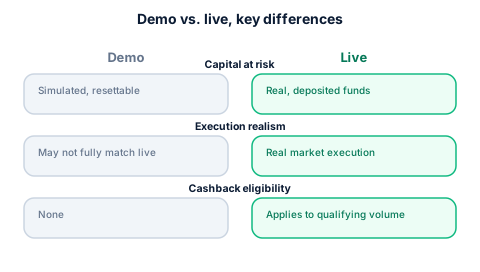
How demo and live accounts actually differ
| Demo account | Live account | |
|---|---|---|
| Capital at risk | Simulated, resettable | Real, deposited funds |
| Execution | Simulated fills; may not fully reflect real liquidity | Real market execution, including real slippage risk |
| Spreads shown | Often mirrors live quotes, but not guaranteed identical in every condition | The actual spread your broker charges, including any widening during low-liquidity windows |
| Swap and commission | May be simulated or absent depending on the platform | Charged exactly as your account type's terms specify |
| Cashback eligibility | None | Applies to qualifying volume on a linked account |
| Psychological stakes | Low — losing simulated funds carries no real cost | Real — see the note below on why this matters |
Why costs can look different on demo
Most reputable brokers try to make their demo environment mirror live conditions reasonably closely, since a demo that behaves nothing like live trading wouldn't be a useful learning tool. That said, a few things commonly differ in practice:
- Execution during volatile or thin markets. A demo server processes orders against simulated liquidity, which doesn't always reproduce the exact behavior of real market depth during a genuine liquidity gap — the same gaps covered in our trading sessions and spread-widening guide.
- Slippage and requotes. Because a demo fill doesn't compete against real order flow, it may not show the same slippage a live order would experience in the same conditions — see our slippage and requotes guide for what actually drives that gap.
- The emotional weight of the trade. This is the difference that matters most and is easiest to underestimate: risking simulated funds and risking your own deposited capital produce genuinely different decision-making pressure, even when every number on screen looks identical.
Moving from demo to live
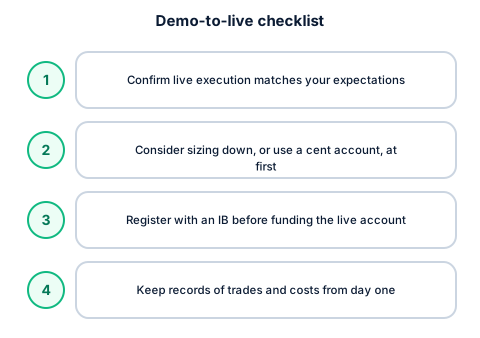
A few practical steps make the transition smoother:
- Confirm your platform's live execution matches what you expect — spreads, available instruments, and order types can occasionally differ slightly between a broker's demo and live environments.
- Consider sizing down initially. A much smaller live position size than you traded on demo lets you experience real execution and real psychological pressure without risking a meaningful amount of capital while you calibrate. A cent account can be a useful bridge here, since it allows very small real-money position sizes with real execution.
- Register your live account with an IB before you fund it, if you plan to use a rebate program — most providers, including CB-Dogs, can only track volume on accounts linked before or shortly after opening, not retroactively.
- Keep records from the start. See our guide to verifying rebate volume from trade history and our record-keeping guide for what to track.
- Size your position based on real risk, not demo habits. See our position sizing from risk guide for the formula.
Get your payout setup ready before you need it
If part of your reason for going live is to start earning and eventually withdrawing cashback, it's worth having your payout details ready before your first live trade rather than after. CB-Dogs pays cashback as USDT on the TRC20 (TRON) network, so setting up a wallet in advance means there's no delay once your first rebate clears — see our wallet setup guide and our USDT forex rebates overview for how the payout process works end to end. This is purely a convenience step; it has no effect on whether your demo experience transfers to live trading.
Does account type otherwise affect cashback?
Yes, separately from the demo-vs-live question — different live account types at the same broker can carry different cashback rates, reflecting their different cost structures:
| Account type | Rebate / lot (USDT) |
|---|---|
| StandardSpread-based account, no commission. | 9.0 |
| MicroRebate is calculated per 100,000 units of micro-lot volume (i.e. the same per-lot rate as Standard, scaled to micro-lot size). | 9.0 |
| Ultra LowLower spreads, spread-based account, no commission. | 3.0 |
| KiwamiXM's tightened-spread account tier available in select regions. | 6.0 |
| ZeroCommission-based account. Rebate is paid in addition to the raw spread — commission you pay is unaffected. | 4.5 |
Provisional rate
Frequently asked questions
No. A rebate is a share of the advertising (IB referral) fee a broker pays on real trading activity, and a demo trade doesn't generate any real broker revenue, so there is nothing to share back. Cashback only applies to a real, funded live account.
Ready to go live?
Register your account with an IB before you fund it if you want your future trading to qualify for cashback. Register with CB-Dogs, compare account types on the XM broker page, or estimate your potential cashback with the cashback calculator before you make the switch.
Risk warning: forex and CFD trading carries a high risk of losing money. Cashback does not offset trading losses. Nothing here is investment advice.