How Cashback Lowers Your Break-Even Win Rate (With Formula)
The break-even win rate formula, and how a per-trade cashback rebate reduces the minimum win percentage a strategy needs to avoid losing money.
By CB-Dogs Editorial5 min read
Disclosure: CB-Dogs receives an advertising (referral) fee — sometimes called an IB commission — from brokers for accounts opened or linked through us, and returns part of it to you as cashback, the same model used by cashback and points sites. This does not change your trading costs.
On this page
"You don't need to win more than half your trades to be profitable" is true, but it depends entirely on your average win size relative to your average loss size — and on your cost per trade. This article works through the actual formula for that minimum win rate, called the break-even win rate, and shows exactly where a cashback rebate fits into it and how much it can move the number.
The short answer
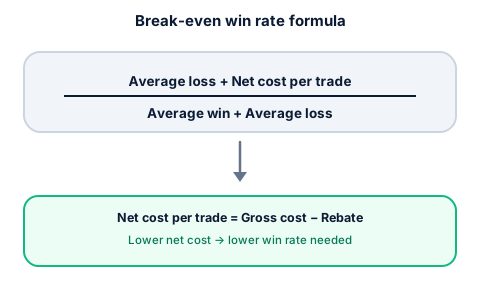
Break-even win rate = (Average loss per trade + Net cost per trade) ÷ (Average win per trade + Average loss per trade)
Where net cost per trade = gross cost per trade (spread + commission + swap) − rebate per trade. Since a rebate is paid on every closed qualifying trade regardless of outcome, it lowers the net cost term directly, which lowers the win rate needed to break even — without changing your strategy's win rate itself.
Why cost per trade shows up in a win-rate formula at all
A strategy's expectancy — its average result per trade over time — depends on how often it wins, how much it wins when it does, how much it loses when it doesn't, and what it costs to place each trade. Setting expectancy to exactly zero and solving for the win rate gives the break-even point: the minimum win percentage at which the strategy stops losing money on average. Costs like spread, commission, and swap apply whether a trade wins or loses, which is why they add directly to the numerator — a higher cost per trade always pushes the required win rate up, all else equal, and a full derivation of why the "loss plus cost" term sits over "win plus loss" follows directly from setting expected value to zero and solving for the win-rate variable.
How a rebate changes the equation
A cashback rebate is paid on every qualifying closed lot, independent of whether that specific trade won or lost — the same mechanic covered in our how forex rebates work guide. Because it applies symmetrically to wins and losses just like cost per trade does, it works as a direct offset to that same term:
Net cost per trade = Gross cost per trade − Rebate per trade
Plug the reduced net-cost figure back into the break-even formula, and the required win rate comes down. The rebate doesn't change how often your strategy wins — it changes how much winning you need to do to come out ahead.
Worked example 1 — a 1:1 reward-to-risk strategy
Illustrative inputs: average win $50, average loss $50, gross cost per trade $4 (spread and commission combined), no rebate.
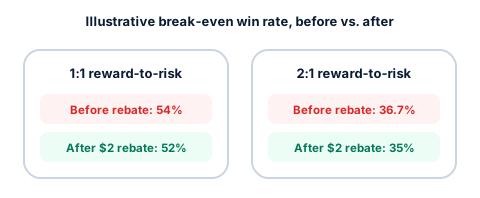
Break-even win rate = ($50 + $4) ÷ ($50 + $50) = $54 ÷ $100 = 54%
Now add an illustrative rebate of $2 per trade. Net cost per trade drops to $4 − $2 = $2.
Break-even win rate = ($50 + $2) ÷ $100 = $52 ÷ $100 = 52%
The rebate moved the required win rate from 54% down to 52% — a small but real reduction, achieved without changing the strategy's actual win rate at all.
Worked example 2 — a 2:1 reward-to-risk strategy
Illustrative inputs: average win $80, average loss $40, gross cost per trade $4, no rebate.
Break-even win rate = ($40 + $4) ÷ ($80 + $40) = $44 ÷ $120 ≈ 36.7%
With the same illustrative $2 rebate, net cost drops to $2:
Break-even win rate = ($40 + $2) ÷ $120 = $42 ÷ $120 = 35%
The absolute drop (1.7 percentage points) is similar in size to example 1, but proportionally smaller against a lower starting break-even rate — the rebate's effect is most noticeable, in relative terms, on strategies that already need a high win rate to clear their costs.
What this formula doesn't tell you
- It doesn't predict your actual win rate. The formula tells you the minimum win rate needed to break even — it says nothing about whether your specific strategy will actually achieve that rate. That depends entirely on your trading edge, which this formula doesn't measure.
- A rebate lowering your break-even point isn't a guarantee of profit. A strategy that already loses money by a wide margin can still lose money after a small reduction in its break-even win rate — the formula shows a real, calculable improvement, not a transformation into a winning strategy.
- Your real average win, loss, and cost figures matter more than any example here. Every number above is a rounded, illustrative input chosen to demonstrate the formula clearly — pull your own trading history's actual averages (see our guide to reading your trade history) for a number that means something for your own trading.
Frequently asked questions
Break-even win rate = (average loss per trade + net cost per trade) divided by (average win per trade + average loss per trade). It's the minimum win percentage a strategy needs, given its typical win/loss sizes and costs, to avoid losing money on average.
Run your own numbers
Pull your own average win, average loss, and cost-per-trade figures from your trade history, and plug them into the formula above. To see what a rebate would add back on your own monthly volume, try the cashback calculator, or register with CB-Dogs before your next trade.
Risk warning: forex and CFD trading carries a high risk of losing money. Cashback does not offset trading losses. Nothing here is investment advice.