Forex Rebates for Scalpers: What Counts and What Doesn't
How forex cashback works if you scalp: what counts as a qualifying trade, generic minimum holding-time rules, and what to check before you enroll.
By CB-Dogs Editorial7 min read
Disclosure: CB-Dogs receives an advertising (referral) fee — sometimes called an IB commission — from brokers for accounts opened or linked through us, and returns part of it to you as cashback, the same model used by cashback and points sites. This does not change your trading costs.
On this page
- The short answer
- Why minimum holding-time rules exist at all
- What actually counts toward your rebate
- Scalper vs. swing trader: same lots, same rebate
- Does scalping change your spread or execution differently under a rebate?
- Account types and commission-based accounts
- A worked example
- What to check before you sign up as a scalper
- How and when your cashback gets paid
- Related reading
- Frequently asked questions
- See what your own volume would earn
Scalpers open and close positions fast — sometimes in seconds — to capture small, frequent price moves. That trading style raises an obvious question for anyone considering a cashback program: does a trade held for 20 seconds even qualify for a rebate, or do rebate programs quietly exclude the exact style that generates the most volume?
The honest answer is "it depends on the rule your broker and IB apply," and this guide explains exactly what that rule usually looks for, why it exists, and how to find out where a specific program draws the line — without pretending there's one universal number that applies everywhere.
The short answer
Forex rebates are almost always calculated on closed trading volume (completed lots), not on how long you held a position or whether the trade won or lost. That's good news for scalpers in principle — a five-second scalp and a five-hour swing trade of the same size generate the same underlying broker commission per lot.
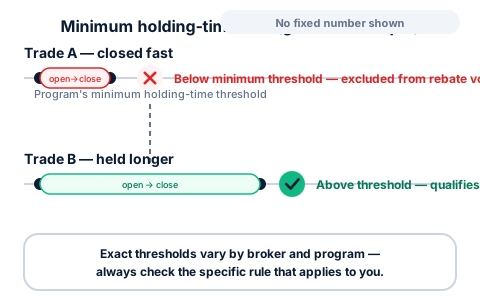
In practice, most brokers and IB programs apply a minimum holding-time rule: a trade closed faster than a stated threshold is excluded from rebate calculations, even though the trade itself is perfectly legitimate. This isn't aimed at scalping as a strategy — it exists to filter out a narrow category of abusive, near-instant open-and-close patterns that can be used to exploit pricing or rebate systems. Genuine scalping, held above the threshold, is not affected.
Why minimum holding-time rules exist at all
If a rebate paid out on every single open-and-close cycle with no minimum duration, a small number of participants could exploit that in ways that hurt the broker's pricing infrastructure — for example, opening and closing thousands of near-instant trades purely to harvest rebate volume, or exploiting brief pricing latency between a broker's own feed and the underlying market (often called latency arbitrage). Brokers police this by requiring a position to stay open for at least some minimum duration before it counts toward IB reporting, independent of whether a rebate program exists at all.
This means the rule isn't really about "scalping" as a category. A scalper who consistently holds trades for, say, one or two minutes and closes with a clear directional view is trading a legitimate short-term style. A pattern of sub-second open-and-close cycles with no real market exposure is closer to what the rule is designed to catch.
What actually counts toward your rebate
- Closed, completed trades — a rebate accrues once a position is closed, not while it's still open.
- Held above the program's minimum duration — exact thresholds vary by broker and even by account type, and published figures across the industry range widely, from under a minute to several minutes. There is no single number that applies to every broker, so always check the specific rule for your account rather than assuming one broker's terms apply to another.
- Volume, not outcome — a losing scalp and a winning scalp of the same size generate the same rebate, because the calculation is based on lots traded, not profit or loss.
- Standard account restrictions still apply — some brokers exclude certain hedged or reversed-position patterns from rebate volume, separately from the holding-time rule. These are program-specific and worth checking directly.
Scalper vs. swing trader: same lots, same rebate
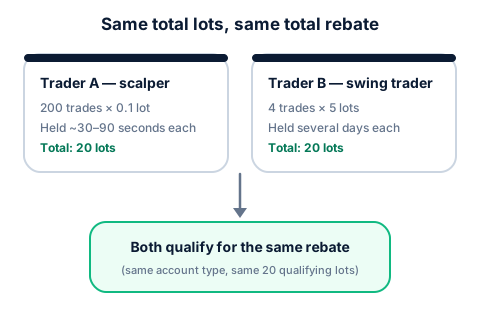
Consider two hypothetical traders in the same month, both trading a standard account:
- Trader A (scalper): 200 trades of 0.1 lot each, held for 30–90 seconds on average → 20 lots total.
- Trader B (swing trader): 4 trades of 5 lots each, held for several days → 20 lots total.
Assuming both traders' individual trades clear the program's minimum holding-time threshold, both end the month with the same 20 lots of rebate-eligible volume — and, at the same per-lot rate, the same total cashback. The rebate mechanism doesn't reward or penalize trading frequency directly; it only counts what actually clears the qualifying bar. See the current rate structure by account type:
| Account type | Rebate / lot (USDT) |
|---|---|
| StandardSpread-based account, no commission. | 9.0 |
| MicroRebate is calculated per 100,000 units of micro-lot volume (i.e. the same per-lot rate as Standard, scaled to micro-lot size). | 9.0 |
| Ultra LowLower spreads, spread-based account, no commission. | 3.0 |
| KiwamiXM's tightened-spread account tier available in select regions. | 6.0 |
| ZeroCommission-based account. Rebate is paid in addition to the raw spread — commission you pay is unaffected. | 4.5 |
Provisional rate
Does scalping change your spread or execution differently under a rebate?
No. As covered in our guide to how forex rebates work, the rebate is paid out of the broker's separate advertising (IB) commission budget, after the trade closes — it has no connection to the pricing engine. A scalper's spread, execution speed, and slippage are exactly the same whether or not they're enrolled in a cashback program. Enrolling doesn't make your fills faster or your spread tighter, and it doesn't make them worse either.
That said, scalpers are unusually sensitive to spread and execution quality in the first place, since a strategy built on small, frequent moves has less room to absorb a wide spread or slow fill. If you scalp, comparing spread and execution across account types (see our guide to lot size, pips, and spread cost) usually matters more to your bottom line than the rebate itself — the rebate is a partial offset on top of whatever your underlying trading costs already are, not a substitute for choosing a suitable account type.
Account types and commission-based accounts
Many scalpers prefer commission-based (ECN/raw-spread) accounts, since a narrower spread plus a fixed per-lot commission can be cheaper than a wider spread on a standard account at high trade frequency — the actual answer depends on your typical trade size and volume, as explained in our cost formula guide. Rebate programs generally track both account types, but the per-lot commission the broker pays its IB — and therefore the rebate — often differs between account types, since the broker's own revenue structure differs too. Check the rate for your specific account type rather than assuming a single headline number applies across the board.
A worked example
Suppose your account earns a hypothetical $4 per standard lot in cashback (a labelled example, not a real rate), and your scalping activity produces 45 qualifying standard lots in a month after excluding any trades that didn't meet the minimum holding-time rule. That would work out to $180 for the month, paid in USDT. To estimate your own numbers based on your actual trading volume:
1 standard lot = 100,000 units of the base currency.
Used only to show how the fee-free threshold applies below.
Rate used
9.0 USDT per lot
Estimated monthly cashback
90.0 USDT
Estimated yearly cashback
1080.0 USDT
If you withdrew 100 USDT today
No fee — you're at or above the 50 USDT fee-free threshold.
You would receive 100.0 USDT
Figures are estimates based on provisional rates and the trading volume you enter. They are not a guarantee of future cashback and do not account for excluded trades.
What to check before you sign up as a scalper
- The program's minimum holding-time rule, stated in its own terms, not a third-party summary.
- Whether hedged or rapidly reversed positions are excluded separately from the holding-time rule.
- Whether the account type you plan to trade is eligible — some IB programs restrict rebates to specific account types.
- How and when volume is reported — most rebate volume comes from the broker's own IB reporting, which is typically compiled after the trading period closes, not in real time.
How and when your cashback gets paid
Once your rebate volume clears, CB-Dogs pays out in USDT over the TRC20 network only. The minimum withdrawal is a small fixed amount (currently 10 USDT), with a flat 3 USDT network fee on withdrawals below 50 USDT — withdrawals of 50 USDT or more are fee-free. Your balance becomes withdrawable only after the broker has actually paid CB-Dogs the underlying commission and a short confirmation period has passed; for XM specifically, that's typically around three to four weeks from the original trade to a withdrawable balance, plus a further 7-day confirmation after crediting. This applies the same way regardless of trading style — a scalper's rebate clears on the same schedule as anyone else's.
Related reading
- Forex rebates for EA and algo traders — the same volume-based rules applied to automated, high-frequency strategies.
Frequently asked questions
No. Scalping itself isn't excluded — what typically gets excluded is a trade held for less than the program's minimum holding-time threshold, regardless of what strategy label you'd give it. A scalp held above that threshold counts the same as any other trade of the same size.
See what your own volume would earn
Minimum holding-time rules only affect trades that fall below the threshold — everything else is calculated the same way regardless of style. Try the cashback calculator with your own typical lot volume, compare account types on the XM broker page, or register to start earning cashback on your next qualifying trade.
Risk warning: forex and CFD trading carries a high risk of losing money. Cashback does not offset trading losses. Nothing here is investment advice.