Hedging and Forex Rebates: Why Opposite Positions May Be Excluded
Why some cashback programs exclude hedged or opposite-direction trades, how brokers typically define the pattern, and how to check your own account.
By CB-Dogs Editorial4 min read
Disclosure: CB-Dogs receives an advertising (referral) fee — sometimes called an IB commission — from brokers for accounts opened or linked through us, and returns part of it to you as cashback, the same model used by cashback and points sites. This does not change your trading costs.
On this page
Hedging — opening a position in the opposite direction of an existing one, sometimes on the same instrument, sometimes across correlated ones — is a normal part of how plenty of traders manage risk. It's also one of the patterns that shows up most often in the fine print of rebate programs as a possible exclusion. If you hedge and you're wondering whether that volume still counts toward your cashback, this is the honest, broker-neutral answer: it depends on the specific pattern and the specific broker, and this guide walks through why.
The short answer
A rebate is paid on qualifying closed trading volume. Most directional trading — including hedges held for a normal duration as part of a genuine risk-management approach — qualifies the same as any other trade. What some brokers exclude is a narrower pattern: near-simultaneous, offsetting positions on the same instrument that net out to little or no real market exposure, especially when opened and closed quickly. The concern isn't hedging as a concept; it's volume generated without the trader actually carrying market risk.
What "hedging" means here
Three patterns commonly get lumped together under "hedging," and they aren't treated the same way by rebate programs:
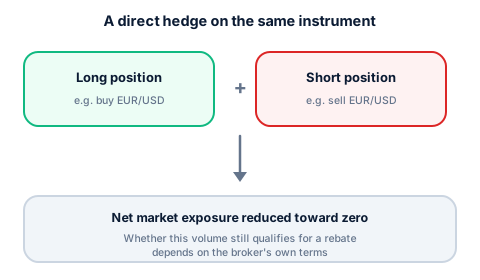
- A direct hedge on one account. Opening a buy and a sell on the same instrument, on the same account, to offset an existing position's exposure — sometimes held briefly to manage a news event, sometimes held for longer as a deliberate strategy.
- A cross-account or cross-broker hedge. Opening opposite positions on two different accounts (sometimes with two different brokers) so that gains on one side offset losses on the other. This is closer to the "self-matching" pattern our EA and algo traders guide covers as a broker account-terms issue in its own right, separate from rebate eligibility.
- A correlated-pair hedge. Opening positions on two different but historically correlated instruments (for example, two currency pairs that tend to move together) rather than the exact same instrument. This is generally treated as two independent directional trades for rebate purposes, since it isn't the same instrument netting to zero.
Why some programs draw a line here
A rebate is ultimately funded by the advertising (IB referral) fee a broker pays for real trading activity — see how forex rebates work for the full mechanics. A position that's fully offset by an opposite position on the same instrument, opened and closed almost immediately, generates trading volume without much genuine market exposure behind it. Left unchecked, that pattern could be used to manufacture rebate-qualifying volume rather than to actually hedge risk — which is why some brokers apply the same kind of scrutiny to it that they apply to ultra-short-duration scalping, covered in our rebates for scalpers guide.
This doesn't mean every hedge is suspect. A trader who opens an offsetting position to manage real risk around a specific event, and holds both legs for a normal duration, looks nothing like a pattern built purely to farm volume — and most brokers' terms are written to target the latter, not the former.
Qualifies, questionable, or excluded?
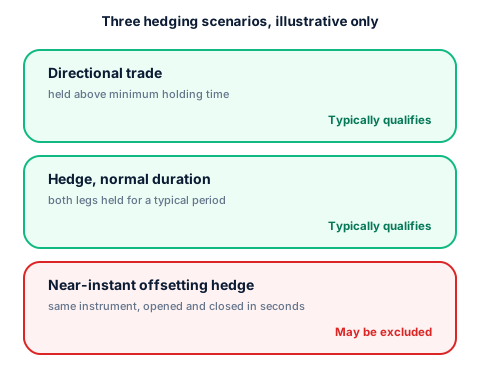
- A single directional trade, any duration above the broker's minimum holding time. Typically qualifies in full, same as any other trade.
- A hedge held for a normal duration. Typically qualifies on both legs, since it doesn't resemble the near-instant, no-exposure pattern brokers are usually targeting.
- A near-simultaneous, same-instrument hedge opened and closed within a very short window. More likely to be excluded, or reduced, under a broker's minimum-holding-time or anti-abuse terms — check the specific wording rather than assuming either outcome.
A worked example (illustrative numbers)
Suppose a trader closes 30 standard lots in a month. Of those, 25 lots were single-direction trades held for a normal duration, and 5 lots were a same-instrument buy and sell opened and closed within seconds of each other as a hedge. In this hypothetical scenario, the 25 directional lots would typically be treated as ordinary qualifying volume, while the 5 near-instant hedge lots would be the ones subject to the broker's specific hedging-exclusion terms, if any exist. These numbers are a round, illustrative example to show how the distinction is usually applied to specific trades rather than a whole account — not a quoted rate or a real broker's rule.
Does this affect your account balance or trading itself?
No. A rebate exclusion only affects the cashback calculated on that specific volume — it has no effect on your trading account, your open positions, margin, or execution. Hedging as a risk-management technique works exactly the same whether or not the resulting volume happens to qualify for cashback; the two are entirely separate systems, one run by your broker's trading platform and the other by the rebate program tracking your closed lots.
Frequently asked questions
Not automatically. Most hedges held for a normal duration qualify the same as any directional trade. What some brokers exclude is a narrower pattern — a same-instrument buy and sell opened and closed almost simultaneously — rather than hedging as a general technique.
Check your own trading pattern
If you're not sure how your own hedging activity would be treated, check your broker's current terms before assuming a specific outcome. To estimate cashback on your typical monthly volume, try the cashback calculator, or register with CB-Dogs to start tracking your own qualifying trades.
Risk warning: forex and CFD trading carries a high risk of losing money. Cashback does not offset trading losses. Nothing here is investment advice.