Pip Value for EUR/USD, GBP/USD, USD/JPY and Gold (XAU/USD): Table and Formulas
A quick-reference pip value table for EUR/USD, GBP/USD, USD/JPY and gold, plus the formulas behind each number and why gold works differently.
By CB-Dogs Editorial6 min read
Disclosure: CB-Dogs receives an advertising (referral) fee — sometimes called an IB commission — from brokers for accounts opened or linked through us, and returns part of it to you as cashback, the same model used by cashback and points sites. This does not change your trading costs.
On this page
- The short answer
- Reference table (standard lot = 1.00)
- Why gold (XAU/USD) is different
- Worked examples (illustrative numbers)
- Cross pairs: when neither currency is your account currency
- Mini and micro lots, quickly
- Why pip value matters beyond the formula
- Frequently asked questions
- Work out your own numbers
Every trading-cost calculation — spread cost, commission cost, position sizing, even reconciling a cashback statement — starts from the same building block: pip value. Get it wrong and every number downstream is wrong too. This guide gives you a fast reference table for the pairs traders ask about most (EUR/USD, GBP/USD, USD/JPY, and gold), plus the underlying formula so you can work out any pair your broker offers.
The short answer
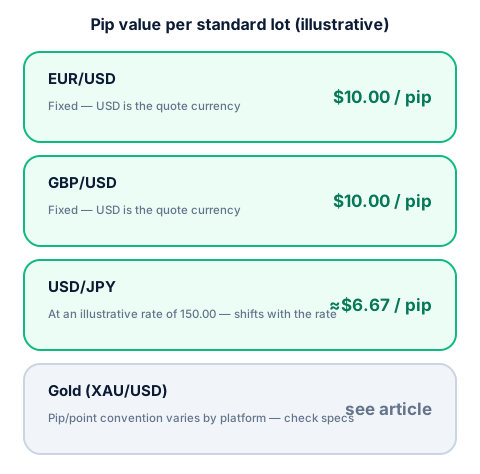
Pip value = (Pip size × Position size) ÷ Exchange rate, converted into your account currency. For a pair quoted directly in your account currency (like EUR/USD or GBP/USD in a USD account), the exchange rate term drops out and the pip value is a fixed number regardless of the current price. For pairs quoted in another currency (like USD/JPY), the pip value shifts slightly whenever that exchange rate moves. Gold (XAU/USD) uses a different pip/point size and a different contract-size convention entirely, which is why it's easy to get wrong.
Reference table (standard lot = 1.00)
| Pair | Pip size | Standard lot (100,000 units, or 100 oz for gold) | Pip value per standard lot (illustrative) |
|---|---|---|---|
| EUR/USD | 0.0001 | 100,000 EUR | $10.00 (fixed — USD is the quote currency) |
| GBP/USD | 0.0001 | 100,000 GBP | $10.00 (fixed — USD is the quote currency) |
| USD/JPY | 0.01 | 100,000 USD | ≈$6.67 at an illustrative rate of 150.00 (shifts with the rate) |
| XAU/USD (gold) | see below — convention varies | commonly 100 troy oz | see worked example below |
For any XXX/USD pair where USD is the second ("quote") currency, the math already lands in dollars, so a standard lot's pip value comes out to a flat $10.00 per pip — that's why EUR/USD and GBP/USD show the same number even though they're different currencies. For USD/JPY, the quote currency is yen, so the raw result is in yen and has to be divided by the current USD/JPY rate to convert back to dollars — which is why that number moves as the rate moves. A mini lot (0.1) is one-tenth of the standard-lot figure; a micro lot (0.01) is one-hundredth.
Why gold (XAU/USD) is different
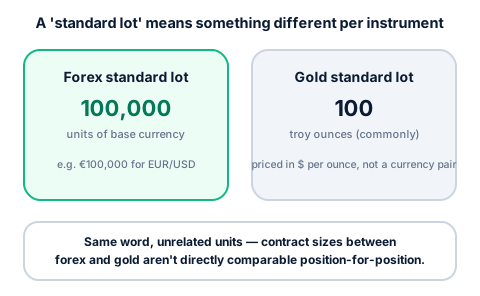
Gold trades against the US dollar as a symbol (XAU/USD), but it isn't a currency pair — it's priced in dollars per troy ounce, and a standard lot commonly represents 100 troy ounces rather than 100,000 units of a base currency. That's a different kind of "100," not the same number applied to a different asset, so contract sizes between forex and gold aren't directly comparable position-for-position.
Gold's pip/point terminology also isn't fully standardized across brokers and platforms:
- Some platforms treat a $0.01 price move as one point, so a standard lot (100 oz) is worth $1.00 per point (10 oz mini lot: $0.10 per point).
- Others call a $0.10 price move a "pip" for gold, so a standard lot is worth $10.00 per pip under that convention.
Worked examples (illustrative numbers)
EUR/USD, standard lot. Pip value: $10.00 (fixed). A 1.2-pip spread costs 1.2 × $10.00 × 1.0 lot = $12.00, using the spread-cost formula from our lot, pip and spread cost guide.
USD/JPY, standard lot, illustrative rate 150.00. Pip value: (0.01 × 100,000) ÷ 150.00 ≈ $6.67. A 1.5-pip spread costs 1.5 × $6.67 × 1.0 lot ≈ $10.00.
Gold, 0.1 lot (10 oz), illustrative price $2,400.00. Using the $0.01-per-point convention: point value = 10 oz × $0.01 = $0.10. A 30-point spread costs 30 × $0.10 = $3.00. Using the $0.10-per-pip convention instead: pip value = 10 oz × $0.10 = $1.00, and the same price move would be quoted as a 3.0-pip spread, costing 3.0 × $1.00 = $3.00 — the same real cost, described in different units. This is exactly why checking your platform's own labeling matters more than memorizing one convention.
All figures above are rounded, hypothetical inputs used to demonstrate the formulas — not a live quote, a real broker's spread, or a CB-Dogs rebate rate for any pair.
Cross pairs: when neither currency is your account currency
The table above covers the easy case, where the quote currency matches your account currency (or, for USD/JPY, where a single conversion step handles it). Cross pairs — like EUR/GBP or GBP/JPY, where the US dollar doesn't appear at all — need an extra step: convert the pip value from the quote currency into your account currency using whatever exchange rate connects the two.
For example, a standard lot of EUR/GBP has a pip value of £10.00 (since GBP is the quote currency), because the raw calculation is identical to the EUR/USD case, just with pounds instead of dollars. If your account currency is USD, that £10.00 then needs converting to dollars using the current GBP/USD rate — at an illustrative rate of 1.25, that's £10.00 × 1.25 ≈ $12.50 per pip. The extra conversion step is the only difference; the underlying pip-size and lot-size logic doesn't change.
Mini and micro lots, quickly
Since pip value scales linearly with position size, you don't need to redo the full formula for smaller sizes — just scale the standard-lot figure directly:
- Mini lot (0.10) = one-tenth of the standard-lot pip value (EUR/USD: $1.00 per pip)
- Micro lot (0.01) = one-hundredth of the standard-lot pip value (EUR/USD: $0.10 per pip)
This scaling relationship is also what makes the position-sizing formula in our position size from risk guide work — once you know a pair's standard-lot pip value, you can solve for exactly the fractional lot size that matches a chosen dollar-risk amount, rather than rounding to the nearest lot size that "feels about right."
Why pip value matters beyond the formula
Pip value isn't just a classroom exercise — it's the number underneath three things traders actually use day to day:
- Estimating trading costs. Spread cost and commission cost both scale with pip value, as covered in our cost formula guide and monthly cost calculator guide.
- Sizing a position from a risk percentage. Our guide to calculating position size from risk uses pip value directly in the sizing formula.
- Reconciling a cashback statement. Because rebates are typically paid per qualifying lot rather than per pip, pip value itself doesn't determine your rebate — but understanding contract size is the same skill you'll use when checking your own trade history, covered in our guide to verifying your rebate volume from trade history.
Frequently asked questions
Pip value = (pip size × position size) ÷ exchange rate, converted into your account currency. For a pair quoted directly in your account currency, the exchange rate term is effectively 1, so the pip value is fixed regardless of the current price.
Work out your own numbers
Use the formulas above with your platform's actual contract specification and current price to get an exact pip value for any pair you trade. To see how qualifying volume adds up over time, try the cashback calculator, or register with CB-Dogs before your next trade.
Risk warning: forex and CFD trading carries a high risk of losing money. Cashback does not offset trading losses. Nothing here is investment advice.