The Cost of Holding a Losing Position Long-Term (Swap Accumulation Explained)
An open losing forex position doesn't just sit still while you wait for it to recover — if it's held overnight, it also accrues swap every single night (including any triple-swap-day multiples), adding a growing, separate cost on top of the unrealized market loss, which makes the position's actual breakeven point move further away the longer it stays open.
By CB-Dogs Editorial7 min read
Disclosure: CB-Dogs receives an advertising (referral) fee — sometimes called an IB commission — from brokers for accounts opened or linked through us, and returns part of it to you as cashback, the same model used by cashback and points sites. This does not change your trading costs.
On this page
- The short answer
- How swap accumulates on a position you haven't closed
- Why this is different from a losing streak or a single swap-day mechanic
- Worked example (illustrative numbers)
- What this means for the position's real breakeven point
- Does a rebate apply while a losing position is still open?
- Related reading
- Frequently asked questions
- Work out your own numbers
Our cost of a losing streak guide covers how fixed trading costs add up across a sequence of separate closed trades, and our triple-swap-day guide covers one specific weekly swap mechanic in isolation. Neither addresses a different, common situation: a single position, still open, sitting at an unrealized loss, that a trader keeps holding rather than closing — and how swap keeps accruing on it every night that passes. This article walks through that specific cost, separate from a losing streak and separate from any one swap mechanic on its own.
Key takeaways
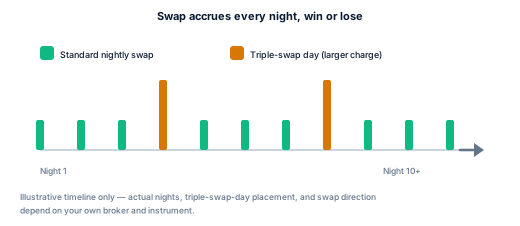
- An open position held overnight accrues swap every night regardless of whether it's currently winning or losing — a losing position doesn't pause the swap charge while you wait for the market to turn around.
- This is a different problem from a losing streak (a sequence of separate closed trades) and from the triple-swap-day mechanic on its own (one weekly multiple) — this is about one single open position's cost growing the longer it stays open.
- Swap on a losing position can run as either a credit or a debit depending on the position's direction and the current rate differential — a debit makes the total cost of eventually closing the position larger than the unrealized market loss alone.
- The longer an unrealized loss is held, the further its actual breakeven point (the price needed just to get back to even, after swap) moves from the original entry price — a distinct effect from the market loss itself.
- A cashback rebate is only credited once qualifying volume closes — it doesn't offset the ongoing cost of an open position while it remains open, and it doesn't scale with how long a losing position has been held.
The short answer
Every open position held past a broker's daily rollover cutoff accrues swap, using the mechanism covered in our swap and overnight fees guide — and that mechanism doesn't check whether the position is currently profitable before applying. A losing position that stays open for weeks or months keeps accumulating that nightly charge on top of its unrealized market loss, and if the swap runs as a debit on that position's direction, the true cost of eventually closing it is larger than the unrealized loss shown on screen at any given moment.
Total cost of a held losing position ≈ Unrealized market loss + (Swap rate × Lots × Nights held, including any triple-swap-day multiples)
How swap accumulates on a position you haven't closed
Swap is charged (or credited) once for every night a position remains open past the broker's rollover cutoff, at a rate set per lot for that specific instrument and direction. Most brokers apply a triple-swap day once a week — commonly Wednesday, to account for the weekend's non-trading days in the settlement cycle — covered in detail in our triple-swap-day guide. None of this mechanism cares whether the position is winning or losing at the time; it applies identically either way. A position held for 30 nights accrues roughly 30 nights' worth of standard swap plus around four triple-swap-day charges (depending on exactly which nights fall on the cycle), regardless of whether the underlying market loss has grown, shrunk, or stayed flat over that same period.
Why this is different from a losing streak or a single swap-day mechanic
Our cost of a losing streak guide covers a sequence of separate trades, each opened and closed, where the fixed cost on each individual trade (spread, commission, and any swap from that trade's own brief holding period) adds up across the streak. This article is about a single position that never closes — the trader keeps holding it open, commonly in the hope that an unrealized loss will recover before it's realized. The triple-swap-day guide, similarly, explains one weekly mechanic on its own; this article is about what that mechanic (plus every other night's ordinary swap) adds up to across an extended, indefinite holding period on one specific position.
Worked example (illustrative numbers)
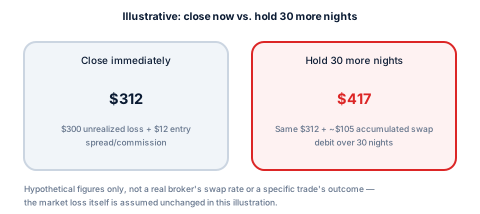
Take an illustrative 1.0 lot position on a major pair, currently sitting at an unrealized loss of $300 from where it was opened. If the trader closed it immediately, the total cost of the trade would be that $300 market loss plus whatever spread and commission were paid at entry (say, an illustrative $12, following the formula in our real monthly trading cost guide) — $312 total.
Instead, the trader holds the position for 30 more nights, hoping for a recovery. Illustrative swap on this position's direction is a debit of $3.50 per night, applied roughly 26 times as ordinary nights plus 4 additional times on triple-swap days (a simplified illustrative approximation of the weekly multiple), for a total swap cost of roughly $105 over the 30 nights. If the market hasn't moved back in the trader's favor by the time the position is finally closed, the total cost is now $312 (original entry cost and unrealized loss) + $105 (accumulated swap) = $417 — $105 more than closing immediately would have cost, with the market loss itself unchanged.
All figures above are rounded, hypothetical inputs used to demonstrate the mechanism — not a real broker's swap rate, not a real trade's outcome, and not a suggestion that any specific position will or won't recover if held longer.
What this means for the position's real breakeven point
Every night of debit swap accrued on an open position pushes its actual breakeven price — the price the market needs to reach just to get back to even, after all costs — further from the original entry price, on top of whatever the initial spread and commission already required, covered generally in our break-even pips per trade guide. This is a purely mechanical effect of holding time and doesn't depend on whether the position eventually recovers or not — it simply means "getting back to even" requires a larger favorable move the longer a debit-swap position stays open. It's a separate consideration from the unrelated risk of a sudden adverse move over a closed weekend, covered in our weekend gap risk guide, and from the account-level consequence of a large unrealized loss eating into available margin, covered in our leverage and margin guide — a large enough combined unrealized loss and accumulated swap can contribute to a margin call or stop-out well before any deliberate decision to close the position is made.
Does a rebate apply while a losing position is still open?
No, not yet — a cashback rebate is credited on qualifying closed lot volume, covered in our guide to how forex rebates work. Opening a position generates the volume, but the rebate isn't credited until that volume is closed out, regardless of how long the position stays open in the meantime or whether it's currently winning or losing. Holding a position open longer doesn't earn any additional rebate on it — the accumulating swap cost described in this article has no offsetting rebate accruing alongside it.
Related reading
- Triple swap day explained — the specific weekly mechanic behind one of the larger individual charges that accumulates as part of this article's total.
- The cost of a losing streak: how trading fees compound your drawdown — the related but distinct problem of fixed costs adding up across a sequence of separate closed trades, rather than one held-open position.
- What is negative balance protection? — the account-level safeguard relevant when an unrealized loss and accumulated swap together grow large relative to account equity.
Frequently asked questions
No. Swap is charged or credited based on the position's instrument, direction, and size, and applies the same way regardless of whether the position is currently winning or losing.
Work out your own numbers
Check your own platform's current swap rate and direction for any position you're holding, and add up the nights already held (including any triple-swap days) against the formula above for an accurate picture of the position's true accumulated cost. To see how qualifying closed volume adds up over time instead, try the cashback calculator, or register with CB-Dogs to start earning cashback on the trades you close.
Risk warning: forex and CFD trading carries a high risk of losing money. Cashback does not offset trading losses. Nothing here is investment advice.
Related articles
Cashback on your XM trades — free, paid in USDT
Sign up free