Weekend Gaps in Forex: Risk and Cost Explained
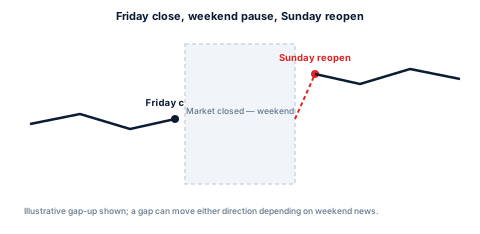
A weekend gap is the difference between a forex pair's Friday closing price and its Sunday reopening price; news during the closed period can push the market well above or below Friday's close, and a standard stop-loss can't execute at your chosen price until trading resumes.
By CB-Dogs Editorial3 min read
Disclosure: CB-Dogs receives an advertising (referral) fee — sometimes called an IB commission — from brokers for accounts opened or linked through us, and returns part of it to you as cashback, the same model used by cashback and points sites. This does not change your trading costs.
On this page
Forex trading effectively pauses over the weekend — most brokers close their platforms Friday evening and reopen Sunday evening, following the global interbank market's own schedule. Nothing stops the news cycle in between, and a weekend gap is what can happen to a pair's price as a result. This article explains the mechanism, why it's a different risk from the daily swap charge, and how traders commonly manage exposure to it.
Key takeaways
- A **weekend gap** is the price difference between a pair's Friday close and its Sunday reopen, caused by news or events during the period when the market isn't trading continuously.
- A standard stop-loss order can't execute at your chosen price during a gap — it fills at the next available price once trading resumes, which can be worse than the level you set.
- Weekend gap risk is separate from swap (overnight financing) — swap is a scheduled, calculable daily cost; a gap is an unscheduled, unpredictable price jump.
- Gap size and direction can't be reliably predicted in advance — it depends on whatever news or events occur during the closed period, which is precisely why it's treated as a risk rather than a cost.
- Common ways traders manage weekend gap exposure include closing or reducing positions before the close, using a guaranteed stop-loss where the broker offers one, or simply accepting the exposure as part of holding through the weekend.
What causes a weekend gap
A weekend gap is the difference between a currency pair's price when trading closes on Friday and the price it reopens at, typically Sunday evening — the result of news or events occurring during the period when the market isn't trading continuously. The interbank forex market runs close to 24 hours a day during the week because trading sessions in different time zones overlap continuously. That continuity breaks over the weekend, when the major financial centers are closed and retail brokers pause trading (typically from Friday evening to Sunday evening, in each broker's own local convention). Central bank statements, elections, geopolitical events, and other market-moving news don't pause along with it — when trading resumes, the first available price can reflect everything that happened in between, producing a jump rather than a gradual move.
Why a stop-loss doesn't fully protect against a gap
A standard stop-loss order is an instruction to close a position once the market trades at a specified price — it depends on the market actually reaching that price during continuous trading. During a gap, the market never trades at the levels in between Friday's close and Sunday's reopen; it simply reopens somewhere else. A standard stop-loss in that case executes at the next available price after the gap, which can be significantly worse than the level originally set — a risk sometimes called slippage through the stop. Some brokers offer a guaranteed stop-loss order, at an extra cost, that fills at the exact specified price regardless of a gap; see stop-loss types: stop, trailing, guaranteed for how that order type works and what it typically costs.
How this differs from swap
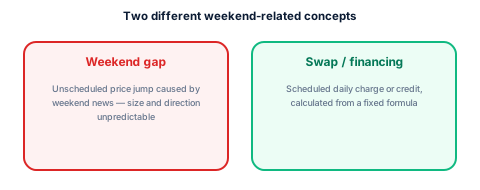
Swap (or overnight financing) is a scheduled charge or credit applied once a position is held past a specific daily rollover time, calculated from the interest-rate differential between the two currencies in a pair — see forex swap and overnight fees explained for the full formula, including the common convention of charging triple swap on one day of the week to account for the weekend. A weekend gap is an entirely different thing: an unscheduled, unpredictable price move caused by news during the market's closed period, with no fixed formula and no way to calculate it in advance. A position can be charged normal swap and still be exposed to gap risk, or vice versa — the two aren't substitutes for each other.
How traders manage weekend gap exposure
Common approaches include closing positions before the weekend close (removing the exposure entirely, at the cost of re-entering the position the following week, with its own new spread), reducing position size going into the weekend so a gap has a smaller dollar impact, and using a guaranteed stop-loss where the broker offers one for the instrument in question. Which of these — if any — makes sense depends on the trader's own risk tolerance and strategy; this article describes the options rather than recommending a specific one.
Frequently asked questions
Yes — a gap can move in either direction relative to an open position, and a position can reopen at a better price just as easily as a worse one. The unpredictability applies to direction as well as size.
Next steps
Read the swap formula that applies to any position held overnight, gap or no gap, in forex swap and overnight fees explained, review stop-loss order types in stop-loss types: stop, trailing, guaranteed, or register with CB-Dogs to earn cashback on your qualifying trading volume.
Risk warning: forex and CFD trading carries a high risk of losing money. Cashback does not offset trading losses. Nothing here is investment advice.
Related articles
Cashback on your XM trades — free, paid in USDT
Sign up free