AUD/USD Trading Costs Explained (Spread, Swap, Pip Value)
AUD/USD trading cost is built from the same three components as any major pair — spread, commission on raw-spread accounts, and swap for positions held overnight — with a standard four-decimal pip and a fixed USD pip value per lot on a USD account, but its swap and liquidity patterns are shaped by the interest-rate gap between Australia and the US and by the Asian trading session.
By CB-Dogs Editorial5 min read
Disclosure: CB-Dogs receives an advertising (referral) fee — sometimes called an IB commission — from brokers for accounts opened or linked through us, and returns part of it to you as cashback, the same model used by cashback and points sites. This does not change your trading costs.
On this page
AUD/USD is one of the most heavily traded major pairs, and its pip-value mechanics are the simplest case in our quote conventions guide: the US dollar is the quote currency, so a USD-account trader's pip value per lot is fixed regardless of the exchange rate. What isn't covered elsewhere is a full, dedicated cost breakdown for AUD/USD specifically — including the interest-rate and session dynamics that shape its swap and typical liquidity pattern. This article walks through all three cost components together with a worked example.
Key takeaways
- AUD/USD uses a standard four-decimal pip, and because the US dollar is the quote currency, its USD pip value per lot is fixed and doesn't shift with the exchange rate the way a USD-base pair's does.
- AUD/USD is a major pair with typically tight, competitive spreads, though its liquidity pattern is shaped by the Asian/Sydney session in a way that some other majors aren't.
- AUD/USD's swap reflects the interest-rate differential between Australia and the US, and Australia has, at various points, carried a notably different policy rate from the US — but this differential moves over time and isn't fixed.
- AUD/USD is commonly described as a 'commodity currency' pair, since the Australian dollar's value is often correlated with commodity export prices, adding a cost-adjacent volatility driver beyond interest rates alone.
- A cashback rebate on AUD/USD works the same way as on any other major pair: calculated on qualifying closed lot volume, not on spread, swap, or the currency's own commodity correlation.
The short answer
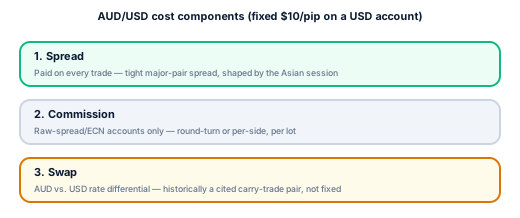
AUD/USD's trading cost is made up of the same three components as any forex pair — spread, commission (on raw-spread accounts), and swap for positions held overnight — using the standard formula and four-decimal pip convention from our lot, pip, and spread cost guide. Because USD is the quote currency, a USD-account trader's pip value per lot on AUD/USD is a fixed $10 per standard lot, the same simple case as EUR/USD or GBP/USD.
Total AUD/USD cost ≈ (Spread in pips × Pip value × Lots) + (Commission per lot × Lots) + (Swap rate × Pip value × Lots × Nights held)
Component 1: the spread
As a major pair with deep interbank liquidity, AUD/USD commonly trades with a tight typical spread, broadly comparable to other majors, though it can run somewhat wider than the very tightest USD-quoted pairs (like EUR/USD) during AUD/USD's own quieter liquidity windows. Because the Australian dollar is most actively traded during the Sydney and broader Asian session, spreads on AUD/USD can behave somewhat differently across the trading day than a purely European/US-session-driven pair — a pattern covered in general terms in our trading sessions guide, with AUD/USD's own liquidity peak sitting earlier in the 24-hour cycle than a pair like EUR/USD.
Component 2: commission
Whether AUD/USD carries a separate commission depends on account type, the same as any pair. A standard account commonly folds cost into a wider spread, while a raw-spread or ECN-style account shows a tighter spread plus a disclosed per-lot commission, following the round-turn-vs-per-side conventions in our commission guide. As a highly liquid major, AUD/USD's raw-spread pricing is commonly among the tighter figures on a broker's commission-account fee schedule, similar to other top-tier majors — check your own broker's fee schedule for the specific figure rather than assuming.
Component 3: swap
AUD/USD's swap reflects the interest-rate differential between Australia and the United States, using the same mechanism as any pair covered in our swap and overnight fees guide. Historically, Australia has at various points held a meaningfully higher central bank policy rate than the US, which made AUD/USD a commonly cited example in discussions of "carry trade" positioning — holding the higher-yielding currency to collect the rate differential as swap. That relationship isn't fixed: policy rates in both countries move over time, and the gap has narrowed, widened, and reversed across different periods, so the specific swap direction and size on your account today should be checked directly rather than assumed from any general reputation the pair has.
Worked example (illustrative numbers)
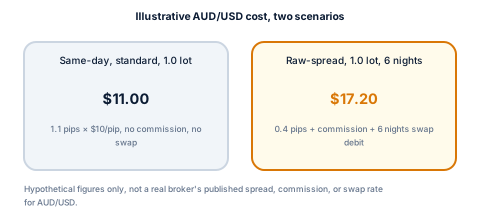
Example 1 — a same-day trade, standard account, 1.0 lot. Illustrative spread: 1.1 pips, at a fixed pip value of $10 per standard lot. Spread cost: 1.1 × $10 = $11.00, no separate commission, no swap since the position closes the same day.
Example 2 — a raw-spread account, same 1.0 lot, held 6 nights. Illustrative spread: 0.4 pips × $10 = $4.00. Illustrative commission: $6.00 per lot round turn. Illustrative swap: −$1.20 per night × 6 nights = −$7.20 (a debit in this example). Total: $4.00 + $6.00 + $7.20 = $17.20.
All figures above are rounded, hypothetical inputs used to demonstrate the formula — not a real broker's spread, commission, or swap rate for AUD/USD, and not a CB-Dogs cashback rate.
Why AUD/USD's cost profile is a little different from a Europe-centric major
Most heavily traded majors (EUR/USD, GBP/USD) see their deepest liquidity during the London and New York sessions. AUD/USD's own liquidity is more evenly spread across the day because the Australian dollar is actively traded during the Asian session as well, which can mean a somewhat different spread-widening pattern around the daily session handoffs than a purely Europe/US-driven pair. On top of that session pattern, AUD/USD carries a genuine correlation with commodity export prices and with Chinese economic conditions, adding a volatility driver that isn't present in the same way for a pair like EUR/GBP. Neither factor changes the cost formula itself — it changes how wide the spread input and how large the price-move input tend to be in practice.
Does a rebate apply to AUD/USD trades?
Cashback eligibility depends on your broker's own qualifying-instrument list, which commonly includes all major forex pairs, including AUD/USD — check your specific broker's terms via our guide to how forex rebates work. As with any pair, the rebate is calculated on qualifying closed lot volume, not on spread, commission, or swap paid, so it functions as a partial offset against your combined AUD/USD trading cost rather than a reduction of any single component.
Related reading
- Forex quote conventions: base/quote and direct/indirect explained — why AUD/USD's USD pip value per lot is fixed on a USD account.
- Forex swap and overnight fees explained — the general swap mechanism behind AUD/USD's own interest-rate-linked charge.
- EUR/GBP trading costs explained — the same three-component breakdown applied to a lower-volatility European cross for comparison.
Frequently asked questions
Yes, on a USD-denominated account. Because the US dollar is the quote currency, AUD/USD's pip value per lot is a fixed $10 for a standard lot, the same simple case as other USD-quoted majors — it doesn't shift with the exchange rate.
Work out your own numbers
Check your own platform's current AUD/USD contract specification — spread, commission structure, and swap rate and direction — and plug it into the formula above for an accurate total. To see how qualifying volume adds up over time, try the cashback calculator, or register with CB-Dogs before your next trade.
Risk warning: forex and CFD trading carries a high risk of losing money. Cashback does not offset trading losses. Nothing here is investment advice.
Related articles
Cashback on your XM trades — free, paid in USDT
Sign up free