How to Read a Forex Broker's Fee Schedule
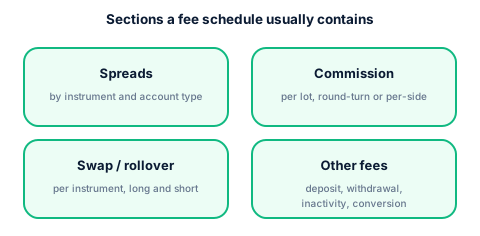
A forex broker's fee schedule typically covers spreads by instrument and account type, commission (round-turn or per-side), swap/rollover rates, and other fees, but usually leaves out slippage and the exact spread or conversion rate applied to a specific trade.
By CB-Dogs Editorial4 min read
Disclosure: CB-Dogs receives an advertising (referral) fee — sometimes called an IB commission — from brokers for accounts opened or linked through us, and returns part of it to you as cashback, the same model used by cashback and points sites. This does not change your trading costs.
On this page
Every regulated forex/CFD broker publishes a fee schedule somewhere on its site, but they're rarely written for easy comparison — different brokers use different terms for the same charge, bury some fees in a footnote, and quote others only inside the trading platform itself. This guide walks through the sections a typical fee schedule contains and what each one actually means for your costs.
Key takeaways
- A typical fee schedule covers spreads by instrument and account type, commission, swap/rollover rates, and other fees such as inactivity or withdrawal charges
- Commission can be charged round-turn (one combined charge) or per-side (charged on each leg), and comparing the two requires converting to the same unit
- A fee schedule states a broker's intended rates but does not disclose slippage or the exact spread received on a specific trade
- Swap is sometimes quoted in points rather than currency, which requires a conversion formula to compare across brokers
- Cashback rates are a separate arrangement from a broker's own fee schedule, not part of what the broker charges directly
The sections a typical fee schedule covers
- Spreads, by instrument and account type. Usually shown as "typical" or "average" spreads per instrument (e.g. EUR/USD, XAU/USD), often split by account type (e.g. standard vs. a raw/ECN-style account). "Typical" spreads can widen under real market conditions — see our guide to when spreads widen.
- Commission. If the account type charges commission, this section states the rate — usually per lot, and critically, either round-turn (one combined charge covering both entry and exit) or per-side (charged separately on each leg). These can look different at a glance while producing an identical total cost — see our round-turn vs. per-side guide for why that distinction matters when comparing brokers.
- Swap / rollover rates. Usually a per-instrument table showing the overnight charge or credit for long and short positions, sometimes quoted in points and sometimes directly in the account's currency. See our swap and overnight fee guide for the formula that converts one into the other.
- Other fees. Deposit fees (often none, but payment-method-dependent), withdrawal fees, inactivity fees after a period without trading, and currency-conversion fees if your account's base currency differs from an instrument's quote currency — see our guide to commission on non-USD accounts for how that conversion typically works.
Where a fee schedule is a real rate table
| Account type | Rebate / lot (USDT) |
|---|---|
| StandardSpread-based account, no commission. | 9.0 |
| MicroRebate is calculated per 100,000 units of micro-lot volume (i.e. the same per-lot rate as Standard, scaled to micro-lot size). | 9.0 |
| Ultra LowLower spreads, spread-based account, no commission. | 3.0 |
| KiwamiXM's tightened-spread account tier available in select regions. | 6.0 |
| ZeroCommission-based account. Rebate is paid in addition to the raw spread — commission you pay is unaffected. | 4.5 |
Provisional rate
A fee schedule for a specific broker and account type, like the one above, is the kind of document this guide is teaching you to read — actual per-account-type rates, sourced from the broker directly, rather than typed into an article's prose (which is also why CB-Dogs never hardcodes a rebate rate in an article body; rates live in one data source and are shown live).
What a fee schedule usually leaves out
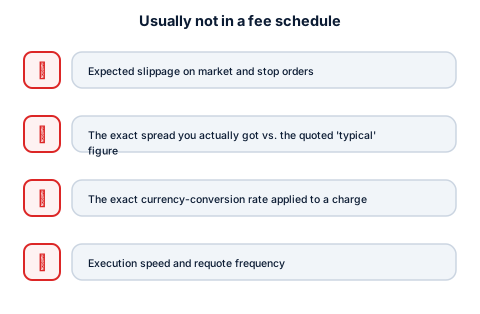
A published rate table tells you what a broker intends to charge, but a few real costs don't appear in it at all:
- Slippage. No fee schedule quotes an expected slippage figure, because it depends on market conditions at the moment of execution, not a fixed rate — see our slippage and requotes guide.
- The exact spread you actually got, versus the "typical" or "average" figure quoted. The only way to know your real spread on a given trade is to check the entry price against the market quote at that instant.
- The exact currency-conversion rate applied to a commission or swap charge on a non-USD (or non-base-currency) account, which is usually the broker's own prevailing rate at settlement time rather than a rate published in the fee schedule itself.
A worked example (illustrative)
Suppose Broker A's fee schedule lists a $3.50 per-side commission and Broker B's lists a $7.00 round-turn commission, both for a standard lot. Read individually, $3.50 looks cheaper than $7.00 — but Broker A charges $3.50 twice per trade (entry and exit), totalling $7.00, identical to Broker B's single $7.00 charge. Neither broker's fee schedule is misleading on its own terms; the trap is in comparing the two without converting to the same unit first. These figures are a round, illustrative example, not either broker's actual current rate.
Frequently asked questions
Brokers use different terminology and different units (per side vs. round-turn, points vs. currency for swap, average vs. typical spread) for functionally similar charges, which makes a line-by-line comparison misleading unless you convert everything to the same unit first.
Put a fee schedule into context
Once you can read a fee schedule confidently, the cashback calculator can help you see how a rebate offsets some of those costs on your typical monthly volume, and the XM broker page shows this site's current per-account-type rates. Register with CB-Dogs to start earning cashback on qualifying volume.
Risk warning: forex and CFD trading carries a high risk of losing money. Cashback does not offset trading losses. Nothing here is investment advice.
Related articles
Cashback on your XM trades — free, paid in USDT
Sign up free