EUR/USD vs. Gold vs. Indices: Comparing Trading Costs (A Generic Framework)
EUR/USD, gold, and index CFDs all charge spread, commission, and overnight financing in different units, so raw pip or point figures aren't comparable; converting each to a shared unit, like cost per $10,000 of notional traded, makes the comparison fair.
By CB-Dogs Editorial5 min read
Disclosure: CB-Dogs receives an advertising (referral) fee — sometimes called an IB commission — from brokers for accounts opened or linked through us, and returns part of it to you as cashback, the same model used by cashback and points sites. This does not change your trading costs.
On this page
"Which is cheaper to trade, EUR/USD, gold, or an index?" is a common question, and it doesn't have a single answer — because the three instrument classes quote their costs in completely different units. A 1-pip EUR/USD spread, a 30-point gold spread, and a 1-point index spread are not directly comparable numbers, even though all three represent a real dollar cost. This guide gives you a framework for comparing them fairly, instead of a specific verdict on which is cheapest (that depends on your broker's actual current rates, which this article deliberately does not quote).
Key takeaways
- EUR/USD, gold (XAU/USD), and index CFDs all charge some mix of spread, commission, and an overnight financing charge — the same three cost 'buckets,' just in different units
- A pip on EUR/USD, a point on gold, and a point on an index are different sizes with different dollar values, so comparing raw spread numbers across instrument classes is misleading
- Converting every instrument's cost to a shared unit — such as dollars per $10,000 of notional traded — is what makes a fair cross-instrument comparison possible
- Overnight financing on indices works like swap on forex (assessed once per night held), but the reference rate and markup convention can differ by broker and instrument
- A cashback rebate is generally calculated on qualifying closed volume regardless of instrument class, though which instruments qualify is set by each broker
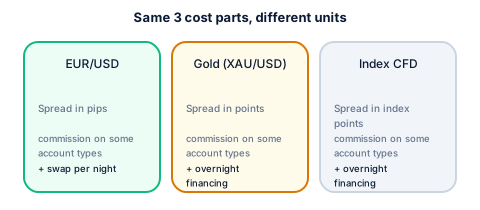
Same three cost components, three different units
Every instrument in this comparison is built from the same three underlying cost components, covered individually in our lot, pip, and spread cost guide, commission guide, and swap and overnight fee guide:
- EUR/USD (and other forex majors): spread quoted in pips, sometimes plus a per-lot commission on raw-spread account types, plus swap for positions held overnight. Pip value and lot size are standardized (100,000 units per standard lot) — see our pip value reference table.
- Gold (XAU/USD): spread quoted in points (often $0.01 or $0.10 per point depending on the platform's convention — check your own platform's contract specification), plus commission on some account types, plus an overnight financing charge. Gold's contract size (commonly 100 troy ounces per standard lot) and point value are covered in our gold trading cost guide.
- Index CFDs (a generic stock index contract — this article names no specific index or broker): spread quoted in index points, which have their own dollar value per point depending on the contract's specification (set by the broker, since index CFDs are synthetic products, not exchange-traded futures with a single universal contract size), plus an overnight financing charge that works similarly to forex swap but is usually benchmarked to a different reference rate.
Why you can't compare raw pip and point numbers directly
A 1.2-pip EUR/USD spread and a 30-point gold spread look wildly different side by side, but that comparison is meaningless without converting both to a dollar cost first, because:
- Pip and point sizes differ. A pip on EUR/USD is a fixed 0.0001 price move; a point on gold or an index is defined by that instrument's own contract specification, and isn't the same fraction of price.
- Contract (lot) sizes differ. A standard forex lot is 100,000 units of the base currency; gold's standard lot is commonly 100 troy ounces; an index CFD's contract size is set independently by each broker.
- Notional value per lot differs hugely. One standard lot of EUR/USD, one lot of gold, and one contract of an index CFD each represent a very different dollar amount of market exposure, even at the same "1 lot" label.
Because of all three, "gold's spread is 25x wider than EUR/USD's" tells you almost nothing about which is actually more expensive to trade in dollar terms.
A common unit: cost per $10,000 of notional traded
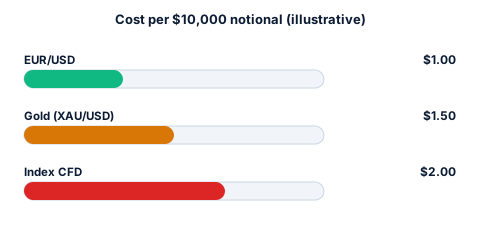
The fix is to convert every instrument's cost into the same unit before comparing. One workable unit is dollars of cost per $10,000 of notional value traded:
Cost per $10,000 notional = (Total cost in $ for one trade ÷ Notional value of that trade in $) × 10,000
Worked illustrative example (all figures rounded and hypothetical, not any broker's real rates):
- EUR/USD: a 1.0-pip spread on a standard lot ($100,000 notional) costs about $10. Cost per $10,000 notional ≈ $10 ÷ 100,000 × 10,000 = $1.00.
- Gold: a hypothetical 30-point spread on a standard lot (100 oz, notional roughly $200,000 at an illustrative $2,000/oz price) costing about $30. Cost per $10,000 notional ≈ $30 ÷ 200,000 × 10,000 = $1.50.
- Index CFD: a hypothetical 1-point spread on a contract with a notional value of roughly $50,000 costing about $10. Cost per $10,000 notional ≈ $10 ÷ 50,000 × 10,000 = $2.00.
In this illustrative example, EUR/USD comes out cheapest per dollar of exposure, gold is in the middle, and the index CFD is the most expensive — but these numbers are made up for illustration only. The real ranking on any given day depends entirely on your broker's actual current spread, commission, and contract-size figures for each instrument, which change and differ by broker.
Overnight financing works the same way, with a caveat
If you hold any of these three overnight, an overnight financing charge (called swap on forex, and usually just "overnight financing" or "holding cost" on gold and index CFDs) applies, following the same logic covered in our swap and overnight fee guide: a rate per night, applied to your position size, in either direction depending on the instrument and your position's direction. The caveat is that the underlying reference rate differs — forex swap reflects the interest-rate differential between two currencies, while gold and index financing charges are typically benchmarked to a different reference rate (often a short-term interest rate benchmark plus the broker's markup) , so you can't assume a pair's typical swap direction tells you anything about gold's or an index's financing direction.
Where cashback fits in
A cashback rebate is generally calculated on your qualifying closed trading volume, and many rebate programs — including CB-Dogs — support multiple instrument classes under one broker relationship, not forex alone. The rebate mechanics themselves (credited after the broker reports the volume, paid out in USDT) don't change based on which instrument you traded; what can change is which instruments a given broker or account type makes eligible for cashback at all, and that's a per-broker detail worth checking with the cashback calculator or the XM broker page rather than assuming it's identical across instrument classes.
Frequently asked questions
Not necessarily — it depends on the broker's actual current spread, commission, and contract size for each instrument, converted to the same unit. Gold's raw point-based spread number looks larger than a forex pip spread, but that alone doesn't tell you the real dollar cost per unit of exposure.
Put this framework to use
Once you can convert any instrument's cost to a common unit, the next step is checking what a rebate does to that cost on your own typical volume — the cashback calculator and the XM broker page show current, real per-account-type figures rather than the illustrative ones used here. Register with CB-Dogs to start earning cashback on qualifying volume across eligible instruments.
Risk warning: forex and CFD trading carries a high risk of losing money. Cashback does not offset trading losses. Nothing here is investment advice.
Related articles
Cashback on your XM trades — free, paid in USDT
Sign up free