Copy Trading Costs Explained
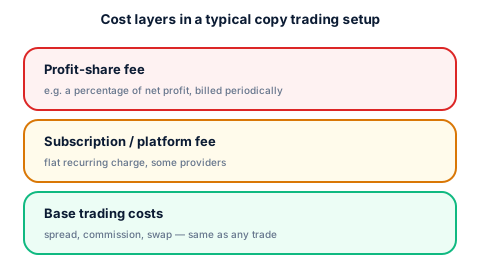
Copy trading normally adds one or more extra fee layers — commonly a profit-share fee and/or a subscription or platform fee — on top of the ordinary spread, commission, and swap costs every trade already carries.
By CB-Dogs Editorial4 min read
Disclosure: CB-Dogs receives an advertising (referral) fee — sometimes called an IB commission — from brokers for accounts opened or linked through us, and returns part of it to you as cashback, the same model used by cashback and points sites. This does not change your trading costs.
On this page
Copy trading — automatically mirroring another trader's positions in your own account — is marketed heavily on the idea of convenience, but its cost structure is usually more layered than ordinary self-directed trading. This article breaks down where those extra costs typically come from, in general, broker-neutral terms.
Key takeaways
- Copy trading still incurs the same underlying spread, commission, and swap costs as any other trade.
- Common added costs include profit-share fees, subscription or platform fees, and execution or slippage differences between the original and copied trade.
- A "free" copy trading service usually waives only one fee layer while others, like profit share, still apply.
- CB-Dogs does not offer copy trading, signal, or managed-account services — it is a cashback program only.
- Some copy trading arrangements restrict withdrawing allocated capital or impose minimum holding periods.
The base layer: ordinary trading costs still apply
Every trade a copied account places still incurs the same underlying costs as any other trade — spread, possible commission, and swap if held overnight. See our lot, pip, and spread cost guide and swap guide for the formulas. Copy trading doesn't remove these costs; it adds to them.
Common additional cost layers
- Profit-share fees. Many copy trading and signal-provider setups take a percentage of the profits generated in the copying account, often billed periodically (e.g. monthly), regardless of whether the copying trader would have made the same decisions independently.
- Subscription or platform fees. Some services charge a flat recurring fee to access a strategy or signal feed, separate from any profit share, whether or not the copied trades are profitable that period.
- Execution and slippage differences. A copied trade executes in the follower's account at a slightly different moment and often a slightly different price than the original trade, because of network latency and each account's own liquidity conditions. This isn't a disclosed "fee" line item, but it functions like one — see our slippage and requotes guide for the underlying mechanics.
- Withdrawal restrictions or minimum periods. Some copy trading arrangements restrict withdrawing allocated capital, or impose a minimum holding period, which isn't a direct monetary cost but can function as one if it forces a trader to stay exposed to a strategy longer than they'd like.
A worked example (illustrative)
Suppose a follower account generates $500 of gross profit in a month by copying a strategy. A hypothetical copy trading service might charge a 20% profit-share fee ($100) plus a $10 flat monthly platform fee, leaving $390 net of copy trading fees — before the underlying spread, commission, and swap costs that were already deducted from the $500 gross figure itself. These numbers are a round, illustrative example only, not any real provider's published rate.
Copy trading vs. trading your own account, cost-wise
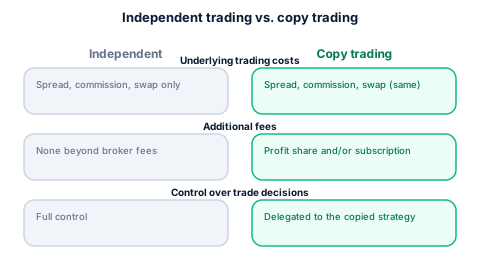
Trading your own account, with or without an EA, still incurs the same base spread/commission/swap costs — see our forex rebates for EA traders guide — but without an additional profit-share or subscription layer on top. That doesn't make one approach objectively better; it's a genuine trade-off between paying for someone else's strategy decisions and making your own, which this article takes no position on.
Comparing two providers on cost alone
Because copy trading cost structures vary so much, a like-for-like comparison usually needs at least these data points from each provider's own disclosure, not from marketing copy:
- The profit-share percentage, and the billing period it's calculated over (per closed trade, monthly, or another cycle).
- Any flat subscription or platform fee, and whether it applies even in a losing period.
- Whether the underlying broker account's spread/commission is the same as a self-directed account with that broker, or marked up specifically for copy trading clients.
- Any minimum allocation, lock-up period, or early-withdrawal penalty tied to the copied strategy.
A provider that discloses all four clearly is usually easier to evaluate honestly than one that only advertises a headline "free to copy" claim while the profit-share or platform fee sits in a separate terms page.
Where cashback fits in
A cashback program like CB-Dogs pays a rebate on qualifying closed trading volume on a linked account, calculated independently of whatever strategy produced that volume — see how forex rebates work. If a copy trading provider's own terms permit rebate registration on the underlying account (many restrict this, since the account may already be tied to their own commercial arrangement with a broker), a rebate can partly offset the base trading costs described above — but never the profit-share or subscription fees, which are unrelated to the broker's own commission/spread economics that rebates are funded from.
Frequently asked questions
No. CB-Dogs is a cashback program only — it pays a rebate on your own qualifying trading volume with a partner broker. It doesn't provide copy trading, signals, EAs, or MAM/PAMM management.
If you trade your own account
Whether or not copy trading is part of your approach, cashback on your own qualifying trading volume works the same way. Use the cashback calculator to estimate rebates, or register with CB-Dogs.
Risk warning: forex and CFD trading carries a high risk of losing money. Cashback does not offset trading losses. Nothing here is investment advice.
Related articles
Cashback on your XM trades — free, paid in USDT
Sign up free