How Brokers Calculate Commission on Non-USD Trading Accounts
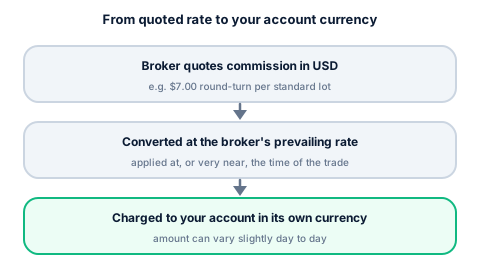
Brokers typically quote commission in one reference currency (usually USD) and convert it into your account's own currency at the exchange rate applied at the time of each trade, so the exact amount charged on a non-USD account can vary slightly day to day.
By CB-Dogs Editorial4 min read
Disclosure: CB-Dogs receives an advertising (referral) fee — sometimes called an IB commission — from brokers for accounts opened or linked through us, and returns part of it to you as cashback, the same model used by cashback and points sites. This does not change your trading costs.
On this page
Most brokers quote commission in a single reference currency — usually USD, e.g. "$7 per round-turn standard lot" — regardless of what currency your account is actually denominated in. If your account is opened in EUR, GBP, or another currency, that headline figure still applies, but a conversion step happens behind the scenes that can make your actual charge a slightly different number each time. This guide explains why.
Key takeaways
- Brokers typically quote commission in one reference currency (commonly USD), then convert it into a non-USD account's base currency at the exchange rate applied at the time of the trade
- Because exchange rates move continuously, the exact converted commission can vary slightly day to day even though the underlying quoted rate hasn't changed
- A USD-denominated account skips the conversion step and is charged the quoted commission figure exactly, with no daily variation
- Account base currency and an instrument's quote currency are two separate things that both factor into total cost, alongside pip value
- CB-Dogs pays cashback in USDT regardless of a trading account's base currency, so this conversion step doesn't affect the rebate itself
Why the quoted rate and your account currency can differ
Brokers standardize their published commission rate in one currency (commonly USD) so it's directly comparable across account types and doesn't need updating every time exchange rates move. When your account is denominated in a different currency, the broker converts that reference-currency amount into your account currency at its own prevailing exchange rate, applied at (or very close to) the moment of the trade. Because exchange rates move continuously, the exact amount debited from a EUR or GBP account for the "same" $7 commission can vary slightly from one day to the next, even though the underlying USD rate never changed.
Two different situations, easy to conflate
- Your account's base currency (the currency your balance is held and reported in) determines what currency the commission is actually deducted in.
- The instrument you're trading has its own quote currency, which may be different again — for example, a EUR-denominated account trading USD/JPY involves three currencies at once (account currency, and the two currencies in the pair) once you also account for pip value. Our pip value guide covers how pip value itself is calculated across different pairs and account currencies; commission conversion is a separate, additional step layered on top of that.
A worked example (illustrative)
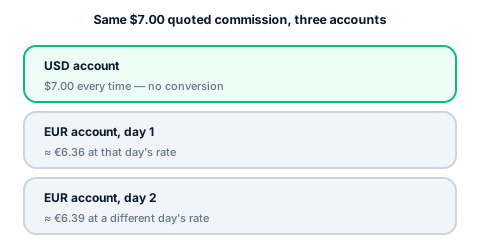
Suppose a broker's published commission is $7.00 round-turn per standard lot, and a trader's account is denominated in EUR. If the EUR/USD exchange rate used for that day's conversion is 1.1000, $7.00 converts to approximately €6.36. If the rate shifts to 1.0950 the next day, the same $7.00 headline commission converts to approximately €6.39 instead — a small difference, but a real one, and not a sign that the broker changed its rate. A USD-denominated account, by contrast, would be charged exactly $7.00 every time, with no conversion step at all. These figures are a round, illustrative example only, not any broker's actual published rate or exchange rate feed.
Does this affect cashback?
Cashback paid by CB-Dogs is settled in USDT regardless of your trading account's base currency, so the rebate itself doesn't go through this same conversion step at the point you receive it — see our USDT forex rebates guide for how that payout works. The commission-conversion mechanism described in this article affects what your broker charges you on each trade, which is a separate figure from what CB-Dogs later credits as cashback on the resulting qualifying volume; see how forex rebates work for how the two connect.
Multi-currency accounts, where offered
Some brokers let clients open sub-accounts or wallets in more than one currency, or select an account base currency that matches the reference currency their commission is quoted in (commonly USD). Choosing a matching base currency, where available, removes the conversion step described above entirely — every commission charge would simply be the quoted figure, with no daily variation from exchange-rate movement. This isn't available at every broker or for every account type, and it doesn't change the underlying commission rate itself, only whether a conversion step is layered on top of it. Whether it's worth switching account currency for this reason alone depends on how much your own trading volume makes the small day-to-day variation meaningful, which for most retail trading volumes is a minor effect rather than a significant cost difference.
What to check on your own account
- Your account's base currency, shown in your broker portal or platform account summary.
- Whether your broker's fee schedule quotes commission in USD or another reference currency — see our guide to reading a fee schedule for where this is usually listed.
- Whether commission on your account is charged round-turn or per-side — a separate distinction from the currency conversion, covered in our round-turn vs. per-side guide, that also affects the total you pay per trade.
Frequently asked questions
If your account isn't denominated in the broker's reference currency for commission (commonly USD), each charge is converted using the exchange rate applied at that trade's time, which shifts slightly day to day even when the underlying quoted rate is unchanged.
Estimate your own rebate
Regardless of your account's base currency, cashback is calculated on your qualifying closed lot volume and paid out in USDT. Use the cashback calculator to estimate rebates on your typical monthly volume, or register with CB-Dogs.
Risk warning: forex and CFD trading carries a high risk of losing money. Cashback does not offset trading losses. Nothing here is investment advice.
Related articles
Cashback on your XM trades — free, paid in USDT
Sign up free