Forex Quote Conventions: Base/Quote and Direct/Indirect Explained
In a currency pair, the first currency listed is the base and the second is the quote currency; when your account currency matches the quote currency, pip value per lot is fixed, but when it matches the base currency instead, pip value shifts with the exchange rate.
By CB-Dogs Editorial3 min read
Disclosure: CB-Dogs receives an advertising (referral) fee — sometimes called an IB commission — from brokers for accounts opened or linked through us, and returns part of it to you as cashback, the same model used by cashback and points sites. This does not change your trading costs.
On this page
Every currency pair has a fixed order — EUR/USD, not USD/EUR — and that order determines which currency is the base and which is the quote. It sounds like a labeling detail, but it directly changes the formula used to calculate pip value and, from there, spread and commission cost. This guide covers the convention and why it matters for cost math specifically.
Key takeaways
- In a pair written as EUR/USD, EUR is the **base currency** (the one being bought or sold) and USD is the **quote currency** (the one used to express the price).
- A **direct quote** expresses how much of a trader's own account currency it takes to buy one unit of a foreign currency; an **indirect quote** expresses how much foreign currency one unit of the account currency buys.
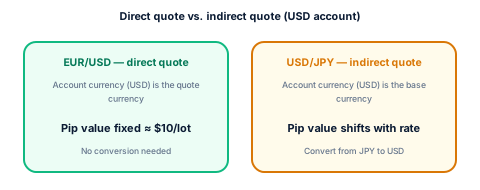
- When a trading account's currency matches the quote currency (as with EUR/USD on a USD account), pip value per standard lot is fixed at roughly $10, since the quote currency doesn't need converting.
- When the account currency matches the base currency instead (as with USD/JPY on a USD account, where USD is the base), pip value must be converted from the quote currency at the current exchange rate, and shifts as that rate moves.
- A cross pair — one that doesn't include the account's own currency at all (like EUR/GBP on a USD account) — requires converting through a third exchange rate, adding one more step to the same underlying calculation.
Base currency and quote currency
In any currency pair, the base currency is the first one listed and the quote currency (sometimes called the counter currency) is the second. EUR/USD means one euro (base) is worth however many US dollars (quote) the quoted price shows — a price of 1.10 means 1 EUR buys 1.10 USD. This ordering is a fixed market convention; the pair is never written the other way around for the same underlying exchange rate.
Direct vs. indirect quotes
From the perspective of a trader whose account is denominated in a given currency, a direct quote states how much of that account currency it takes to buy one unit of a foreign currency — for a USD account, EUR/USD (1 EUR = 1.10 USD) is a direct quote. An indirect quote states how much foreign currency one unit of the account currency buys instead — for the same USD account, USD/JPY (1 USD = 150 JPY) is an indirect quote. The distinction is about perspective, not about the pair itself: the same USD/JPY pair would be a direct quote from the perspective of a JPY-denominated account.
Why this changes the pip-value calculation
This isn't just terminology — it changes the formula. When the account currency is the quote currency (a direct quote for that account, like EUR/USD on a USD account), pip value per standard lot comes out to a fixed figure around $10, because the quote currency already matches the account currency and no conversion step is needed. When the account currency is instead the base currency (an indirect quote for that account, like USD/JPY on a USD account), the pip value is generated in the quote currency (yen) and has to be converted back to the account currency at the current exchange rate — which means it shifts slightly as that rate moves, unlike the fixed EUR/USD figure. See pip value for major pairs and gold for the worked formula and a reference table covering both cases.
Cross pairs add one more conversion step
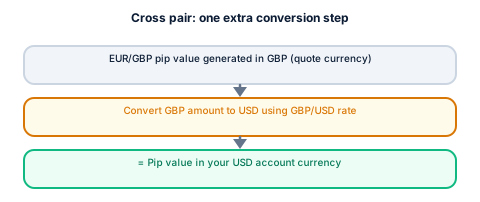
A cross pair doesn't include the account's own currency at all — EUR/GBP on a USD account is a common example. Here, pip value is generated in the quote currency (GBP, in that example) and then has to be converted to the account currency (USD) through a separate exchange rate (GBP/USD), one additional step beyond either the direct or indirect case above. This is also why cross pairs sometimes carry a slightly different spread structure than the two majors that make them up — the broker is effectively pricing two currency relationships instead of one.
Why this matters for comparing broker costs
Two brokers quoting an "identical" pip-based spread on the same pair can still produce different actual dollar costs if their pip-value or rounding conventions differ slightly, particularly on indirect-quote and cross pairs where a live exchange-rate conversion is involved. When comparing total cost across brokers or account types — including how a rebate offsets that cost — it's worth calculating pip value from the formula directly rather than assuming every pair behaves like the fixed-value EUR/USD case. See how to choose your forex account base currency for how the account currency choice itself, separate from any single pair's quote convention, affects cost calculations across your whole account.
Frequently asked questions
GBP is the base currency (the one being bought or sold) and USD is the quote currency (the one the price is expressed in), following the pair's fixed listed order.
Next steps
Work through the full pip-value formula for both quote conventions in pip value for major pairs and gold, see how account currency choice affects cost calculations in how to choose your forex account base currency, or register with CB-Dogs to earn cashback on your qualifying volume across any pair.
Risk warning: forex and CFD trading carries a high risk of losing money. Cashback does not offset trading losses. Nothing here is investment advice.
Related articles
Cashback on your XM trades — free, paid in USDT
Sign up free