How to Choose Your Forex Account Currency: USD vs. Your Local Currency
Your account's base currency mainly affects deposit/withdrawal conversion and how your statement reads, not which instruments you can trade. USD is the common default since most instruments quote in it, but there's no single correct choice, and it has no effect on cashback, always paid in USDT.
By CB-Dogs Editorial4 min read
Disclosure: CB-Dogs receives an advertising (referral) fee — sometimes called an IB commission — from brokers for accounts opened or linked through us, and returns part of it to you as cashback, the same model used by cashback and points sites. This does not change your trading costs.
On this page
Most brokers let you pick your trading account's base (or "denomination") currency at sign-up — commonly USD, EUR, or a shortlist of major currencies, and sometimes your own local currency. It's an easy decision to skip past, but it quietly affects how often your money gets converted, and at what rate. This guide walks through what the choice actually controls, and — separately — where it has no effect at all.
Key takeaways
- Your account's base currency mainly determines the currency your deposits, withdrawals, and statement balance are shown in — it doesn't restrict which instruments you can trade
- USD is the common default because most forex pairs, gold, and many indices are USD-quoted, which minimizes currency conversion on commission and swap charges
- Matching your account currency to your local currency can reduce deposit/withdrawal conversion, but may increase conversion elsewhere if the instruments you trade aren't quoted in that currency
- Every trade's profit or loss is converted into your account currency regardless of which currency the instrument itself is quoted in, so some conversion is often unavoidable either way
- Cashback is paid in USDT via TRC20 regardless of your account's base currency, so this choice has no effect on how your rebate is calculated or paid out
What base currency actually controls
Your account's base currency is the unit your balance, deposits, withdrawals, and statement are shown in. It's set once at account opening and generally can't be changed afterward without opening a new account. What it does and doesn't control:
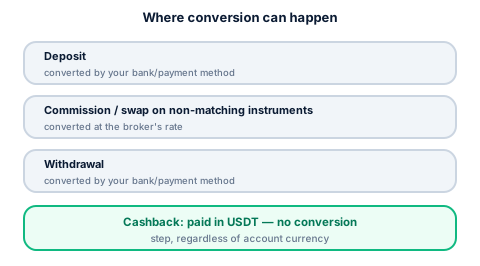
- Deposits and withdrawals are converted into and out of your account currency by your payment method or bank, at whatever rate they apply at that moment — unrelated to your broker's own trading conversion rates.
- Commission and swap charges are usually quoted by the broker in USD (or occasionally in the instrument's own quote currency) and then converted into your account currency at the broker's prevailing rate — see our guide to commission on non-USD accounts for exactly how that conversion works.
- Trading profit and loss on any instrument not already quoted in your account currency gets converted when the position closes, again at the broker's prevailing rate at that moment.
What it does not control: which instruments you can trade (nearly all brokers let any account currency trade any available instrument), your spread or commission rate itself, or — as covered below — your cashback.
Why USD is the common default
Most forex majors are quoted with USD on one side (EUR/USD, GBP/USD, USD/JPY), gold is conventionally quoted in USD (XAU/USD), and a large share of index CFDs are also USD-denominated. Choosing USD as your account currency means fewer of your trades require a currency conversion step at all, which can mean slightly more predictable commission and swap amounts from trade to trade (since there's no daily exchange-rate variation layered on top). This is the main reason USD is the most common default account currency offered, even for traders who don't live in a country that uses USD day to day.
When your local currency might make more sense
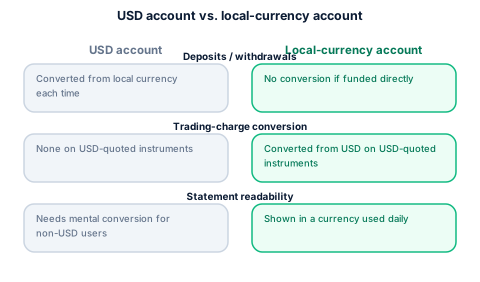
| USD account | Local-currency account | |
|---|---|---|
| Deposits/withdrawals in local currency | Converted each time, by your bank or payment method | No conversion needed if funding directly in that currency |
| Commission/swap on USD-quoted instruments | No conversion (already matches) | Converted from USD at the broker's rate |
| Statement readability | Requires mental conversion if you don't think in USD | Balance and P/L shown in a currency you use daily |
| Availability | Offered by nearly every broker | Not every broker offers every local currency as an account option |
If you fund and withdraw frequently and your bank already charges a spread on USD conversion, a local-currency account can reduce how often that conversion happens. If most of what you trade is USD-quoted, a USD account reduces conversion on the trading side instead. There's no single correct answer — it's a trade-off between where you'd rather absorb the conversion, not a way to eliminate it.
Where this choice has no effect: cashback
Regardless of which account currency you choose, CB-Dogs cashback is credited and withdrawn as USDT on the TRON network (TRC20) — see our USDT forex rebates guide for the full payout mechanics. Your qualifying lot volume is calculated the same way whether your account is denominated in USD, EUR, or your own local currency; the broker reports volume in lots, not in your account's currency, so there's no conversion step in the rebate calculation itself. This is one part of the setup you genuinely don't need to optimize around — pick your account currency based on deposit/withdrawal and trading-conversion convenience, and treat cashback as a separate, currency-agnostic layer on top.
Related reading
- How to convert USDT to local currency safely — what happens after conversion, once you turn your USDT rebate into local currency.
- Forex quote conventions: base/quote and direct/indirect explained — the related base-currency concept that applies to a currency pair's quote, not your account.
Frequently asked questions
Generally no — base currency is set at account opening and typically can't be changed afterward. Switching currencies usually means opening a new account, which most brokers allow alongside your existing one.
Next steps
Once your account currency is set, the cashback calculator shows how a rebate applies to your typical volume regardless of that choice, and our USDT wallet setup guide covers preparing to receive cashback payouts. Register with CB-Dogs to start earning cashback on qualifying volume.
Risk warning: forex and CFD trading carries a high risk of losing money. Cashback does not offset trading losses. Nothing here is investment advice.
Related articles
Cashback on your XM trades — free, paid in USDT
Sign up free