Forex Trading Across Time Zones: A Practical Guide for Expats
Trading forex as an expat mainly means translating market-session times and your broker's server time into your own local clock, so you know when spreads widen, when news lands, and when rollover falls in your day.
By CB-Dogs Editorial4 min read
Disclosure: CB-Dogs receives an advertising (referral) fee — sometimes called an IB commission — from brokers for accounts opened or linked through us, and returns part of it to you as cashback, the same model used by cashback and points sites. This does not change your trading costs.
On this page
Moving abroad doesn't change how forex markets work, but it does change when they line up with your day. A session that used to open at breakfast can now open after midnight, and a rollover time that never mattered before can suddenly land right in the middle of your evening. This guide is a practical checklist for adjusting your trading routine to a new time zone — not country-specific advice, since the same principles apply wherever an expat happens to relocate.
Key takeaways
- Forex trading sessions (Sydney, Tokyo, London, New York) run on fixed UTC hours — what changes when you move abroad is only how those hours map onto your own local clock.
- Your broker's platform typically displays times in the broker's own server time zone, which is usually different from both your home country's and your new local time zone — always confirm this mapping rather than assuming.
- Major news releases and the daily rollover/swap cutoff keep the same UTC timing regardless of where you live, so relocating can shift them from a convenient hour to an inconvenient one, or the reverse.
- None of this changes how cashback is calculated — qualifying volume and rebates are based on your closed lots, not on what time zone or country you trade from.
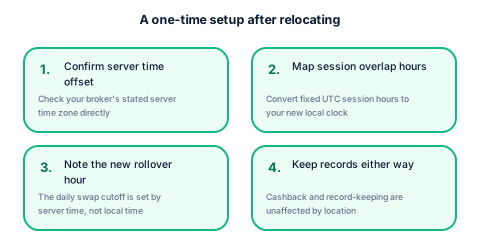
- A simple one-time setup (confirming server time offset, session overlap hours, and rollover time in your new local clock) avoids most time-zone-related surprises going forward.
Sessions don't move — you did
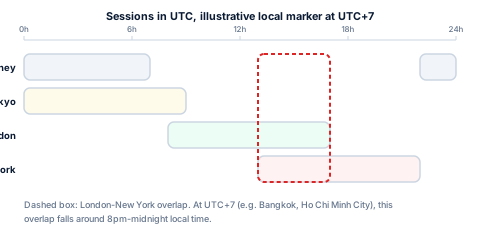
The four major forex trading sessions run on fixed hours in UTC, described in full in forex trading sessions and when spreads widen. Relocating doesn't change those hours at all — it only changes what time they fall at on your own local clock. A trader who moves from a UTC−5 time zone to a UTC+7 one (Bangkok and Ho Chi Minh City, for example, both run on UTC+7) will find that the London-New York overlap, which used to land in their afternoon, now falls well after midnight local time.
Check your broker's server time first
Most trading platforms display order and chart times in the broker's own server time zone, which is a separate thing again from both UTC and your local time. It's common for a broker's server time to sit at a fixed offset from UTC (often aligned to a specific financial center, sometimes adjusted for that region's daylight-saving convention even if your own location doesn't observe one) — the only reliable way to know your specific broker's current offset is to check its stated server time directly, since this can change with daylight-saving transitions at different times of year in different places.
What actually changes for an expat trader, practically
- When you're awake for news and session opens. A release that used to land mid-morning might now land in the middle of the night. If your strategy depends on being active around specific news windows, this is worth planning around deliberately rather than discovering by accident.
- When you're asleep during open positions. Holding a position overnight now means "overnight" in your new local time, which may or may not overlap with the market's most volatile hours — worth checking if your risk tolerance for holding through news or rollover assumed your old schedule.
- VPS or always-on trading setups become more relevant for strategies that need to react during hours you're now asleep, since manually monitoring around a shifted clock is harder to sustain long-term.
- Local internet and power reliability can matter more in some locations than others — a factor entirely separate from time zones, but one expats relocating to a new market sometimes encounter for the first time.
Thailand and Vietnam as an example, not a special case
Traders relocating to destinations like Thailand or Vietnam (both commonly UTC+7) sometimes ask whether trading works differently there. Mechanically, it doesn't: the same session hours, the same rollover mechanics, and the same cashback calculation apply as they would from any other location — only the local-clock mapping changes, exactly as it would after a move anywhere else. This article treats those two countries purely as a neutral time-zone example, not as a region with different rules; always confirm your own broker's and CB-Dogs' current eligibility terms for your specific country of residence at the eligibility page before relying on anything trading-related after an international move.
What doesn't change
Cashback eligibility and calculation are entirely unaffected by time zone or physical location (subject to your country of residence being an eligible one under CB-Dogs' terms) — a lot closed at 3 a.m. local time counts exactly the same as one closed at 3 p.m., since qualifying volume is based on the trade itself, not when or where you happened to be sitting when you placed it. See how forex rebates work for the underlying mechanics.
Frequently asked questions
The rebate rate itself doesn't change based on location — it's set by broker and account type. What can change is whether you remain eligible to register or hold an account at all, which depends on your current country of residence under CB-Dogs' and the broker's own terms; check the eligibility page after any move.
Next steps
See forex trading sessions and when spreads widen for the underlying session-hour mechanics, and forex swap and overnight fees explained for how the rollover cutoff works. Register with CB-Dogs so your cashback keeps accruing on every qualifying lot, wherever in the world you happen to be trading from.
Risk warning: forex and CFD trading carries a high risk of losing money. Cashback does not offset trading losses. Nothing here is investment advice.
Related articles
Cashback on your XM trades — free, paid in USDT
Sign up free