Contract Size, Lot Size and Margin: A Worked Example for Beginners
Contract size is the fixed unit amount a broker assigns to one lot of an instrument — 100,000 units of the base currency for a standard forex lot, commonly 100 troy ounces for gold — and required margin equals lot size times contract size times price, divided by leverage.
By CB-Dogs Editorial6 min read
Disclosure: CB-Dogs receives an advertising (referral) fee — sometimes called an IB commission — from brokers for accounts opened or linked through us, and returns part of it to you as cashback, the same model used by cashback and points sites. This does not change your trading costs.
On this page
- The short answer
- What contract size actually is
- Notional value: the real exposure before leverage
- Required margin: the same formula, every instrument
- Why this distinction matters for beginners
- Does a rebate apply the same way across instruments?
- Related reading
- Frequently asked questions
- Work out your own numbers
"Lot size" gets most of the attention in beginner guides, but it's only half of what actually determines a position's real size and margin requirement. The other half is contract size — the fixed unit amount a broker assigns to one full lot of a given instrument — and it's different for forex, gold, indices, and oil. This guide walks through what contract size means for each, and how it combines with lot size and leverage in the required-margin formula.
Key takeaways
- Contract size is the fixed unit amount one full lot represents — 100,000 units of the base currency for a standard forex lot, commonly 100 troy ounces for gold, and a broker-defined per-point value for index and commodity CFDs.
- Notional value = lot size × contract size × price — this is the real market exposure a position controls, before leverage enters the picture at all.
- Required margin = (lot size × contract size × price) ÷ leverage — the same formula applies to every instrument, once you know that instrument's own contract size.
- Mixing up contract sizes across instruments is a common beginner mistake — a 1.0 lot position on gold is not the same notional exposure as a 1.0 lot position on a forex pair.
- A rebate is calculated on qualifying closed lot volume, using the instrument's own lot convention — it doesn't change the margin formula in any way.
The short answer
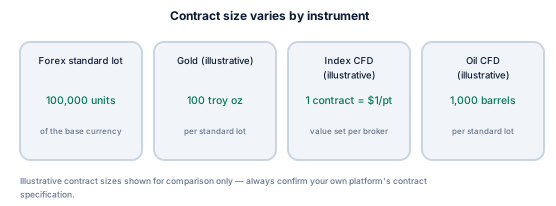
Contract size is the fixed quantity of an underlying asset that one full lot represents. For a standard forex lot, that's 100,000 units of the base currency. For gold, it's commonly 100 troy ounces per standard lot, though this varies by broker. Index and commodity CFDs typically define contract size as a fixed dollar value per point of price movement, set by the broker rather than tied to a physical unit.
Required margin = (Lot size × Contract size × Price) ÷ Leverage
What contract size actually is
A lot is a standardized trading unit, and contract size is what that unit is worth in the underlying asset. The two terms are easy to conflate because "lot size" is often used loosely to mean both "how many lots you're trading" and "how big one lot is" — this article uses lot size strictly for the first meaning (0.01, 0.10, 1.00, etc.) and contract size for the second (what one full lot, 1.00, actually represents).
- Forex: a standard lot's contract size is 100,000 units of the base currency (the first currency in the pair). A mini lot (0.10) is 10,000 units; a micro lot (0.01) is 1,000 units.
- Gold (XAU/USD): commonly 100 troy ounces per standard lot, though this is set by each broker and isn't universal — see our gold trading costs guide for how this feeds into gold's own cost structure.
- Index CFDs: typically defined as a fixed dollar (or other base-currency) value per point of index movement, rather than a physical unit count — for example, an illustrative $1 per point per 1.0 lot.
- Oil and other commodity CFDs: often expressed in barrels or a similar physical unit per standard lot, again set by the individual broker.
Notional value: the real exposure before leverage
Notional value = Lot size × Contract size × Price
This is the actual market exposure a position controls — the dollar (or other currency) amount that's moving with the market, independent of how much of your own capital was required to open it. Leverage doesn't change notional value at all; it only changes how much margin is required to control that same notional value, a distinction covered in full in our leverage and margin guide.
Worked example: notional value across three instruments
Forex — 1.0 standard lot of EUR/USD at 1.1000. Notional value = 100,000 × 1.1000 = $110,000.
Gold — 1.0 standard lot at an illustrative $2,000/oz, 100 oz contract size. Notional value = 100 × $2,000 = $200,000.
Oil — 1.0 standard lot at an illustrative $80/barrel, 1,000-barrel contract size. Notional value = 1,000 × $80 = $80,000.
All three are "1.0 lot" positions, but their real market exposure is meaningfully different — a beginner comparing "1 lot of gold" to "1 lot of EUR/USD" as if they carry equivalent risk is comparing three different contract sizes without realizing it.
Required margin: the same formula, every instrument
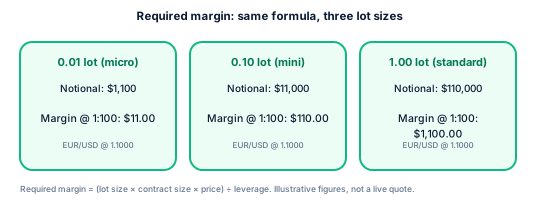
Required margin = (Lot size × Contract size × Price) ÷ Leverage, which is the same formula as notional value divided by leverage. Using the EUR/USD example above at 1:100 leverage:
- 0.01 lot: notional $1,100 ÷ 100 = $11.00 required margin.
- 0.10 lot: notional $11,000 ÷ 100 = $110.00 required margin.
- 1.00 lot: notional $110,000 ÷ 100 = $1,100.00 required margin.
Margin scales linearly with lot size once contract size and price are fixed — doubling the lot size doubles both notional value and required margin. See our lot size calculator guide for how a calculator tool automates this same arithmetic across different instruments and account currencies.
Why this distinction matters for beginners
A trader who only thinks in terms of "lots" without separating out contract size can make sizing mistakes that have nothing to do with their actual risk tolerance — for example, assuming a 0.5 lot gold position and a 0.5 lot EUR/USD position carry roughly comparable exposure, when in fact gold's contract size and price level typically produce a larger notional value per lot. This matters most when moving between instruments for the first time, or when comparing position sizes across a portfolio that includes more than one asset class.
Our guide to calculating position size from risk percentage covers the separate question of how large a position should be given your account balance and stop-loss distance — contract size is what makes that formula's pip-value input correct for the specific instrument you're trading, rather than an assumption carried over from forex.
Does a rebate apply the same way across instruments?
Cashback eligibility and calculation both depend on your broker's own qualifying-instrument list and how it defines a qualifying lot for each one — covered in general in our guide to how forex rebates work. Since forex, gold, and other CFDs can use different contract sizes, a "lot" of one instrument isn't automatically equivalent to a "lot" of another for rebate purposes either — check your specific broker's rate schedule per instrument rather than assuming a single rebate-per-lot figure applies everywhere.
Related reading
- Forex leverage and margin explained — the full margin-level, margin-call, and stop-out mechanics that build on the required-margin formula in this article.
- Gold (XAU/USD) trading costs explained — how gold's own contract size and pip convention feed into its spread, commission, and swap cost.
- Lot size, pip, and spread cost explained — how contract size also determines pip value, separate from the margin question in this guide.
- Forex lot size calculator explained — turning a risk amount and stop-loss into a standard, mini, or micro lot size.
Frequently asked questions
Contract size is the fixed quantity of the underlying asset that one full (1.00) lot represents. For a standard forex lot, that's 100,000 units of the base currency. It's set by each broker and instrument, and it's separate from lot size, which is how many lots you choose to trade.
Work out your own numbers
Check your own platform's contract specification for the instrument you trade, and plug its contract size into the formula above alongside your lot size, the current price, and your account's leverage. To see how qualifying volume across instruments adds up over time, try the cashback calculator, or register with CB-Dogs before your next trade.
Risk warning: forex and CFD trading carries a high risk of losing money. Cashback does not offset trading losses. Nothing here is investment advice.
Related articles
Cashback on your XM trades — free, paid in USDT
Sign up free