Forex Lot Size Calculator Explained: Standard, Mini, and Micro Lots
A standard lot is 100,000 units of the base currency, a mini lot is 10,000 (one-tenth), and a micro lot is 1,000 (one-hundredth); a lot size calculator converts a risk amount and stop-loss distance into the largest lot size that keeps a loss at or under that amount.
By CB-Dogs Editorial5 min read
Disclosure: CB-Dogs receives an advertising (referral) fee — sometimes called an IB commission — from brokers for accounts opened or linked through us, and returns part of it to you as cashback, the same model used by cashback and points sites. This does not change your trading costs.
On this page
A "lot" is just a fixed unit of trade size in forex — but standard, mini, and micro lots represent very different amounts of real market exposure, and mixing them up is one of the most common ways new traders end up risking far more (or far less) than they intended. This guide explains exactly what each lot size represents and how a lot size calculator turns an account risk amount into a specific position size.
Key takeaways
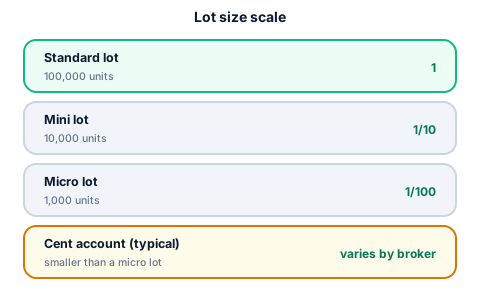
- A standard lot is 100,000 units of the base currency, a mini lot is 10,000 units (one-tenth of a standard lot), and a micro lot is 1,000 units (one-hundredth)
- Lot size directly scales pip value — a standard lot's pip value is 10x a mini lot's and 100x a micro lot's, for the same currency pair
- A lot size calculator's core job is converting an account risk amount and a stop-loss distance (in pips) into the largest position size that keeps a loss at or under that risk amount
- Smaller accounts commonly use mini or micro lots (or a cent account) specifically because standard-lot position sizes would make normal risk management impossible on a small balance
- Cashback rebates are generally calculated on total qualifying lot volume regardless of whether it comes from one standard lot or the equivalent in mini or micro lots
What each lot size actually represents
A "lot" is a standardized trade size, expressed as a multiple of the base currency's units:
| Lot type | Units of base currency | Fraction of a standard lot |
|---|---|---|
| Standard lot | 100,000 | 1 |
| Mini lot | 10,000 | 1/10 (0.1) |
| Micro lot | 1,000 | 1/100 (0.01) |
Some brokers also offer cent accounts, where the account itself is denominated in cents rather than the standard currency unit, effectively allowing even smaller position sizes than a micro lot — see our forex cent accounts guide for how that scaling works and what it means for cashback. The 100,000-unit figure above is itself the contract size for a standard forex lot — see our contract size, lot size and margin guide for how that combines with leverage to set required margin, and how it differs for gold, indices, and oil.
Lot size scales pip value directly, using the pip value formula from our lot, pip, and spread cost guide: pip value = pip size × position size ÷ exchange rate (for pairs where the quote currency isn't your account currency). For a EUR/USD-style pair, that works out to roughly:
- Standard lot (100,000 units): about $10 per pip
- Mini lot (10,000 units): about $1 per pip
- Micro lot (1,000 units): about $0.10 per pip
These figures are illustrative — the pip value for a specific pair also depends on the current exchange rate; see our pip value reference table for major-pair and gold figures.
What a lot size calculator actually does
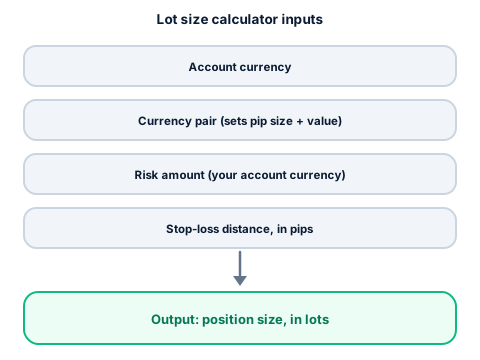
A lot size calculator takes a handful of inputs and works backward to a position size:
- Account currency — needed to convert pip value into your own currency if the pair doesn't already quote in it.
- Currency pair — determines the pip size and, combined with the current exchange rate, the pip value per lot.
- Risk amount — how much you're willing to lose on this specific trade, usually expressed in your account currency or as a percentage of account balance.
- Stop-loss distance, in pips — how far from your entry price your stop-loss is placed.
From these four inputs, the calculator applies the same core formula covered in detail in our position sizing from risk guide:
Position size (in lots) = Risk amount ÷ (Stop-loss in pips × Pip value per lot)
The result is a lot size — but the calculator (or you, manually) then has to decide which unit to express it in. A result of "0.34 lots," for example, is 0.34 of a standard lot, which most platforms let you enter directly; a broker without fractional-standard-lot support might require rounding to the nearest mini or micro lot instead, which is exactly where understanding the unit conversions above matters.
Worked example (illustrative)
Suppose a hypothetical trader has a $2,000 account, is willing to risk $40 (2%) on a trade, and places a 40-pip stop-loss on a EUR/USD-style pair with an illustrative pip value of $10 per standard lot:
Position size = $40 ÷ (40 pips × $10) = $40 ÷ $400 = 0.10 lots
0.10 standard lots is exactly 1 mini lot — so this trader could place the trade as either "0.10 standard lots" or "1.0 mini lot" on a platform that separates the two units, with an identical result. A trader with a smaller $200 account risking the same 2% ($4) with the same 40-pip stop would need 0.01 standard lots (1 micro lot) — a position ten times smaller, which is exactly the kind of precision a standard-lot-only platform without micro or mini support can't offer.
Why lot size matters for cashback too
Cashback is generally calculated on total qualifying closed lot volume, not on the number of trades or which lot-size unit you used to place them. Ten micro-lot trades (0.01 lots each) add up to the same 0.10 lots of qualifying volume as a single mini-lot trade — the rebate math doesn't care how you split the size up, only the total. This is worth knowing if you're deliberately sizing down to micro lots while building account size or testing a strategy: your qualifying volume, and the resulting cashback, still accumulates proportionally. See our how forex rebates work guide for the full mechanics of how qualifying volume becomes a payout.
Frequently asked questions
A mini lot is 10,000 units of the base currency (one-tenth of a standard 100,000-unit lot); a micro lot is 1,000 units (one-hundredth of a standard lot, or one-tenth of a mini lot).
Put it into practice
Once you know which lot size fits your risk amount, the cashback calculator can show how a rebate applies to your typical monthly lot volume, and the XM broker page lists current per-account-type rates. Register with CB-Dogs to start earning cashback on qualifying volume, at any lot size.
Risk warning: forex and CFD trading carries a high risk of losing money. Cashback does not offset trading losses. Nothing here is investment advice.
Related articles
Cashback on your XM trades — free, paid in USDT
Sign up free