Position Sizing and Trading Costs: Why Your Risk-Based Lot Size Needs an Adjustment
The standard position-size formula (risk amount divided by stop-loss pips times pip value) doesn't include spread or commission, so the real dollar loss if a stop-loss is hit is slightly larger than the intended risk; adding spread and commission, converted to pips, into the stop-loss distance corrects for this.
By CB-Dogs Editorial6 min read
Disclosure: CB-Dogs receives an advertising (referral) fee — sometimes called an IB commission — from brokers for accounts opened or linked through us, and returns part of it to you as cashback, the same model used by cashback and points sites. This does not change your trading costs.
On this page
- The short answer
- Why the standard formula understates real risk
- Building the adjusted formula
- Worked example
- A quick way to estimate the adjustment without recalculating every trade
- Is this adjustment necessary for everyone?
- How margin fits in separately
- Does a rebate offset this gap?
- Related reading
- Frequently asked questions
- Work out your own numbers
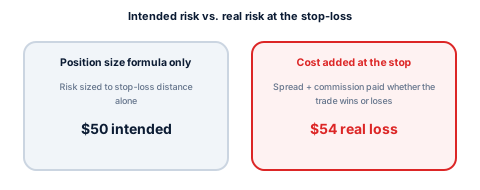
Our guide to calculating forex position size from risk percentage covers the standard formula: risk amount divided by stop-loss distance in pips, divided by pip value. That formula is correct as far as it goes — but it quietly assumes the only cost of being wrong is the stop-loss distance itself. In practice, spread and commission are paid whether the trade wins or loses, which means the real dollar loss at a stop-out is slightly larger than the "intended" risk the formula produces. This article shows the adjustment.
Key takeaways
- The standard position-size formula sizes to stop-loss distance alone — it doesn't include spread or commission, which are paid regardless of outcome.
- Real loss at a stop-out = (stop-loss distance + spread + commission-in-pips) × pip value × lot size — larger than the stop-loss distance alone suggests.
- Adding spread and commission (converted to pips) into the stop-loss distance before solving for lot size keeps your real risk at your intended percentage.
- The adjustment is usually small in percentage terms for a wide stop-loss, and proportionally larger for a tight stop-loss.
- A rebate, where it applies, offsets part of this same cost on a per-lot basis — it doesn't change the position-sizing math itself, but it does reduce the net effect of the adjustment.
The short answer
Unadjusted position size = Risk amount ÷ (Stop-loss pips × Pip value per lot). This is the formula from our position-sizing guide, and it sizes correctly to the price move you're risking — but not to your total dollar loss, because it leaves out spread and commission, which are paid on every trade regardless of whether the stop-loss is hit.
Adjusted position size = Risk amount ÷ ((Stop-loss pips + Spread pips + Commission-in-pips) × Pip value per lot).
Why the standard formula understates real risk
When a stop-loss is hit, the actual loss isn't just "stop-loss distance × pip value × lot size" — it also includes the spread paid to enter (and often exit) the position, and any commission charged on the round turn, both covered in our guides to lot, pip, and spread cost and commission per lot. The standard position-sizing formula treats the stop-loss distance as if it were the entire cost of being wrong, when in practice it's the largest component but not the only one.
Building the adjusted formula
The fix is to fold spread and commission into the stop-loss distance before solving for position size, using the same pip-conversion approach from our break-even pips guide:
- Convert commission to pips: Commission per lot ÷ Pip value per lot.
- Add spread (already in pips), commission-in-pips, and the stop-loss distance together to get an adjusted "effective stop distance."
- Solve for lot size using the adjusted distance: Position size = Risk amount ÷ (Effective stop distance × Pip value per lot).
This produces a slightly smaller position size than the unadjusted formula — which is the point: it keeps your real dollar loss at a stop-out closer to your intended risk amount, rather than letting cost push it slightly higher every time.
Worked example
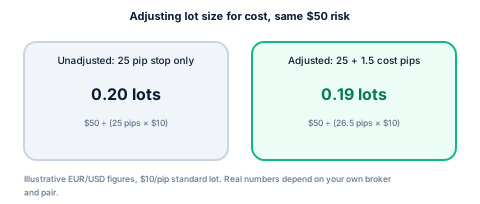
Illustrative inputs: $5,000 account, 1% risk ($50), 25-pip stop-loss, EUR/USD, $10 pip value per standard lot, spread 1.2 pips, commission $3 per lot ($0.30 in pips at this pip value).
Unadjusted: Position size = $50 ÷ (25 × $10) = 0.20 lots. If the stop-loss is hit exactly, and spread/commission are added on top, real loss ≈ (25 + 1.2 + 0.3) × $10 × 0.20 = 26.5 × $10 × 0.20 = $53, not $50.
Adjusted: Effective stop distance = 25 + 1.2 + 0.3 = 26.5 pips. Position size = $50 ÷ (26.5 × $10) = 0.19 lots. Real loss at the stop-out ≈ 26.5 × $10 × 0.19 ≈ $50.35 — much closer to the intended $50.
The adjustment reduced position size by roughly 5% in this example, bringing real risk back in line with the intended 1%.
A quick way to estimate the adjustment without recalculating every trade
Rather than recalculating spread and commission in pips for every single trade, many traders find it faster to compute a rough "typical cost in pips" figure once for a given pair and account type, then simply add that fixed number to the stop-loss distance before sizing any trade on that pair — refreshing the figure only when the broker's rates change or the pair's typical spread shifts meaningfully. This trades a small amount of precision (since actual spread can vary slightly trade to trade, especially around the session and news windows covered in our trading sessions guide) for a much simpler process that's easier to apply consistently.
Is this adjustment necessary for everyone?
No — it's a refinement, not a requirement. Many traders size positions using the standard formula and treat the small cost gap as an acceptable rounding difference, particularly on wider stop-losses where the gap is proportionally small. The adjustment is most worth making deliberately when: your stop-loss is tight relative to your spread and commission, you're trading a high-cost instrument or exotic pair (see our exotic vs. major pairs cost guide), or you want your real dollar risk to match your intended risk percentage as precisely as possible for record-keeping or strategy-testing purposes.
How margin fits in separately
This adjustment is about risk sizing, not margin. Required margin — how much of your account balance is locked up to open the position at all — is a separate calculation covered in our leverage and margin guide. A position adjusted for cost as shown above still needs its own margin check; the two calculations answer different questions and neither substitutes for the other.
Does a rebate offset this gap?
Partially, in effect. A cashback rebate is paid per qualifying closed lot, as explained in our guide to how forex rebates work — it doesn't change the position-sizing formula itself, but it does reduce the net cost that created the gap between intended and real risk in the first place. Converting the rebate to pips using the same method as commission (rebate per lot ÷ pip value per lot) shows roughly how much of the adjustment it offsets, though the rebate itself arrives separately from the trade's price outcome, not as part of the fill.
Related reading
- How to calculate forex position size from risk — the standard formula this article adjusts for cost.
- Break-even pips explained — the same spread-and-commission-to-pips conversion used in the adjustment here.
- Forex leverage and margin explained — the separate margin-requirement calculation for the same position.
Frequently asked questions
It's built to size to stop-loss distance specifically, which is usually the largest component of risk. Spread and commission are smaller, separate costs paid on every trade regardless of outcome, and including them requires an extra conversion step that many versions of the formula skip for simplicity.
Work out your own numbers
Pull your own account balance, risk percentage, stop-loss distance, spread, and commission, and plug them into the adjusted formula above. To see what cashback would add back on your own qualifying volume, try the cashback calculator, or register with CB-Dogs before your next trade.
Risk warning: forex and CFD trading carries a high risk of losing money. Cashback does not offset trading losses. Nothing here is investment advice.
Related articles
Cashback on your XM trades — free, paid in USDT
Sign up free