Exotic Currency Pairs vs. Major Pairs: Trading Costs Compared
Major currency pairs like EUR/USD trade in deep, liquid markets with tight spreads, while exotic pairs — those involving an emerging-market currency — trade in thinner markets and typically carry wider spreads, higher swap, and greater slippage risk for the same position size.
By CB-Dogs Editorial3 min read
Disclosure: CB-Dogs receives an advertising (referral) fee — sometimes called an IB commission — from brokers for accounts opened or linked through us, and returns part of it to you as cashback, the same model used by cashback and points sites. This does not change your trading costs.
On this page
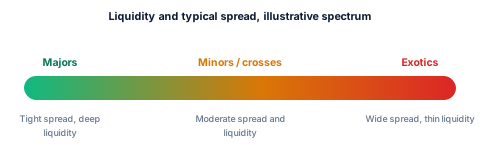
Not every currency pair costs the same to trade. Majors like EUR/USD and USD/JPY sit at one end of a spectrum, with deep liquidity and tight spreads; exotic pairs sit at the other, with wider spreads and thinner order books. This article explains why, with an illustrative side-by-side comparison.
Key takeaways
- **Major pairs** are the most heavily traded currency pairs against the US dollar (EUR/USD, USD/JPY, GBP/USD, and similar), with deep liquidity and typically the tightest spreads available.
- **Exotic pairs** combine a major currency with an emerging-market or less-traded currency (for example, USD/ZAR, USD/MXN, or USD/THB), and trade in thinner markets with wider typical spreads.
- Wider spreads on exotics mean a higher transaction cost for the same position size, even before commission or swap are added.
- Thinner liquidity on exotic pairs also increases slippage risk — the actual fill price is more likely to differ from the requested price, especially in larger sizes or fast-moving conditions.
- Cashback is generally calculated per qualifying lot regardless of which pair was traded, so a wider-spread exotic pair still earns rebate on the same volume — it just starts from a higher gross cost that the rebate offsets a smaller percentage of.
What makes a pair "major" or "exotic"
A major pair pairs the US dollar with another heavily traded currency — euro, yen, British pound, Swiss franc, Canadian dollar, Australian dollar, or New Zealand dollar — and represents the bulk of daily global forex trading volume. An exotic pair pairs a major currency, usually the US dollar or euro, with the currency of a smaller or emerging economy — commonly cited examples include USD/ZAR (South African rand), USD/MXN (Mexican peso), and USD/THB (Thai baht). Some brokers also use the term "minor" or "cross" for pairs between two major currencies that don't include the US dollar (like EUR/GBP), which sits between the two categories in typical liquidity and cost.
Why exotics cost more to trade
Spread width is closely tied to liquidity — how much trading volume flows through a pair, and how many market participants are actively quoting it. Majors are quoted continuously by a large number of liquidity providers competing on price, which compresses spreads. Exotic currencies typically have smaller, less liquid underlying markets, fewer active quoting participants, and in some cases capital controls or lower convertibility, all of which widen the spread a broker needs to quote to manage its own risk. Swap rates on exotics are also often higher in magnitude, reflecting a larger interest-rate differential between the US dollar and many emerging-market currencies.
An illustrative cost comparison
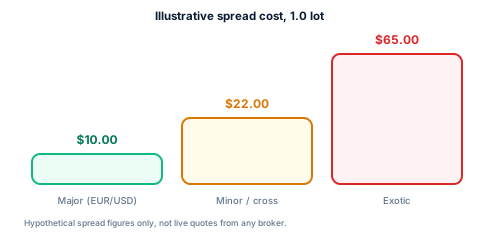
Using hypothetical, illustrative numbers: a major pair like EUR/USD might carry a typical spread around 1.0 pip, costing roughly $10 per standard lot (see forex lot, pip and spread cost explained for the formula). An exotic pair might carry a typical spread of 40 pips or more, which — even accounting for a different pip value at that pair's exchange rate — usually works out to a spread cost many times higher than the major pair's, for the identical 1.0 lot size. Neither figure is a live quote; actual spreads shift constantly with market conditions and differ by broker.
How this changes the rebate math
A cashback rebate is generally paid per qualifying lot traded, regardless of which pair generated that lot — so an exotic-pair trade and a major-pair trade of the same size typically earn the same rebate. The practical difference shows up in the ratio: a rebate that offsets a meaningful share of a tight major-pair spread offsets a much smaller share of a wide exotic-pair spread. See how cashback lowers your break-even win rate for how that ratio is calculated, and real monthly forex trading cost for folding pair-specific spread assumptions into a full monthly total.
Liquidity and slippage on exotics
Beyond the quoted spread, thinner order books mean the price actually available at the moment of execution can move more than on a major pair, particularly for larger sizes or during volatile periods — a form of execution risk generally referred to as slippage. This isn't unique to exotics, but it tends to be more pronounced there because fewer participants are absorbing order flow at any given price level. Traders who trade exotic pairs regularly often size positions more conservatively for this reason, though how to do so is a personal risk-management decision this article doesn't prescribe.
Frequently asked questions
As a general pattern, yes — wider typical spreads and thinner liquidity are common features of exotic pairs. Exact costs vary by broker and by specific pair, so compare actual quoted spreads rather than assuming a fixed multiple.
Next steps
Compare cost across asset classes more broadly in EUR/USD vs. gold vs. indices trading costs compared, work through the full monthly picture in real monthly forex trading cost, or register with CB-Dogs to earn cashback on your qualifying volume across any pair your broker supports.
Risk warning: forex and CFD trading carries a high risk of losing money. Cashback does not offset trading losses. Nothing here is investment advice.
Related articles
Cashback on your XM trades — free, paid in USDT
Sign up free