Triple Swap Day Explained: Why Overnight Fees Jump Once a Week
Triple swap day is a common convention where a broker charges three nights' worth of swap on a single weekday, to account for the weekend when the forex market is closed but currency positions still settle value-date; the specific weekday varies by broker.
By CB-Dogs Editorial6 min read
Disclosure: CB-Dogs receives an advertising (referral) fee — sometimes called an IB commission — from brokers for accounts opened or linked through us, and returns part of it to you as cashback, the same model used by cashback and points sites. This does not change your trading costs.
On this page
- The short answer
- Why swap gets tripled at all
- What this looks like across a trading week
- Worked example
- Checking your own broker's schedule
- Does the direction of swap matter here?
- How this differs from weekend gap risk
- Does holding overnight for a shorter or longer period change this?
- Does a rebate offset a triple-swap charge?
- Related reading
- Frequently asked questions
- Work out your own numbers
Most days, swap is a small, predictable line item — a few dollars per lot, charged or credited once. Then, on one specific day of the trading week, the same position can show a charge three times larger, with no change in position size or market conditions. This is the "triple swap day" convention, and this article covers why it exists, how to calculate it, and how it's different from weekend gap risk.
Key takeaways
- Triple swap day is a common (though not universal) convention where a broker charges three nights' worth of swap on a single weekday, to account for the weekend.
- The mechanism exists because currency trades in the interbank market settle on a value date two business days later (T+2), and weekends don't count as settlement days.
- The specific weekday that carries the triple charge varies by broker — commonly, though not always, Wednesday.
- Triple swap day is a scheduled, calculable cost, unrelated to weekend gap risk, which is an unscheduled and unpredictable price move.
- A cashback rebate is calculated on qualifying trading volume, not on swap charges, so it doesn't offset a triple-swap charge directly.
The short answer
Triple swap day is a common convention where a broker charges three nights' worth of the normal daily swap rate on a single weekday, rather than one night's worth on each calendar day including the weekend. It exists because of how currency trades actually settle in the underlying interbank market — a mechanic covered in more general terms in our swap and overnight fees guide.
Why swap gets tripled at all
A spot forex trade conventionally settles two business days after the trade date (commonly called T+2) in the underlying interbank market, even though a retail position can be held open indefinitely by rolling it forward each day. Swap represents the cost or credit of extending that settlement one more day — an interest-rate differential between the two currencies in the pair, applied per lot, per night.
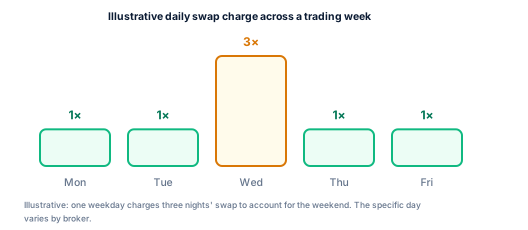
Weekends complicate this because the interbank market doesn't settle trades on Saturday or Sunday. To keep the accounting consistent with real settlement mechanics, brokers commonly bundle the weekend's worth of the settlement extension into a single weekday's swap charge — most often (though not universally) applied on Wednesday, when a trade opened that day would otherwise settle on Friday under T+2, crossing the weekend before completing.
What this looks like across a trading week
On a typical week, a position held overnight accrues the same daily swap rate Monday through Friday — except on the triple-swap day, where the charge (or credit) is three times the normal daily amount. The total swap accrued across a full week that includes the triple day is the same as if swap had actually been charged every calendar day including the weekend — the triple charge is a bundling mechanism, not an extra fee on top of what the position would otherwise accrue.
Worked example
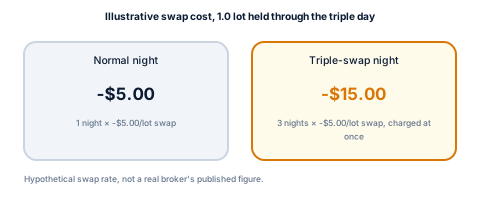
Illustrative inputs: 1.0 lot position, swap rate −$5.00 per lot per night (a debit in this example).
- Normal night: 1 night × −$5.00 = −$5.00.
- Triple-swap night: 3 nights × −$5.00 = −$15.00, charged on the single triple-swap day.
Held across a full week that includes one triple-swap day and no other overnight holds beyond the five weekday nights, the position accrues the same total swap it would if charged every calendar day at the normal daily rate — the triple charge simply concentrates the weekend's portion into one day's statement line rather than spreading it out.
Checking your own broker's schedule
Since neither the specific weekday nor the exact multiplier is standardized across the industry, the only reliable source is your own broker's contract specification or swap schedule, usually published in the platform's symbol properties panel or a dedicated swap-rates page. A few things worth confirming directly rather than assuming: which weekday (or weekdays) carry the multiplied charge, whether the multiplier is exactly three or something else for a specific instrument, and whether the convention applies uniformly across all tradable instruments or varies between forex pairs, gold, and other CFDs.
Does the direction of swap matter here?
Yes — the tripling multiplies whatever the underlying daily rate already is, whether that's a credit or a debit. A position earning a small positive swap credit each night, due to the interest-rate differential between the two currencies working in its favor, earns three times that credit on the triple-swap day instead. The tripling mechanism is symmetric; it doesn't change the direction of the swap, only its magnitude on that one day.
How this differs from weekend gap risk
Triple swap day is sometimes confused with weekend gap risk, but the two are unrelated mechanisms that happen to both involve the weekend. Triple swap is a scheduled, calculable cost — you can know the rate and the day in advance, and compute the exact charge before it happens. A weekend gap, covered in our weekend gap risk guide, is an unscheduled, unpredictable price move caused by news during the market's closed period, with no fixed formula and no way to calculate it ahead of time. A position can be charged normal swap and still be exposed to gap risk, or experience a triple-swap charge with no gap at all — they're independent of each other.
Does holding overnight for a shorter or longer period change this?
Comparing overnight (multi-day) holding against closing every position the same session is covered in general in our overnight vs. intraday trading costs guide. The triple-swap mechanic specifically only matters if a position happens to be held open through whichever day carries the triple charge — a position opened and closed entirely within a single day, any day of the week, never accrues swap at all, triple or otherwise.
Does a rebate offset a triple-swap charge?
No, not directly. A cashback rebate is calculated on qualifying closed lot volume, as explained in our guide to how forex rebates work — it has no connection to swap, whether charged at the normal daily rate or the triple-swap rate. The rebate still reduces your combined overall trading cost across whatever categories made it up, but it isn't a direct offset against a specific swap charge on a specific day.
Related reading
- Forex swap and overnight fees explained — the full daily swap formula this article's triple-day convention builds on.
- Weekend gap risk in forex trading — the separate, unrelated risk of a price jump over the same weekend period.
- Swap-free Islamic forex accounts explained — how an alternative fee structure can replace daily and triple swap entirely.
Frequently asked questions
A common convention where a broker charges three nights' worth of the normal daily swap rate on a single weekday, to account for the weekend when the interbank market doesn't settle trades. The specific day varies by broker.
Work out your own numbers
Check your own broker's current swap rate and triple-swap schedule for the instrument you trade, and plug it into the formula above for an accurate weekly total. To see how qualifying volume adds up over time, try the cashback calculator, or register with CB-Dogs before your next trade.
Risk warning: forex and CFD trading carries a high risk of losing money. Cashback does not offset trading losses. Nothing here is investment advice.
Related articles
Cashback on your XM trades — free, paid in USDT
Sign up free