Overnight vs. Intraday Forex Trading Costs Compared
Intraday trading avoids swap but pays spread/commission on every trade; overnight trading pays swap per night held on far fewer trades. Neither is inherently cheaper — it depends on your trade frequency versus holding duration and the pair's swap rate.
By CB-Dogs Editorial4 min read
Disclosure: CB-Dogs receives an advertising (referral) fee — sometimes called an IB commission — from brokers for accounts opened or linked through us, and returns part of it to you as cashback, the same model used by cashback and points sites. This does not change your trading costs.
On this page
"Is it cheaper to close my trades every day, or hold them overnight?" doesn't have a fixed answer — it depends on how many trades you place versus how many nights you hold, and the specific pair's swap rate. This guide breaks down the two different cost drivers behind each style so you can work out which applies more to your own trading, instead of assuming one style is universally cheaper.
Key takeaways
- Intraday trading avoids swap entirely (positions are closed before rollover) but pays spread and, where applicable, commission on every single trade
- Overnight and swing trading pay spread and commission far less often, but add a swap charge for every night a position stays open
- Which style costs more in total depends on your specific trade frequency and holding duration, not on the style itself — there's no universal answer
- A high-frequency intraday trader can rack up more total spread/commission cost than a low-frequency swing trader pays in swap, and vice versa, depending on the actual numbers involved
- Cashback is generally calculated on qualifying closed lot volume regardless of how long a position was held, so switching styles changes your total rebate mainly through changes in your total volume, not your holding time
Two different cost drivers
Both trading styles draw from the same three cost components covered in our lot, pip, and spread cost guide, commission guide, and swap and overnight fee guide — spread, commission, and swap. What differs is which component dominates:
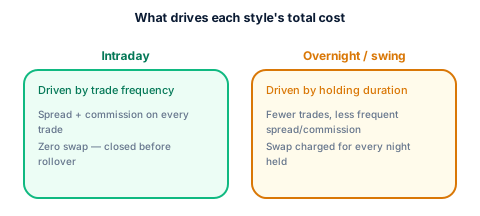
- Intraday trading (opening and closing every position the same trading day, before rollover) never pays swap, because swap is only charged on positions still open when the trading day rolls over. Its total cost is driven almost entirely by how many trades you place — every trade pays the spread (and commission, on commission-based account types) again.
- Overnight and swing trading (holding positions across one or more rollovers) pays spread and commission far less often per unit of time, since a single position can stay open for days, but adds a swap charge for every night held — which can include a "triple swap" day where three nights' worth is charged at once, covered in our swap guide. Traders who want to avoid this charge entirely regardless of holding duration can look at a swap-free Islamic account instead of switching trading style.
The formulas, side by side
Using the building blocks from our cost formula guides, without re-deriving them here:
Intraday total cost ≈ (Spread cost per trade + Commission per trade) × Number of trades
Overnight/swing total cost ≈ (Spread cost per trade + Commission per trade) × Number of trades + (Swap per night × Nights held)
The overnight formula is always the intraday formula plus a swap term — so overnight trading is never cheaper per trade, all else being equal. The comparison only flips in overnight trading's favor when the trade-count difference is large enough to outweigh the added swap: fewer, larger trades held longer can end up cheaper in total than many small trades opened and closed repeatedly.
Worked example (illustrative)
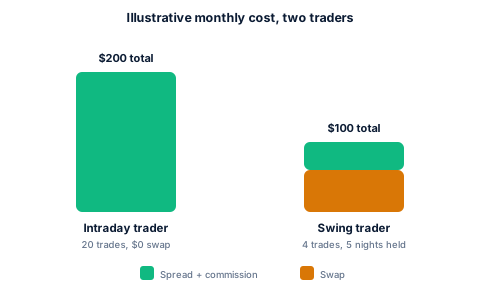
Assume a hypothetical pair with a $10 spread cost per standard lot per trade, no commission, and a $3 swap debit per lot per night:
- Intraday trader: places 20 round-trip trades in a month, all closed same-day. Total cost ≈ $10 × 20 = $200. Swap: $0.
- Swing trader: places 4 trades in the same month, each held for an average of 5 nights. Total cost ≈ ($10 × 4) + ($3 × 4 lots-worth × 5 nights) = $40 + $60 = $100.
In this illustrative example, the swing trader's far lower trade frequency more than offsets the added swap cost. Flip the assumptions — say the swing trader instead held each of those 4 trades for 20 nights instead of 5 — and the swap term alone becomes $3 × 4 × 20 = $240, more than the intraday trader's entire monthly cost. Neither outcome is a general rule; both depend entirely on the specific trade count, holding duration, and rates involved, which is why this article gives you the formula rather than a verdict.
Where trading-session timing fits in
Trade frequency and holding duration aren't the only variables — when you trade also affects the spread side of the formula, since spreads can widen around session changes, low-liquidity periods, and news, independent of whether you're trading intraday or overnight. See our trading sessions and spread-widening guide for that separate factor.
Where cashback fits in
Cashback is generally calculated on qualifying closed lot volume, not on holding duration — a 1-lot position closed the same day and a 1-lot position held for a week both contribute the same 1 lot of qualifying volume, all else equal (subject to any broker-specific minimum-holding-time rule, covered in our scalping and rebates guide). This means the choice between intraday and overnight trading mainly affects your cashback total through its effect on your total lot volume over a given period — a high-frequency intraday style can generate more qualifying volume from many smaller trades, while an overnight style might generate less volume from fewer, larger positions, or more, depending entirely on your own trade sizes. Neither style is inherently better for cashback; see our how forex rebates work guide for the full mechanics, and our real monthly trading cost guide for how a rebate nets against total cost across different trader profiles.
Frequently asked questions
No. Intraday trading avoids swap but pays spread and commission on every trade; overnight trading pays swap but on far fewer trades. Which is cheaper depends on your specific trade count, holding duration, and the pair's rates — see the worked formulas above.
Put the numbers to work
Once you know which cost driver applies more to your own trading, the cashback calculator shows how a rebate nets against your typical monthly volume, and the XM broker page lists current per-account-type rates. Register with CB-Dogs to start earning cashback on qualifying volume, whatever your trading style.
Risk warning: forex and CFD trading carries a high risk of losing money. Cashback does not offset trading losses. Nothing here is investment advice.
Related articles
Cashback on your XM trades — free, paid in USDT
Sign up free