Swap-Free (Islamic) Forex Accounts Explained: How the Cost Structure Really Works
A swap-free (Islamic) account removes the daily overnight swap charge or credit so a position can be held without accruing interest-like swap; the trade-off is commonly a wider spread, a per-instrument admin fee, or a maximum holding period instead.
By CB-Dogs Editorial4 min read
Disclosure: CB-Dogs receives an advertising (referral) fee — sometimes called an IB commission — from brokers for accounts opened or linked through us, and returns part of it to you as cashback, the same model used by cashback and points sites. This does not change your trading costs.
On this page
A swap-free account, often labelled "Islamic account," removes the overnight swap charge or credit that applies to a standard account. It exists mainly so traders following Islamic finance principles, which generally prohibit interest (riba), can hold positions overnight without that swap functioning like an interest payment. This guide covers how the cost structure actually works underneath — factually, and without wading into religious interpretation, which is between each trader and their own guidance.
Key takeaways
- A swap-free account removes the standard overnight swap charge or credit, so holding a position overnight doesn't accrue an interest-like fee in either direction.
- Removing swap doesn't mean an account is free of all overnight-related cost — brokers commonly replace it with a wider spread, a flat administrative fee after a set number of days, or both, and often only on certain instruments.
- Swap-free status typically applies per account, not per trade — a trader picks the account type at opening, rather than toggling swap on or off for individual positions.
- Some brokers limit which instruments qualify for swap-free treatment, or cap how many days a position can stay open before a different charge applies.
- Cashback eligibility is generally unaffected by whether an account is swap-free — a rebate is calculated on qualifying closed lot volume, separate from the swap mechanism.
What "swap-free" actually removes
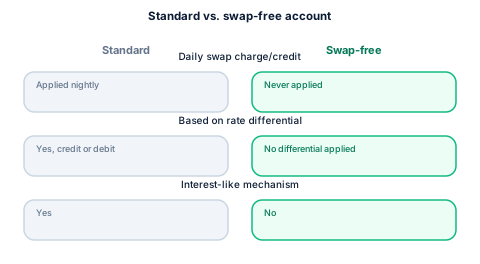
Standard forex accounts apply a daily swap — a credit or debit based on the interest-rate differential between the two currencies in a pair, described in full in forex swap and overnight fees explained — to any position held open past the daily rollover time. A swap-free account sets that daily swap to zero: no credit, no debit, regardless of which direction the position is held or which pair it's on.
The trade-off: what commonly replaces swap
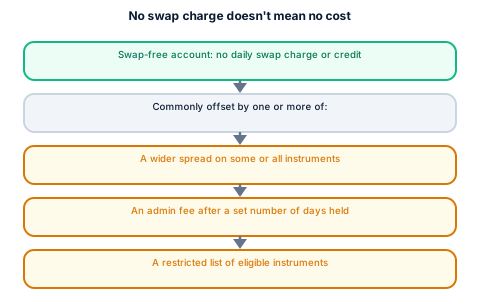
Removing swap doesn't remove a broker's underlying cost of financing an open position — brokers commonly recover that cost a different way on swap-free accounts, most often through one or more of the following:
- A wider spread on some or all instruments, applied at every trade rather than only to overnight-held ones.
- A flat administrative or "swap-free" fee that begins accruing after a position has been held open for a set number of days (a common pattern is a fee-free initial window followed by a per-day charge — the exact number of days and fee amount vary by broker).
- Restricted instrument availability — some brokers only offer swap-free treatment on major forex pairs, excluding metals, exotics, or CFDs on other asset classes.
- A maximum holding period, after which the position may be closed, converted to standard swap terms, or subject to the administrative fee described above.
Who typically opens a swap-free account
Swap-free accounts are most associated with traders following Islamic finance principles, and eligibility is sometimes restricted to residents of certain countries or requires a declaration at account opening — brokers vary in how they administer this. Some traders also choose a swap-free account for reasons unrelated to religious compliance, such as intentionally holding longer-term positions where avoiding a compounding daily swap debit is simply the cheaper structural choice, depending on the offsetting mechanism used. Either way, eligibility and administration rules are set entirely by the broker, not by CB-Dogs.
How a swap-free account interacts with cashback
Cashback under CB-Dogs is calculated on qualifying closed lot volume, the same way regardless of whether the account is swap-free or standard — see how forex rebates work for the underlying mechanics. The swap mechanism and the rebate mechanism are separate line items entirely: choosing a swap-free account changes your swap cost, not your rebate calculation. If a swap-free account carries a wider spread as its offsetting mechanism, that does change your overall spread cost, which is worth weighing against the rebate you'd earn on the same volume — see how to compare two brokers' total cost with rebates included for that net-cost comparison method.
Deciding whether swap-free makes sense for your own trading
For a trader who needs a swap-free account for compliance reasons, the real decision usually isn't whether to use one, but which offsetting mechanism to prefer — a wider spread suits a lower-frequency, longer-hold style, while an administrative fee after a set number of days can suit a trader who rarely holds a position that long in the first place. For a trader without a compliance requirement, the comparison is simpler: work out the standard account's swap cost for your typical hold time and pair mix, and compare it directly against the swap-free account's offsetting cost for the same activity, using the net-cost-per-lot approach linked above.
Frequently asked questions
Not necessarily. It removes the daily swap charge or credit specifically, but brokers commonly recover a similar cost through a wider spread, an administrative fee after a set holding period, or restricted instrument availability. Check your specific broker's terms.
Next steps
See forex swap and overnight fees explained for the standard-account swap mechanics this article compares against, and how to compare two brokers' total cost with rebates included to weigh a swap-free account's offsetting cost against a standard account. Register with CB-Dogs before opening either account type so your qualifying volume counts toward cashback from your first trade.
Risk warning: forex and CFD trading carries a high risk of losing money. Cashback does not offset trading losses. Nothing here is investment advice.
Related articles
Cashback on your XM trades — free, paid in USDT
Sign up free