How to Compare Two Brokers' Total Cost With Rebates Included
Comparing brokers by spread or commission alone is incomplete: net cost per lot equals gross trading cost (spread plus commission plus average swap) minus your rebate per lot, and a wider-spread broker with a bigger rebate can end up cheaper than a tighter-spread broker with none.
By CB-Dogs Editorial4 min read
Disclosure: CB-Dogs receives an advertising (referral) fee — sometimes called an IB commission — from brokers for accounts opened or linked through us, and returns part of it to you as cashback, the same model used by cashback and points sites. This does not change your trading costs.
On this page
- Why comparing spreads alone is misleading
- The net-cost-per-lot formula
- Step 1: gather each broker's gross cost inputs
- Step 2: gather each broker's rebate rate
- Step 3: work the formula for a hypothetical trade
- Worked example: Broker A vs. Broker B
- Where this breaks down (execution quality and reliability aren't in the formula)
- Frequently asked questions
- Next steps
Comparing two brokers by spread alone, or even by spread plus commission, misses half the picture if you're registered with a cashback provider. The number that actually determines which broker costs you less is net cost per lot — gross trading cost minus whatever rebate you'd actually receive on that volume. This guide walks through the formula and a worked example.
Key takeaways
- Comparing brokers by spread or commission alone is incomplete — the number that matters is net cost per lot: gross trading cost minus any cashback rebate you'd actually receive.
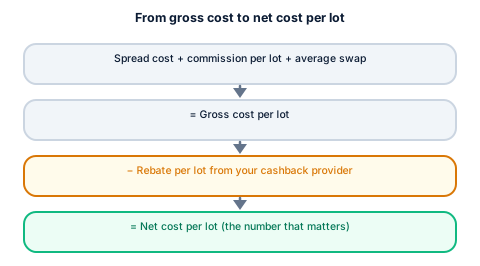
- Net cost per lot = (spread cost + commission per lot + average swap, all converted to your account currency) − rebate per lot from your cashback provider.
- A broker with a wider spread can still end up cheaper overall once a larger per-lot rebate is subtracted, and a tighter-spread broker with no rebate can end up more expensive.
- Rebate rates differ by broker and by account type, so use your own actual account type's real rate in the comparison, not a generic headline number.
- The formula generalizes to any two brokers — plug in your own real spread, commission, swap, and rebate figures rather than assuming either one is cheaper.
Why comparing spreads alone is misleading
A broker advertising a tighter headline spread isn't automatically cheaper once a rebate is in the picture. If you're registered with a cashback provider, part of every qualifying trade's cost comes back to you afterward — which means the broker's raw spread and commission numbers only tell half the story. The other half is the rebate rate for that specific broker and account type, which can vary meaningfully. Our raw spread vs. standard account guide covers the equivalent trade-off within a single broker's account types; this guide extends the same logic across two different brokers.
The net-cost-per-lot formula
Net cost per lot = Gross cost per lot − Rebate per lot
Where:
Gross cost per lot = Spread cost per lot + Commission per lot + Average swap per lot (all converted to the same account currency)
Spread cost per lot uses the formula from our lot, pip, and spread cost guide (spread in pips × pip value per lot); commission per lot is stated directly by the broker, covered in our commission per lot guide; average swap per lot depends on how long positions are typically held, covered in our swap and overnight fees guide.
Step 1: gather each broker's gross cost inputs
For each broker and account type you're comparing, note the typical spread (in pips) for the pair you trade most, any per-lot commission, and — if you tend to hold positions overnight — the average swap. These figures are usually published on the broker's own contract specification or fee schedule page; see our how to read a broker's fee schedule guide for where to look.
Step 2: gather each broker's rebate rate
| Account type | Rebate / lot (USDT) |
|---|---|
| StandardSpread-based account, no commission. | 9.0 |
| MicroRebate is calculated per 100,000 units of micro-lot volume (i.e. the same per-lot rate as Standard, scaled to micro-lot size). | 9.0 |
| Ultra LowLower spreads, spread-based account, no commission. | 3.0 |
| KiwamiXM's tightened-spread account tier available in select regions. | 6.0 |
| ZeroCommission-based account. Rebate is paid in addition to the raw spread — commission you pay is unaffected. | 4.5 |
Provisional rate
Your cashback provider's rate for that specific broker and account type is the other half of the formula. Rates can differ meaningfully by account type even at the same broker, so make sure you're using the rate for the account type you'd actually open — the table above shows current rates by account type as a live example.
Step 3: work the formula for a hypothetical trade
Once you have gross cost per lot and rebate per lot for each broker, subtract to get net cost per lot, then compare the two net figures directly. Whichever is lower is genuinely cheaper for your typical trading pattern — not necessarily whichever had the tighter headline spread.
Worked example: Broker A vs. Broker B
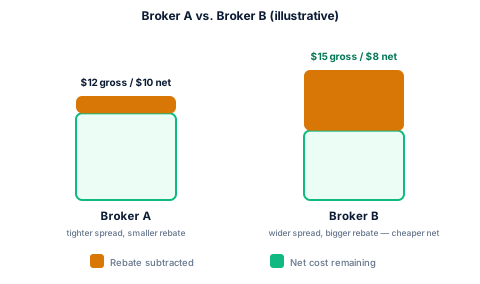
Assume, purely as an illustration:
- Broker A: gross cost of $12.00 per standard lot (tighter spread, no commission), rebate of $2.00 per lot → net cost: $10.00
- Broker B: gross cost of $15.00 per standard lot (wider spread), rebate of $7.00 per lot → net cost: $8.00
Despite Broker B's higher gross cost, its larger rebate makes it cheaper on a net basis in this hypothetical — the opposite of what comparing gross spreads alone would suggest. The actual numbers for any two real brokers depend entirely on their own current spread, commission, swap, and rebate figures.
Where this breaks down (execution quality and reliability aren't in the formula)
Net cost per lot is a cost comparison, not a complete broker-quality comparison. Execution speed, slippage during volatile moments (see our slippage and requotes guide), platform stability, and withdrawal reliability all matter and aren't captured by this formula at all. A lower net cost on paper doesn't outweigh a broker that consistently executes poorly or is slow to process withdrawals — treat this formula as one input among several, not the only one. To apply this same net-cost logic across several account types rather than just two brokers, see our guide to comparing account types with a spreadsheet using your own trading pattern.
Frequently asked questions
No — if you consistently close positions the same day, average swap per lot is effectively zero for you, and the comparison simplifies to spread cost plus commission minus rebate.
Next steps
Run the cashback calculator with your own typical volume and account type, and see our real monthly forex trading cost guide for a fuller worked example combining several cost factors. To project this net-cost comparison over a full year, see our guide to calculating annual forex trading costs from monthly volume. Register with CB-Dogs before opening or linking your broker account so the comparison reflects your actual rebate rate from the start.
Risk warning: forex and CFD trading carries a high risk of losing money. Cashback does not offset trading losses. Nothing here is investment advice.
Related articles
Cashback on your XM trades — free, paid in USDT
Sign up free