Per-Lot vs. Percentage Cashback: How Rebate Calculation Models Differ
Forex cashback is calculated either as a fixed amount per qualifying lot traded, or as a percentage share of the spread or commission revenue the broker pays the introducing broker on your volume — the fixed-per-lot model is generally easier to predict in advance, while the percentage model scales directly with the account type's own underlying cost structure.
By CB-Dogs Editorial6 min read
Disclosure: CB-Dogs receives an advertising (referral) fee — sometimes called an IB commission — from brokers for accounts opened or linked through us, and returns part of it to you as cashback, the same model used by cashback and points sites. This does not change your trading costs.
On this page
- The short answer
- Model A: fixed per-lot
- Model B: percentage of spread or commission revenue
- A worked, illustrative comparison
- Which model applies to your account
- Hybrid and layered structures
- How to tell which model a program is actually using
- Why account type changes the effective rebate under either model
- A note on comparing programs, not just models
- Related reading
- Frequently asked questions
- Work out your own numbers
Our guide to how forex rebates work covers the big picture: a rebate is a share of the Introducing Broker (IB) commission a broker already pays for referring you. What it doesn't cover in detail is how that share is actually calculated, since brokers and IB programs commonly use one of two different models. This article covers both, and why the difference matters for how predictable your own rebate is.
Key takeaways
- A fixed per-lot rebate pays a set amount for every qualifying lot traded, regardless of the specific spread or commission that trade generated for the broker.
- A percentage-based rebate pays a share of the actual spread or commission revenue the broker earned on your trading, so it scales directly with that revenue.
- The fixed per-lot model is generally easier to predict and calculate in advance; the percentage model can vary more across account types and instruments, since revenue per lot itself varies by those factors.
- Neither model changes your own spread, commission, or execution — both are paid from the broker's existing IB budget, calculated after the fact on volume you've already traded.
- CB-Dogs' current rate structure for each broker and account type is always shown on our live rates table, not typed into any single article, since rates can be adjusted over time.
The short answer
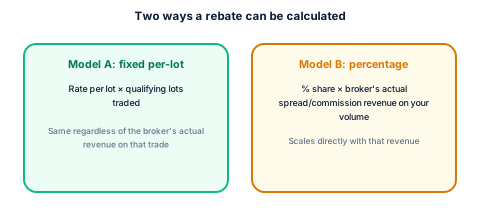
Model A — fixed per-lot: you're paid a set dollar (or other currency) amount for every qualifying lot traded, no matter how much spread or commission that specific trade actually generated. Model B — percentage-of-revenue: you're paid a percentage share of the actual spread markup or commission the broker earned from your trading. Which model an IB program uses (and whether it can differ by broker or account type) is set by the program itself — check the current rate structure rather than assuming one model applies everywhere.
Model A: fixed per-lot
Under a fixed per-lot model, the calculation is simply rate per lot × qualifying lots traded. The rate itself is set per broker and often per account type, since different account types generate different amounts of underlying revenue for the broker even though the per-lot rebate paid to you might be structured as a flat figure. This model's main appeal is predictability: once you know the rate for your account type, you can calculate your expected rebate on any volume without needing to know the exact spread or commission charged on each individual trade.
Model B: percentage of spread or commission revenue
Under a percentage model, the calculation is percentage share × the broker's actual spread markup or commission revenue on your qualifying volume. Because that underlying revenue itself depends on the spread in pips at the moment of each trade, the specific instrument traded, and the account type's own commission structure, the resulting rebate can vary more from trade to trade than a flat per-lot figure would. This model's appeal is that it scales directly with the account's actual cost structure — a wider-spread account type naturally generates more percentage-based rebate than a razor-thin raw-spread account, all else equal, since the underlying revenue being shared is itself larger.
A worked, illustrative comparison
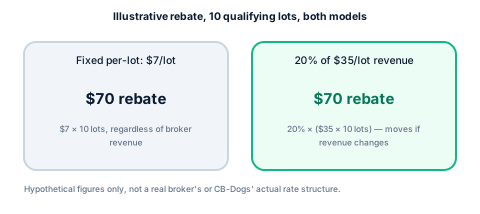
Illustrative inputs: 10 qualifying lots traded in a month.
- Fixed per-lot model: $7 per lot (illustrative) × 10 lots = $70 rebate, regardless of what the broker actually earned on those specific trades.
- Percentage model: 20% (illustrative) of $35 per lot broker revenue (illustrative) × 10 lots = 20% × $350 = $70 rebate — the same total in this particular illustrative case, purely because the inputs were chosen to land on the same number. Change the broker's actual per-lot revenue and the percentage model's output moves with it, while the fixed model's output stays exactly $7 per lot no matter what.
The point of the example isn't that the two models produce identical results in general — they usually won't — it's to show mechanically how one model stays fixed regardless of the broker's own revenue while the other tracks it directly.
Which model applies to your account
| Account type | Rebate / lot (USDT) |
|---|---|
| StandardSpread-based account, no commission. | 9.0 |
| MicroRebate is calculated per 100,000 units of micro-lot volume (i.e. the same per-lot rate as Standard, scaled to micro-lot size). | 9.0 |
| Ultra LowLower spreads, spread-based account, no commission. | 3.0 |
| KiwamiXM's tightened-spread account tier available in select regions. | 6.0 |
| ZeroCommission-based account. Rebate is paid in addition to the raw spread — commission you pay is unaffected. | 4.5 |
Provisional rate
CB-Dogs' current rates by broker and account type are always shown in the table above rather than typed into this or any other article, since rates can be adjusted and a static number would go stale. If you're comparing account types under either model, our guide to raw spread vs. standard accounts covers how the underlying spread and commission structure differs by account type in the first place, and our guide to rebate tiers covers a separate mechanism — a rate that changes with your own volume — that can apply on top of either calculation model.
Hybrid and layered structures
Some IB programs don't use a single pure model across their entire broker lineup — a program might pay a fixed per-lot rate on one broker's accounts and a percentage-based rate on another's, particularly when brokers themselves pay the IB differently depending on their own internal cost accounting. It's also common for a volume-based rebate tier, covered in our rebate tier guide, to sit on top of either base model, raising the effective rate (or percentage) once a trader crosses a monthly volume threshold. Reading a specific program's terms for the specific broker and account type in question, rather than assuming a single calculation method applies everywhere, avoids a mismatched expectation.
How to tell which model a program is actually using
A few signals distinguish which model you're looking at. A fixed per-lot model is usually disclosed as a flat currency amount ("$X per lot" or "$X per round-turn lot"), the same regardless of instrument or account type unless a separate table breaks it out per account type. A percentage-based model is usually disclosed as a share ("X% of spread" or "X% of commission"), which requires knowing the underlying spread or commission to calculate an actual dollar figure in advance. If a program's disclosure names a flat dollar figure per lot, you're looking at Model A; if it names a percentage without a flat dollar figure attached, you're looking at Model B.
Why account type changes the effective rebate under either model
Because a raw-spread or ECN-style account typically generates broker revenue mostly through a stated commission rather than a wide spread, while a standard account typically folds more revenue into the spread itself, the underlying revenue base that a percentage-based rebate is calculated from can look quite different across account types even at an identical traded volume — a point covered from the trading-cost side (rather than the rebate side) in our how forex brokers make money guide. A fixed per-lot rebate sidesteps this entirely by not depending on the underlying revenue mix at all, which is one reason some programs prefer it for simplicity.
A note on comparing programs, not just models
If you're evaluating more than one cashback provider rather than just one program's terms, the calculation model is only one input into a fair comparison — the same guide to verifying a forex cashback provider is legitimate covers the other checks worth making (payout track record, transparency about the underlying IB relationship, and clear terms on exclusions) before assuming a higher-sounding percentage or per-lot figure from one provider is automatically the better deal once account type, instrument mix, and payout reliability are all factored in.
Related reading
- How forex rebates work — the broader IB commission flow that both calculation models are drawn from.
- What is a forex rebate tier? — a separate mechanism (rate scaling with your own volume) that can layer on top of either model.
- Raw spread vs. standard account: which is cheaper? — how account type changes the underlying spread/commission mix that a percentage-based rebate is calculated from.
Frequently asked questions
Per-lot cashback pays a fixed amount for every qualifying lot traded, regardless of the broker's actual revenue on that trade. Percentage-based cashback pays a share of the broker's actual spread or commission revenue on your volume, so it scales with that revenue.
Work out your own numbers
Check the current rate table for your broker and account type to see which calculation model applies and what rate you'd earn. To see how it adds up on your own volume, try the cashback calculator, or register with CB-Dogs before your next trade.
Risk warning: forex and CFD trading carries a high risk of losing money. Cashback does not offset trading losses. Nothing here is investment advice.
Related articles
Cashback on your XM trades — free, paid in USDT
Sign up free