Chasing Forex Rebates vs. Trading Edge: Why Cashback Isn't a Strategy
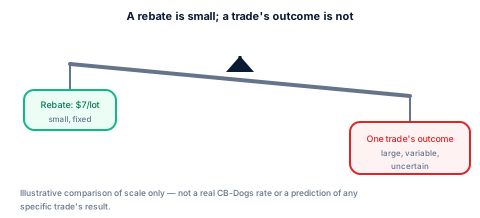
A forex cashback rebate is a small, fixed-per-volume return that reduces trading cost after the fact — it's never large enough on its own to justify a trade, a position size, or a volume target that your own trading edge wouldn't otherwise support, and treating it as one is a common way traders quietly increase their risk without increasing their expected return.
By CB-Dogs Editorial6 min read
Disclosure: CB-Dogs receives an advertising (referral) fee — sometimes called an IB commission — from brokers for accounts opened or linked through us, and returns part of it to you as cashback, the same model used by cashback and points sites. This does not change your trading costs.
On this page
- The short answer
- Why a rebate can't be an edge
- The specific trap: trading for the volume, not the setup
- Worked example: how small the rebate really is next to one bad trade
- How to check yourself for this pattern
- Does CB-Dogs' rebate structure encourage this?
- Related reading
- Frequently asked questions
- Work out your own numbers
Our overtrading guide covers the mechanical cost problem of splitting the same volume into more trades, and our rebate tier guide covers how a volume threshold structure works and what to check before assuming a higher tier is worth chasing. Neither addresses the more basic risk question underneath both: what happens when a trader lets the rebate itself — rather than a tested strategy — decide how much or how often to trade. This article is about that specific trap, and why a rebate can never be large enough to substitute for a genuine trading edge.
Key takeaways
- A cashback rebate is a small, fixed return per unit of qualifying volume — it reduces cost after a trade closes, but it doesn't change the trade's own probability of winning or losing.
- Because a rebate is typically a small fraction of a single trade's normal spread or commission cost, it's almost never large enough to turn a genuinely bad trade into a good one, or to offset a single oversized loss.
- The specific risk is behavioral, not mathematical: taking a lower-quality setup, increasing position size, or trading more frequently specifically to hit a volume figure, rather than because your own strategy calls for it.
- This is a related but distinct problem from mechanical overtrading (splitting the same volume into more, smaller trades) and from evaluating a rebate tier's structure — this article is about why volume itself shouldn't become the goal.
- A rebate works as intended when it's collected as a byproduct of trading you were already going to do — not when trading decisions start being driven by the rebate.
The short answer
A forex cashback rebate reduces your net trading cost on volume you generate — it doesn't, and can't, change whether any individual trade was a good decision. Because a typical rebate is a fraction of what you already pay in spread and commission, as covered in our how forex cashback compounds over a year guide, it's small relative to what a single oversized or low-quality trade can lose. Trading more, or bigger, specifically to earn more rebate — rather than because your own tested strategy calls for it — trades a small, certain cost reduction for a much larger, uncertain risk, which is a poor exchange.
Why a rebate can't be an edge
A trading "edge" is a repeatable reason to expect a positive result from a set of trades over time — a tested entry and exit method, a statistical tendency, a risk-management approach that keeps losses smaller than wins. A rebate is a different kind of thing entirely: a small, fixed-per-lot or fixed-percentage return that arrives regardless of whether the underlying trade won or lost. It doesn't improve your entry, your exit, or your win rate — it only ever nets against cost, as our how forex rebates work guide explains. A rebate can meaningfully improve the economics of a strategy that already has a genuine edge (lowering the win rate or reward-to-risk ratio needed to break even, covered in our break-even win rate guide) — but it cannot manufacture an edge where none exists, and it's far too small to offset the downside of a single bad decision.
The specific trap: trading for the volume, not the setup
The most common version of this pattern shows up in a few related forms: taking a marginal or low-conviction setup specifically because "it'll count toward this month's volume," increasing position size beyond what your own risk management calls for because a bigger lot means a bigger rebate, or placing extra trades near the end of a month specifically to clear a rebate tier's volume threshold, covered in our rebate tier guide. Each of these substitutes a rebate-driven reason for a strategy-driven one, and each increases real trading risk (a bigger position, an extra low-quality trade) in exchange for a rebate that's a small fraction of what's now at stake.
Worked example: how small the rebate really is next to one bad trade
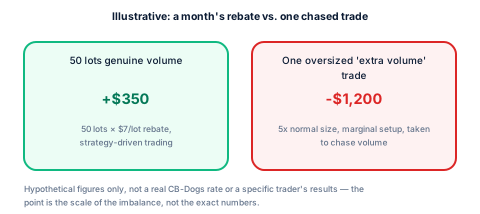
Assume an illustrative rebate of $7 per lot. A trader who places 50 lots of genuine, strategy-driven volume in a month earns $350 in cashback — a real, useful reduction in trading cost. Now assume that same trader, chasing a higher volume tier, takes one additional oversized position outside their normal risk parameters (say, five times their usual size on a marginal setup) that results in a $1,200 loss. That single decision — taken partly because "the extra volume would help this month's rebate" — wipes out more than three months of the entire $350 monthly rebate, for the sake of a few extra lots of qualifying volume worth perhaps $20–$50 more in cashback. The rebate on the additional volume never had a realistic chance of covering the downside risk it was used to justify.
All figures above are illustrative and hypothetical, not a real CB-Dogs rate or a specific trader's actual results — the arithmetic scales differently for any real rebate rate and any real trade outcome, but the underlying imbalance (a small, fixed rebate against a much larger, variable trade risk) holds generally.
How to check yourself for this pattern
A few honest questions can surface whether volume or the rebate is quietly influencing trading decisions: Would you take this specific trade at this specific size if there were no cashback program at all? Is a trade being placed near a reporting period's end specifically because of remaining volume, rather than because a setup appeared? Has average position size crept up over time without a corresponding change in your own risk tolerance or account size? Our trading journal template for costs and rebates guide covers tracking cost, rebate, and trade rationale together over time, which is the most direct way to notice this pattern forming before it compounds.
Does CB-Dogs' rebate structure encourage this?
No — CB-Dogs calculates cashback on qualifying closed lot volume the same way regardless of trade quality, size, or timing, and does not offer any structure (like an aggressive short-term volume bonus) designed to push a trader toward a specific trade or timing decision. The risk described in this article comes from how an individual trader might choose to respond to any rebate program's existence, not from CB-Dogs' own program design.
Related reading
- How overtrading increases your trading costs — the related, mechanical cost problem of splitting the same volume into more trades.
- What is a forex rebate tier? Do volume tiers make sense? — how a volume-threshold structure works and what to check before treating a tier as worth chasing.
- How cashback lowers your break-even win rate — the legitimate way a rebate improves a strategy's economics, without changing the strategy itself.
Frequently asked questions
No. A rebate is a small, fixed return on volume that reduces trading cost after the fact — it has no effect on a trade's probability of winning or losing, so it can't substitute for a tested strategy or genuine trading edge.
Work out your own numbers
Compare your own typical rebate per lot against your own typical risk per trade before letting volume targets influence a trading decision. To see how a rebate nets against your existing, strategy-driven trading pattern, try the cashback calculator, or register with CB-Dogs to start earning cashback on the volume you were already going to trade.
Risk warning: forex and CFD trading carries a high risk of losing money. Cashback does not offset trading losses. Nothing here is investment advice.
Related articles
Cashback on your XM trades — free, paid in USDT
Sign up free