How Forex Cashback Adds Up Over a Year: A Hypothetical Walkthrough
Forex cashback doesn't earn interest on itself — it accumulates as a running total of monthly rebates. A hypothetical 12-month walkthrough here shows how volume, consistency, and your account's per-lot rate change that cumulative total.
By CB-Dogs Editorial4 min read
Disclosure: CB-Dogs receives an advertising (referral) fee — sometimes called an IB commission — from brokers for accounts opened or linked through us, and returns part of it to you as cashback, the same model used by cashback and points sites. This does not change your trading costs.
On this page
"Compounding" usually describes investment returns growing on themselves. Forex cashback doesn't work that way — but people still ask how it "adds up" over a year, and the answer is genuinely useful to walk through with real steps. This is a hypothetical, illustrative walkthrough, not a projection of what any real trader will earn.
Key takeaways
- Forex cashback accumulates as a running total of rebates paid on your qualifying monthly volume — it doesn't earn interest or grow on its own like an investment return.
- A hypothetical 12-month walkthrough here shows monthly rebates added together into a cumulative total, using rounded, illustrative numbers throughout.
- The total is driven by three things you actually control: how much qualifying volume you trade, how consistently you trade it, and your account type's per-lot rate.
- Unwithdrawn cashback sits as a balance — it's still yours, but it doesn't increase on its own the way an invested balance might.
- The cashback calculator gives a personalized estimate for your own typical volume; this article shows the shape of a buildup over time, not a specific number to expect.
What "compounding" means here (and what it doesn't)
When people ask how cashback "compounds" over a year, they usually mean something simpler: how does a monthly rebate add up if you keep trading month after month? The answer is straightforward addition, not compound growth — but seeing it laid out month by month makes clear what actually drives the total, which is the point of this walkthrough.
Step 1: find your per-lot rate
| Account type | Rebate / lot (USDT) |
|---|---|
| StandardSpread-based account, no commission. | 9.0 |
| MicroRebate is calculated per 100,000 units of micro-lot volume (i.e. the same per-lot rate as Standard, scaled to micro-lot size). | 9.0 |
| Ultra LowLower spreads, spread-based account, no commission. | 3.0 |
| KiwamiXM's tightened-spread account tier available in select regions. | 6.0 |
| ZeroCommission-based account. Rebate is paid in addition to the raw spread — commission you pay is unaffected. | 4.5 |
Provisional rate
Your cashback rate depends on your broker and account type — the table above shows CB-Dogs' current published rates for XM. Rates can change, so always check the live rate rather than a saved number, and use these real figures instead of a memorized one when estimating your own cashback.
Step 2: estimate a typical month
Once you know your rate, a single month's cashback is your qualifying lot volume for that month multiplied by your account type's per-lot rate. Our cashback calculator does this multiplication for you and also shows the withdrawal fee for a chosen amount — see our calculator walkthrough for how the tool itself works. The rest of this article uses fully hypothetical, rounded numbers to illustrate the next step: what happens across several months instead of just one.
Step 3: walk it forward across 12 months
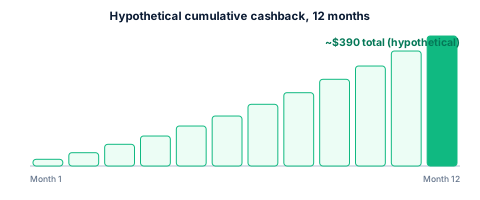
Picture a hypothetical trader whose monthly qualifying volume gradually increases as they become more active over the year — say, starting around $20 of rebate in an early month and gradually rising toward $45 by the final month, purely as an illustration. Each month's rebate is simply added to the running total from the months before it: month one contributes its own amount, month two adds its own amount on top, and so on. There's no multiplier effect between months — the total at month 12 is just the sum of 12 individual monthly rebates, some larger than others depending on that month's volume.
What changes the total: volume, consistency, and rate
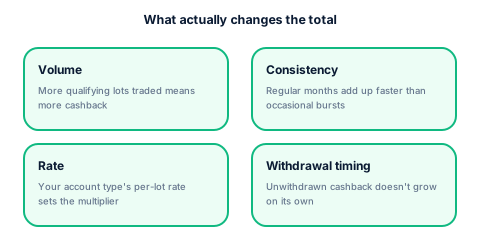
Four factors determine how a cumulative total actually turns out:
- Volume. More qualifying lots traded in a given month means more cashback that month — this is the single biggest lever, and it's a direct consequence of your trading activity, not something to increase purely to chase cashback.
- Consistency. A trader who trades a similar amount every month accumulates a fairly predictable running total; a trader with occasional bursts and long gaps ends up with a lumpier total that depends heavily on when the bursts happened.
- Rate. Your account type's per-lot rate sets the multiplier applied to your volume — checking the current rate for your account type (via the table above) rather than assuming it matches a different account type matters here.
- Withdrawal timing. Cashback that hasn't been withdrawn still belongs to you, but it sits as a static balance rather than earning anything further on its own — see USDT forex rebates for how crediting and withdrawal timing actually works, including the confirmation hold period.
Using the calculator for your own numbers
This walkthrough is meant to show the mechanic, not to substitute for your own numbers. The cashback calculator takes your actual account type and typical lots per month and gives you a real monthly and yearly estimate based on current rates, rather than the rounded, hypothetical figures used above. If your own monthly volume varies, running the calculator with a few different typical months and adding the results by hand mirrors exactly what this walkthrough did — just with your own numbers instead of illustrative ones.
Frequently asked questions
No — cashback is a rebate on trading volume, credited as a running total. It doesn't earn interest or investment returns on its own while unwithdrawn.
Next steps
Run the cashback calculator with your own account type and typical volume, and see how forex rebates work for the full mechanics behind crediting and payout. Register with CB-Dogs before opening or linking your broker account so your trading activity can start being tracked.
Risk warning: forex and CFD trading carries a high risk of losing money. Cashback does not offset trading losses. Nothing here is investment advice.
Related articles
Cashback on your XM trades — free, paid in USDT
Sign up free