How Overtrading Increases Your Trading Costs (Even When You're Right)
Overtrading raises total cost because spread and (often) a per-trade minimum commission are charged on every trade regardless of size, so splitting the same total lot volume into more, smaller trades multiplies those fixed charges without changing the underlying market exposure.
By CB-Dogs Editorial6 min read
Disclosure: CB-Dogs receives an advertising (referral) fee — sometimes called an IB commission — from brokers for accounts opened or linked through us, and returns part of it to you as cashback, the same model used by cashback and points sites. This does not change your trading costs.
On this page
- The short answer
- The arithmetic behind it
- Rebate volume doesn't grow the same way
- Why this compounds during a losing streak
- Is more frequent trading always overtrading?
- How to notice this in your own trading
- Does a rebate offset the extra cost from overtrading?
- Related reading
- Frequently asked questions
- Work out your own numbers
"Overtrading" is usually discussed as a discipline problem — trading out of boredom or impatience rather than a genuine setup. It's also, less often discussed, a straightforward cost problem: every additional trade re-charges spread and, on many accounts, a per-trade minimum commission, regardless of how small the trade is. This article works through the arithmetic of how trading the same total volume in more, smaller pieces raises your total cost, even when every individual trade is a reasonable decision on its own.
Key takeaways
- Spread and a per-trade minimum commission are charged per trade, not per unit of volume — so splitting the same total volume into more trades multiplies those fixed charges.
- A cashback rebate is paid on total qualifying lot volume, not on number of trades, so it doesn't grow just because a trader places more, smaller trades.
- The net effect of overtrading is usually a higher total cost for the same underlying market exposure, since extra trades add fixed cost without adding qualifying volume.
- This is a cost-accounting point, not a claim about trading psychology or strategy quality — a legitimately higher trade frequency for strategy reasons is a separate question from cost-driven overtrading.
- Tracking cost per trade alongside total monthly volume in a trading journal is the most direct way to notice this pattern in your own trading.
The short answer
Spread is paid on every trade, and many commission structures include a per-trade minimum that applies regardless of how small the trade is — covered in general in our commission per lot guide. Splitting a given amount of total trading volume into more, smaller trades charges spread (and often that minimum commission) more times for the same underlying market exposure, which raises total cost without necessarily changing the trader's actual position in the market.
The arithmetic behind it
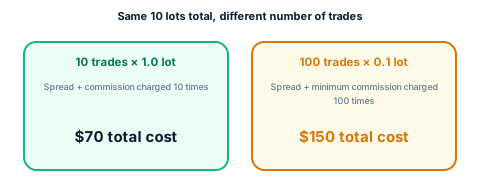
Take a hypothetical trader who places 10 lots of total trading volume in a month, either as 10 separate 1.0-lot trades or as 100 separate 0.1-lot trades. Illustrative inputs: spread cost $6 per 1.0 lot round turn, commission $1 per 1.0 lot with a $1.50 minimum per trade.
10 trades of 1.0 lot: spread cost = 10 × $6 = $60. Commission = 10 × $1 = $10 (no minimum triggered at full lot size). Total ≈ $70.
100 trades of 0.1 lot: spread cost scales down per trade (0.1 × $6 = $0.60), but is charged 100 times = $60 — the same total spread cost, since spread scales with volume regardless of how it's split. Commission at 0.1 lot would be $0.10 per trade, but the $1.50 minimum applies instead: 100 × $1.50 = $150. Total ≈ $210.
This example deliberately uses a per-trade minimum commission to illustrate the mechanism clearly — the effect is smaller (though not zero, due to any fixed order-processing costs or wider effective spreads on very small trades) on a cost structure without a minimum. The key point holds either way: anything charged per trade rather than per unit of volume multiplies with trade count, not with total size.
Rebate volume doesn't grow the same way
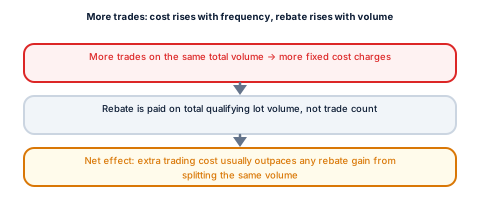
A natural question is whether more trades at least generate more cashback to offset the extra cost. Generally, no — a rebate is calculated on total qualifying closed lot volume, as explained in our guide to how forex rebates work, not on number of trades placed. Ten lots of total volume generates the same qualifying volume, and therefore the same total rebate, whether it's placed as 10 trades or 100 trades — the rebate side of the equation stays flat while the cost side rises with trade count. The net effect in the worked example above is a higher total cost for the same rebate, not a wash.
Why this compounds during a losing streak
The fixed per-trade cost component doesn't care whether a trade wins or loses — it's charged either way. During a losing streak, that means every additional trade (win or lose) keeps adding to the fixed-cost total on top of whatever the trade's own result was, a dynamic covered in more depth in our guide to how fees compound drawdown during a losing streak. A higher trade frequency during a losing streak specifically — sometimes driven by an attempt to "win back" losses quickly — combines both dynamics: more fixed-cost charges, at a time when the trader can least afford the extra drag.
Is more frequent trading always overtrading?
No. Frequency itself isn't the problem — a strategy that genuinely calls for many smaller trades (certain short-term or scalping approaches, covered in our forex rebates for scalpers guide) can be entirely reasonable on its own terms, provided the trader has accounted for how the cost structure scales with trade count. The distinction this article draws is between trade frequency that's a deliberate part of a tested strategy, and trade frequency that creeps up from impatience or boredom, adding fixed costs without adding a corresponding strategic reason.
How to notice this in your own trading
Comparing total monthly cost against total monthly qualifying volume — rather than looking at cost per trade in isolation — is the most direct way to spot this pattern. Our trading journal template for costs and rebates and real monthly forex trading cost guide cover logging this over time; if total cost as a percentage of total volume is rising month over month while your average position size is shrinking and trade count is climbing, that's the specific pattern this article describes.
Does a rebate offset the extra cost from overtrading?
Only partially, and not proportionally. Since the rebate tracks total qualifying volume rather than trade count, it doesn't grow to match the extra fixed costs that come from splitting the same volume into more trades — as shown in the worked example above, the gap between cost and rebate widens, not narrows, as trade count rises for the same total volume.
Related reading
- The cost of scaling in and out of a position — the related arithmetic when one intended position is deliberately split into multiple orders.
- Cost of a losing streak: how fees compound drawdown — how fixed per-trade costs interact with a string of losing trades specifically.
- How to reduce your forex trading costs — broader approaches to lowering total cost, including trade frequency.
Frequently asked questions
For the same total trading volume, yes, in most cost structures — spread and any per-trade minimum commission are charged per trade, so splitting the same volume into more trades multiplies those fixed charges. Trading more often to achieve genuinely more total volume is a different comparison.
Work out your own numbers
Compare your own broker's spread and commission structure — including any per-trade minimum — against your actual trade count and total volume over a recent month. To see your qualifying volume and potential rebate side by side, try the cashback calculator, or register with CB-Dogs before your next trade.
Risk warning: forex and CFD trading carries a high risk of losing money. Cashback does not offset trading losses. Nothing here is investment advice.
Related articles
Cashback on your XM trades — free, paid in USDT
Sign up free