The Cost of Scaling In and Out of a Forex Position
Scaling in or out of a position — splitting one intended trade size into several smaller orders — multiplies the number of times spread and per-trade commission are paid, so four 0.25-lot entries typically cost more in total than a single 1.0-lot entry of the same net size.
By CB-Dogs Editorial3 min read
Disclosure: CB-Dogs receives an advertising (referral) fee — sometimes called an IB commission — from brokers for accounts opened or linked through us, and returns part of it to you as cashback, the same model used by cashback and points sites. This does not change your trading costs.
On this page
Scaling in and out of a position — opening or closing the same intended size across several smaller orders instead of one — is a common way to manage risk and average an entry or exit price. It also has a cost consequence that's easy to overlook: every order is its own transaction, and every transaction pays its own spread and, on commission-based accounts, its own commission.
Key takeaways
- Scaling in means building an intended position size across multiple smaller orders; scaling out means closing it the same way, instead of one entry or exit.
- Each scaled order pays spread independently, so the total spread cost of a scaled position is generally higher than a single order of the same net size.
- On a per-trade commission structure, each scaled order also pays its own commission charge, multiplying that cost by the number of orders used.
- Total qualifying rebate volume is generally unaffected — the sum of the lots across all scaled orders is the same closed volume either way, so cashback on the total is typically unchanged.
- Some brokers apply a minimum trade size or a per-order minimum commission that makes very small scaled orders disproportionately expensive — check your broker's fee schedule before splitting a position into many small pieces.
What scaling in and out means
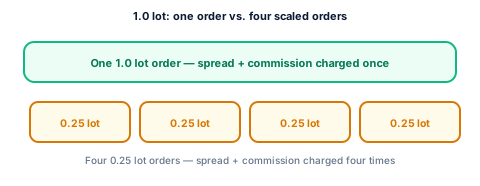
Scaling in is building a position gradually — for example, opening 0.25 lots four times to reach a total 1.0 lot position, rather than opening 1.0 lot in a single order. Scaling out is the reverse: closing a position gradually across several smaller orders instead of one. Traders use this to average into an uncertain move, reduce the impact of a single bad entry price, or take partial profit while letting part of a position run.
Why each scale is its own cost event
A spread is charged each time an order opens or closes, calculated on that order's own size. Four 0.25-lot orders each pay the spread on their own 0.25 lots — the total spread cost across all four is the same as if the whole 1.0 lot had been charged at once, roughly speaking, provided the spread in pips doesn't change between orders. Where scaling adds real cost is on commission-based accounts charging a fixed or minimum fee per trade: four separate 0.25-lot trades can trigger four separate minimum-commission charges, where one 1.0-lot trade would trigger only one.
A worked, illustrative example
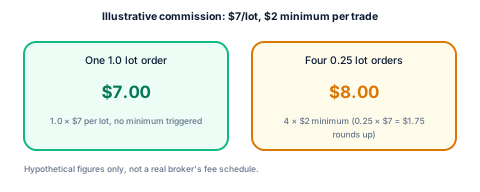
Assume a hypothetical broker charges $7 per lot, round turn, with a $2 minimum commission per trade. A single 1.0 lot entry costs $7.00 in commission. Four separate 0.25-lot entries would each generate 0.25 × $7 = $1.75 in commission — but since that's below the $2 minimum, each order is instead billed at the $2 minimum, for a total of $8.00 across the four orders — $1.00 more than the single-order approach, purely from the minimum-commission rule. Spread cost, in this simplified example, comes out roughly the same either way, since it scales linearly with size and no minimum applies. All figures are hypothetical and illustrative, not a real broker's fee schedule.
When scaling can still be worth the extra cost
Scaling isn't a mistake — it's a risk-management and execution choice, and the extra cost above is often small relative to the benefit of not committing full size at a single price. Traders scale in to reduce the impact of a poorly timed single entry, and scale out to lock in partial gains while leaving room for a position to keep working. Whether that trade-off is worth it for a given strategy is a personal risk-management decision, not something this article recommends one way or the other — this is cost information, not trading advice.
How scaling affects your rebate volume
Cashback is generally calculated on total qualifying closed lot volume, and four 0.25-lot closes summed together represent the same total closed volume as one 1.0-lot close. In most cases, splitting a trade into several smaller orders doesn't reduce the rebate earned on the total size — see how to verify your rebate volume from trade history for how to check that your statement reflects the sum correctly across multiple order lines for what was, economically, one position. Some brokers set a minimum trade size below which an order doesn't count toward qualifying volume at all — confirm this before scaling into unusually small pieces.
Frequently asked questions
It can, mainly on commission-based accounts with a per-trade minimum fee, since more orders can mean more minimum charges. On spread-only accounts with no per-trade minimum, the difference is usually smaller.
Next steps
Check how spread and commission combine into a single trade's total cost in forex lot, pip and spread cost explained, confirm your rebate volume matches your trade history with how to verify your rebate volume from trade history, or register with CB-Dogs to earn cashback on your total qualifying volume either way.
Risk warning: forex and CFD trading carries a high risk of losing money. Cashback does not offset trading losses. Nothing here is investment advice.
Related articles
Cashback on your XM trades — free, paid in USDT
Sign up free